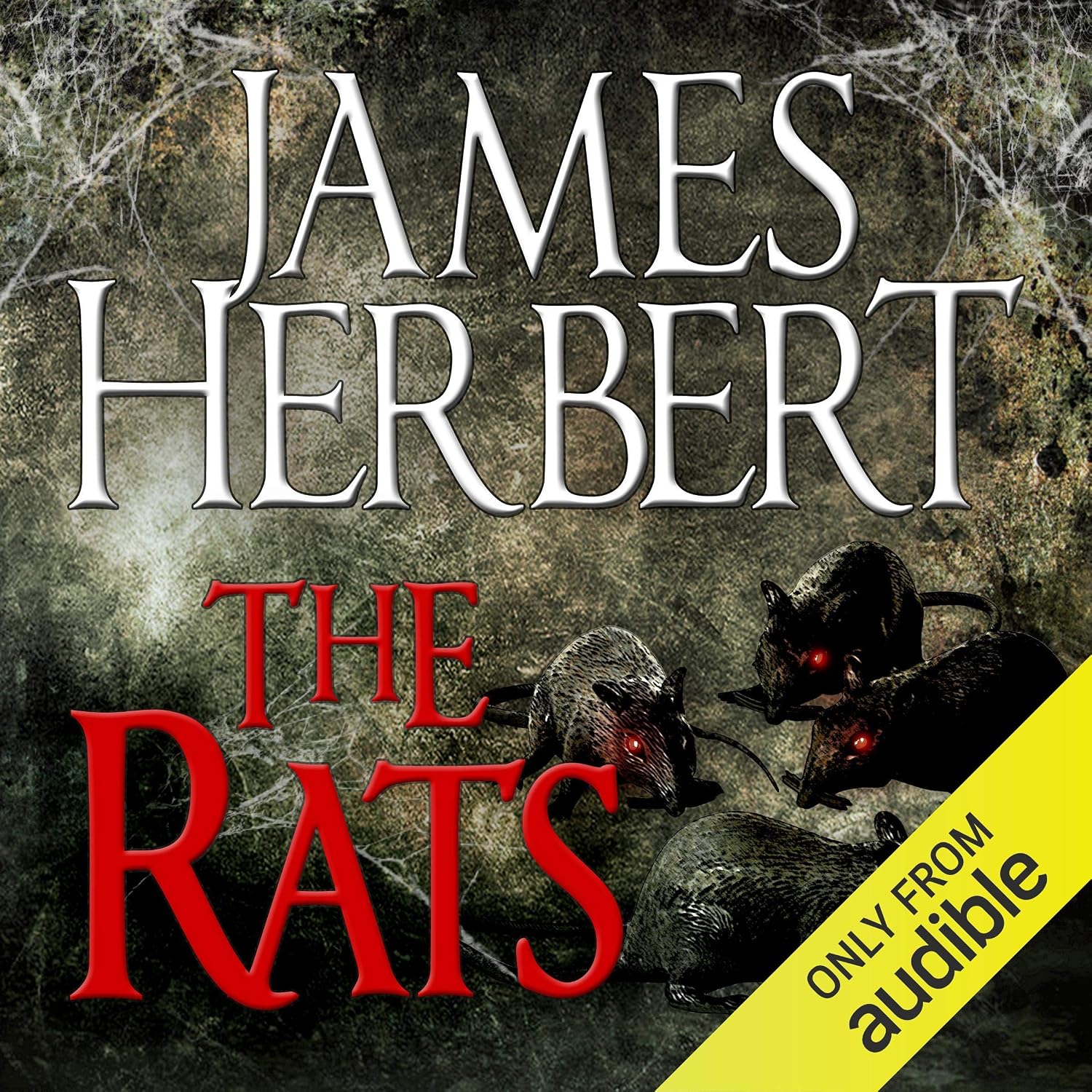
There are few things quite so effective at turning an ordinary day into a nightmare as the sudden realisation that something you have always regarded as harmless is actually capable of killing you. Most of us would rather not think too hard about rats, particularly the ones that scuttle around the bins or disappear into the gaps beneath the floorboards. James Herbert takes that everyday unease and pushes it to a wonderfully unpleasant extreme in The Rats, his debut novel. It’s a simple premise, but one that gets under the skin remarkably quickly, and it’s easy to see why this book made such an impact when it first appeared.
The story begins in the East End of London, where reports of people being attacked by unusually large and vicious rats are initially treated as isolated incidents. That becomes rather harder to dismiss when the victims start piling up, including children, and the attacks spread into increasingly populated areas. Harris, a young art teacher, becomes involved after one of his pupils arrives at school with a rat bite. What begins as a local mystery soon develops into a full-blown public emergency, as the authorities struggle to understand what they’re dealing with and, more importantly, how to stop it.
I liked the way Herbert gets straight to the point. There’s very little messing about with elaborate explanations or lengthy introductions. The opening attack makes it abundantly clear what sort of book we’re reading, and from there the tension builds through a series of increasingly alarming incidents. Herbert understands that the most frightening thing about an infestation isn’t necessarily the first rat you see, but the growing suspicion that there are hundreds more nearby, just out of sight. He makes excellent use of that fear, turning familiar places into potential killing grounds. A school, a cinema or a Tube station should be ordinary parts of everyday life, but here none of them offers any guarantee of safety.
Harris makes a useful central character because he’s an ordinary man caught up in something far beyond his experience. He’s not a particularly remarkable hero, nor does Herbert spend an enormous amount of time developing him into one. He’s a teacher who happens to be in the wrong place at the wrong time, and I found that perfectly appropriate for this sort of story. His involvement gives us someone to follow as the crisis unfolds, while his determination to help provides a human thread through the increasingly chaotic events. I would have liked a little more depth to him, and some of the supporting characters are similarly sketched rather lightly, but this isn’t really a novel that depends on complex character studies.
What Herbert does particularly well is make the attacks feel personal. He gives some of the victims enough background to establish them as people rather than simply names on a casualty list. That makes the violence considerably more affecting, especially when the rats target the most vulnerable. The attack on a young child and her dog is especially grim, and the fact that Herbert is quite prepared to put such characters in danger makes it clear that nobody is protected by the usual conventions of horror fiction. There’s a nastiness to the book that feels deliberately provocative, and I suspect some readers will find parts of it harder going than others. Herbert certainly doesn’t believe in sparing us the details.
The rats themselves are excellent monsters. They’re enormous, aggressive and disturbingly intelligent, but what makes them particularly frightening is their ability to operate in numbers. One might be unpleasant enough, but a swarm is something else entirely. Herbert captures the sense of helplessness that comes from being surrounded by creatures that are faster, more numerous and utterly uninterested in human attempts to reason with them. Their attacks also become increasingly organised and audacious, which gives the story a pleasing sense of escalation. Just when you think the authorities might have found a way to contain the outbreak, the rats find another way to make things considerably worse.
There’s also an interesting picture of London beneath the creature-feature horror. Herbert’s East End is a place of neglected streets, bombsites, derelict buildings and people who are already living on the margins. The first victims are not necessarily the people anyone is likely to notice, and the authorities’ initial reluctance to take the situation seriously feels like an extension of that neglect. The novel isn’t especially subtle in its social observations, but there’s something effective about the idea that a crisis becomes impossible to ignore only when it reaches places where the more comfortable members of society might be affected. The rats may be the immediate threat, but human complacency and indifference help make the situation worse.
The scientific explanation behind the creatures gives the novel a slightly different flavour from a conventional monster story. Herbert introduces the idea of an unnatural strain of rats, with an origin rooted in human interference and the consequences of nuclear testing. It’s not particularly sophisticated science, and the eventual explanation is perhaps a little more convenient than convincing, but it provides enough background to make the threat feel grounded in something recognisable. More importantly, it hints that humanity may have created a problem it simply cannot control.
There are certainly rough edges. The characterisation is sometimes thin, the dialogue can feel dated, and the plot occasionally relies on people making decisions that seem designed to put them in the path of the next attack. The episodic structure also means that the novel can feel more like a succession of increasingly gruesome set pieces than a carefully developed thriller. But I didn’t find those shortcomings particularly damaging. The pace is brisk, the premise is wonderfully direct and Herbert has a clear instinct for knowing when to turn the screw.
I came away from The Rats understanding why it remains such an important part of Herbert’s work. It’s a lean, nasty and thoroughly effective piece of horror, built around a fear that is all the more uncomfortable because it begins with something so familiar. The violence is extreme, the atmosphere is suitably grim and the threat never feels safely contained. It may not offer the depth of character or thematic complexity of some of his later novels, but it doesn’t need to. Herbert takes a simple idea and makes the most of it, delivering a wonderfully unpleasant reminder that sometimes the things lurking beneath our feet are best left undisturbed. I certainly won’t be looking quite so casually at the next rat I see.
Buy your copy here

Leave a Reply