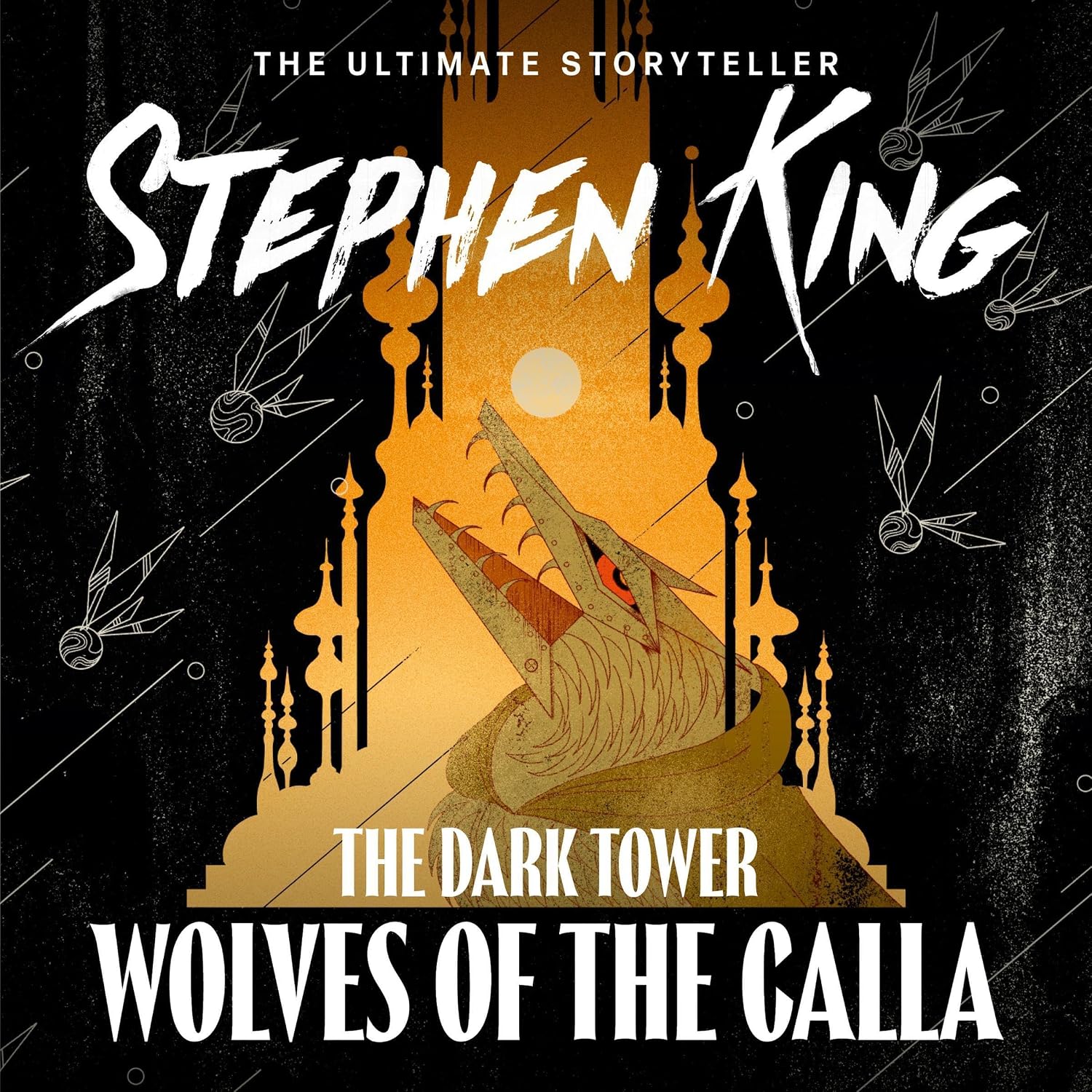
By the time I reached Wolves of the Calla, I had stopped thinking of the Dark Tower books as a straightforward quest story. Stephen King had already taken Roland from a dying western landscape to strange parallel worlds, introduced talking machines and mind-bending mythology, and somehow assembled a ka-tet that I had become genuinely attached to. So when we arrive in Calla Bryn Sturgis and are presented with a community that needs saving, I was expecting something familiar. What I got was a story that felt surprisingly grounded beneath all the weirdness.
There is still plenty of the surreal fantasy that has become a trademark of the series, but this time King settles into a much more traditional western structure. A small community is threatened by an almost supernatural force, the locals need help, and a group of outsiders rides into town. Except, naturally, this being Stephen King, things are considerably more complicated than that.
The central conflict with the Wolves works particularly well because the threat is not simply physical. The people of Calla Bryn Sturgis have lived with the Wolves for generations, surrendering their children to them because the practice has become an accepted part of life. What really struck me was how easily a terrible situation can become normal when people have lived with it for long enough. The Calla has built customs, beliefs and even expectations around something that should never have been accepted in the first place.
That gives Roland and his ka-tet an interesting role. They are not simply riding into town to defeat the bad guys. They are challenging an entire way of thinking. The people of the Calla have become dependent on a system they hate, and breaking that cycle requires them to take responsibility for what happens next.
I particularly enjoyed that aspect of the story because King does not make courage look effortless. The villagers have to learn to stand together, organise themselves and actually believe that their actions can make a difference. It becomes a story about reclaiming agency rather than simply overcoming an external enemy.
And then there is Father Callahan.
Having encountered Callahan previously, I was genuinely pleased to see him brought into the Dark Tower story. His history gives the character a real sense of weight, and his struggle with guilt, faith and failure adds a surprisingly human element to what could otherwise have been a fairly straightforward battle against monsters.
His redemption is probably my favourite part of the novel. Callahan is not magically forgiven for everything that has happened to him. Instead, redemption comes through finally choosing to stand and do something when running away would be easier. That felt much more believable to me. King understands that redemption is rarely about erasing the past. It is about deciding what you are going to do with the person you have become.
Andy the Messenger provides a rather different perspective on trust and betrayal. I enjoyed how the truth about Andy gradually emerges because it makes the Calla’s situation feel even more precarious. He is one of those characters who seems harmless right up until you realise just how much information he has been gathering. The betrayal works because the community has trusted him, and that makes the eventual revelation feel like a violation of something much deeper than simple loyalty.
There is also the continuing sense that Roland’s journey is becoming tangled up with everything else. The Dark Tower mythology keeps expanding, and the connections to King’s wider universe are becoming harder to ignore.
And then there are the pop-culture references.
King really does throw everything into the blender here. We get nods to Star Wars, Harry Potter, Marvel comics and plenty more besides. Sometimes these references are hilarious, sometimes they are deliberately bizarre, and occasionally they threaten to pull me out of the story. I generally enjoyed them, though. They have become part of the peculiar identity of the Dark Tower books, where medieval fantasy, westerns, horror and modern pop culture can somehow occupy the same page without completely collapsing under their own weight.
The book is not without its flaws. It is long, and there are sections where the story could probably have moved a little faster. Some of the mythology becomes increasingly complicated, too, and I can understand why readers might find the sheer number of connections a little overwhelming. Personally, though, I have reached the point where I rather enjoy the feeling that King is throwing another piece of the puzzle onto the table.
I listened to the Audible audiobook narrated by George Guidall, and once again he proved to be a terrific fit for this world. Rather than simply delivering the dialogue, he gives the characters distinct personalities and lets the shifts between humour, tension and outright strangeness happen naturally. There is a confidence to his performance that makes the long journey through the Calla feel surprisingly immersive.
Ultimately, Wolves of the Calla worked for me because it combines a fairly straightforward story about a community standing up against oppression with the increasingly strange mythology of the Dark Tower. Beneath the monsters, prophecies and pop-culture jokes, it is really a story about responsibility, betrayal, loyalty and the possibility of redemption.
By this point, I am no longer wondering whether Roland will reach the Tower.
I am much more interested in what the journey is going to turn him into.
Buy your copy here

Leave a Reply