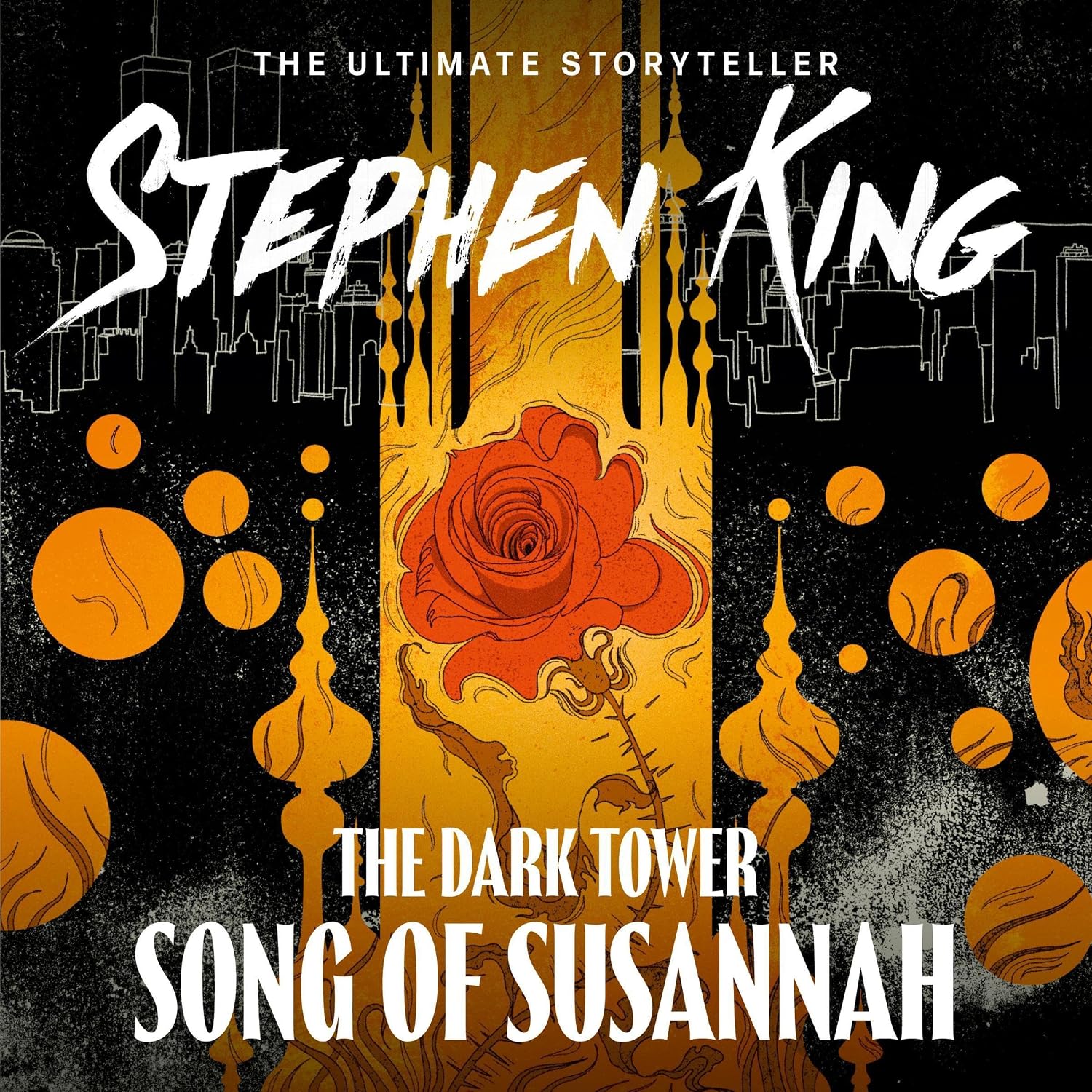
Song of Susannah is probably the point where I finally stopped trying to predict what Stephen King was going to do with the Dark Tower series. After six books of strange worlds, shifting realities, talking machines, magical doors and increasingly tangled connections to King’s wider universe, you might think I would have learnt my lesson. I clearly hadn’t. Because this book is possibly the weirdest one yet.
And I mean that as a compliment.
The story feels like King has taken everything he has been building towards and decided to throw it into a blender. The ka-tet is split up, Susannah’s situation becomes increasingly bizarre, the boundaries between worlds continue to blur, and then King does something that still makes me smile. He puts himself into the story.
Yes, Stephen King becomes a character in his own novel.
It is such a gloriously strange decision that I almost admired the sheer nerve of it before I had even decided whether I liked it. There is something wonderfully meta about an author inserting himself into the machinery of his own creation, particularly in a series that has spent so much time playing with ideas about stories, realities and the connections between them.
At the heart of the book, though, are some surprisingly old-fashioned ideas about bargains and consequences.
The Faustian deal is one of the strongest themes running through Song of Susannah. Characters make choices because they believe they can control the outcome, only to discover that bargains with powerful forces rarely come with the small print conveniently highlighted. There is a familiar human weakness in that. We want something badly enough that we convince ourselves the consequences will somehow be manageable.
King has a lot of fun with that idea, but he also makes it uncomfortable. The choices made earlier in the series are beginning to catch up with people, and not always in ways they could have anticipated.
That leads into another theme I particularly enjoyed, the idea that your past can come back to bite you.
The Dark Tower books have always been concerned with history, memory and repetition, but here those ideas become much more personal. Characters cannot simply leave their previous decisions behind because the story keeps dragging those decisions back into the present. What has happened matters, and there is a sense that nobody gets to rewrite their history simply because they would prefer a different outcome.
I found that especially effective with Susannah. Her struggle is not just about what is happening to her now. It is also about identity, control and the complicated accumulation of everything she has already experienced. The series has always played with questions about who these characters are, but here King pushes those questions much further.
There is also plenty of social commentary buried beneath all the supernatural madness. The novel repeatedly asks what people are prepared to sacrifice when they want something badly enough, and how easily desperation can make a terrible bargain seem like a reasonable one. It is not exactly subtle, but then subtlety has never been the Dark Tower’s greatest strength.
And that brings me to one of my small reservations. Song of Susannah is not really a satisfying standalone story. It feels like a bridge between larger pieces of the saga, and there are moments when I could almost hear King saying, “You’ll understand why this matters later.” The book is also so packed with mythology, alternate realities and connections that it can occasionally feel like homework for the final instalment.
But by this point, I was invested enough that I didn’t really mind.
In fact, I rather enjoyed the feeling that the series was finally becoming completely unhinged.
I read the Audible audiobook narrated by George Guidall, and his performance once again added considerably to the experience. He handles the shifting personalities and increasingly surreal situations without making them feel confusing, giving the characters enough individuality that I could follow the emotional thread even when the plot was deliberately going off in several directions at once. There is a real sense of momentum in his delivery that suits a book where almost anything can happen next.
What I particularly like about Song of Susannah is that King is no longer pretending this is going to be a conventional fantasy quest. The fourth wall is wobbling, the rules of reality are becoming increasingly negotiable, and the author himself has wandered onto the stage.
At this point, I have completely stopped asking where the story is going.
I just want to see what happens when it gets there.
Buy your copy here

Leave a Reply