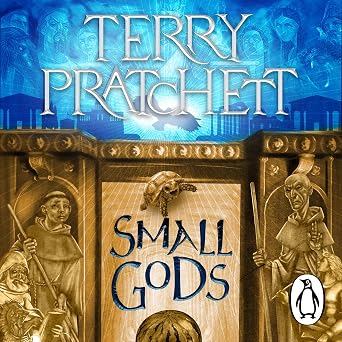
here are books you read because they are funny, books you read because they make you think, and then there are Discworld books that somehow manage to do both while quietly poking you in the ribs and asking whether you have considered the possibility that absolutely everything you believe might be slightly ridiculous.
Small Gods is very much one of those books.
It is also one of those Discworld novels that feels increasingly relevant the older I get. Not because the world has somehow become more sensible, obviously, but because Terry Pratchett was rather good at looking at the things people accept without question and asking the extremely inconvenient question of why.
In this case, religion gets the full Pratchett treatment.
The story takes us to Omnia, a land where the Church of Om has become an enormous and powerful institution. The problem is that the Great God Om is supposed to be at the centre of everything, except that most people seem considerably more interested in the machinery of religion than the actual god.
And then there is Brutha.
Brutha is not your typical Discworld hero. He is a young novice with an extraordinary memory, very little worldly experience and an almost painfully sincere faith. Unfortunately for him, he discovers that his god is not quite the omnipotent being he had been led to believe.
In fact, Om currently appears in the form of a tortoise.
A tortoise with opinions.
This is where Small Gods becomes particularly entertaining because Pratchett takes something that could easily have become a rather heavy-handed satire of organised religion and instead fills it with talking animals, incompetent priests, philosophical arguments, political manoeuvring and a surprisingly aggressive tortoise.
It is very funny.
But underneath all the jokes is some genuinely sharp social commentary. Pratchett is interested in the difference between faith and religious institutions, between believing something and simply following orders because somebody with a hat told you that this is what you are supposed to do.
There is also a lot here about power. Once an organisation becomes sufficiently large, it can become more interested in preserving itself than in the principles upon which it was supposedly founded. People become concerned with hierarchy, bureaucracy and control. Doctrine becomes more important than compassion.
And that all sounds terribly serious, doesn’t it?
Fortunately, there is a tortoise.
One of the things I particularly enjoy about Small Gods is that Pratchett never treats his characters as mere vehicles for his arguments. Brutha is genuinely likeable, and his journey is as much about learning to think for himself as it is about discovering what his faith actually means. He begins as someone who accepts the world exactly as he has been taught it, and gradually starts to understand that questioning something does not necessarily mean abandoning it.
That is quite a powerful idea, particularly when wrapped in a story where the god himself is basically shouting from inside a shell because nobody is listening.
The novel also has plenty to say about knowledge, education and intellectual freedom. There is a constant tension between people who want to understand the world and those who benefit from keeping everyone else ignorant. Again, it is handled with enough humour that you can laugh at the absurdity before realising that Pratchett is talking about rather serious things.
And then there are the characters who make the whole thing work. Om himself is brilliant, particularly because he is forced to confront the rather uncomfortable truth that having absolute power does not necessarily mean people will be devoted to you. Sometimes they are just devoted to the institution that claims to represent you.
Which is probably not a particularly comfortable thought for a god.
The audiobook is another reason this edition works so well for me. Andy Serkis gives the narration a tremendous amount of energy and personality. There is a real sense of character in the performance, and he handles the shifts between comedy, drama and the more philosophical moments beautifully. The story feels alive, which is exactly what you want from a Discworld audiobook.
Peter Serafinowicz has the perfect presence as Death, bringing exactly the right combination of solemnity and understated absurdity to those appearances. And then there is Bill Nighy as the voice of the footnotes. His trademark nonchalance is sublime. He sounds as though he has been handed the entire universe, briefly glanced at the instructions and decided that commenting from the margins is probably the sensible option.
What I love most about Small Gods is that it manages to be both funny and genuinely thoughtful without sacrificing either side. It asks questions about faith, power, authority, knowledge and the importance of thinking for yourself, but never feels like it is standing at the front of the classroom waving a large educational poster.
Instead, it gives you a tortoise.
And somehow that works.
Small Gods is one of those Discworld stories that reminds me why I keep coming back to Pratchett. Beneath the jokes, the wordplay and the wonderfully silly situations, there is always something worth thinking about. Sometimes it is hidden in a character. Sometimes it is buried in a footnote. Sometimes it is being shouted by a very angry tortoise.
And sometimes, quite simply, the joke is the point.
Another excellent addition to these new audiobook editions, and another reminder that Discworld was never just about fantasy. It was always about us.
Buy your copy here

Leave a Reply