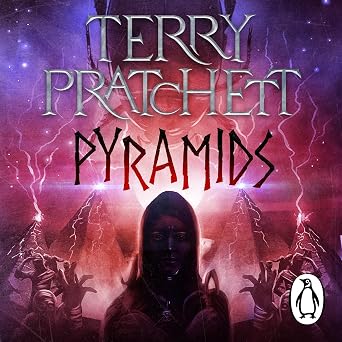
Pyramids is one of those Discworld books that I seem to appreciate a little more every time I come back to it. It is not quite the same sort of story as some of the later books, partly because it stands rather proudly on its own little patch of desert, but it has all the things I have come to expect from Terry Pratchett. There are absurd situations, ridiculous people, terrible decisions, jokes that sneak up on you, and underneath all of that, some surprisingly sharp observations about the way societies work.
At the centre of the story is Teppic, a young man who has been sent away from his home in the kingdom of Djelibeybi to be educated as an assassin. This is, naturally, a perfectly sensible career choice for the heir to the throne. Unfortunately for Teppic, his education has left him considerably more interested in modern ideas than the ancient traditions he is expected to uphold. Then his father dies, leaving Teppic to return home and become king.
There is a problem with this.
Actually, there are several problems with this.
The first is that Teppic is not particularly interested in being king. The second is that the kingdom has been doing things the same way for thousands of years, and therefore sees no particular reason to stop now. The third is that everyone around Teppic seems to believe that tradition is automatically a good thing simply because it is traditional.
And this is where Pyramids becomes much more than a story about assassins, ancient kingdoms and an enormous architectural project that probably should have been subjected to some sort of planning permission.
One of the things I particularly enjoyed this time around is just how much Pratchett is saying about tradition and the way people use the past to justify the present. Djelibeybi has essentially become a society where nobody remembers why things are done, only that they have always been done. That feels very familiar. We all have our own little pyramids of tradition, carefully maintained long after anyone has remembered what they were supposed to achieve.
Pratchett also has quite a lot of fun with class, privilege and the idea of progress. Teppic has been exposed to a wider world and has discovered that there are other ways of doing things. That makes him something of a revolutionary when he returns home, despite the fact that he is mostly just trying to stop everyone from behaving completely madly.
Then there is the pyramid itself.
I love the sheer ridiculousness of the idea that an entire civilisation can devote enormous amounts of time, money and human effort to building gigantic monuments because their ancestors did it. It is simultaneously hilarious and rather uncomfortable. Pratchett manages to make you laugh at the absurdity while quietly asking whether our own societies are really all that different.
And, of course, because this is Discworld, the book cannot simply remain a straightforward examination of ancient traditions. We get assassins, camels with attitude, mathematics, priests, bureaucracy, ghosts, time behaving in increasingly inconvenient ways and one of the most entertainingly strange explorations of Ancient Egypt you are ever likely to encounter.
The characters are another reason the book works so well for me. Teppic is an appealingly reluctant hero, while Ptraci is wonderfully memorable and the various members of Djelibeybi’s royal household provide Pratchett with plenty of opportunities to demonstrate his particular talent for making the ridiculous sound entirely reasonable.
The audiobook editions are another part of the fun. Alfred Enoch gives the narration a terrific energy. He is probably best known to many people as Dean Thomas in the Harry Potter films, but he proves himself more than capable of handling the peculiar rhythms and varied characters of Discworld. There is a nice sense of personality throughout his performance, and he brings the story to life without ever overwhelming the writing.
Then there is Peter Serafinowicz as Death, who has exactly the right presence for the character. Death works best when he is both completely absurd and completely serious at the same time, and Serafinowicz gets that balance beautifully.
And Bill Nighy as the voice of the footnotes? Sublime. His trademark nonchalance makes the footnotes feel like they are being delivered by someone who has wandered into the story, taken one look at the chaos and decided that commenting on it is probably the safest option.
What I particularly like about Pyramids is that beneath all the jokes there is a surprisingly thoughtful story about change. How much should we respect tradition? When does tradition become an excuse for refusing to change? And what happens when a society has become so invested in its own history that it cannot imagine having a future?
Pratchett never lectures us about any of this. He simply builds a pyramid, fills it with jokes, adds several thousand years of questionable decision-making and lets us work it out for ourselves.
It is funny, clever, occasionally ridiculous and considerably more thoughtful than it initially appears. Another excellent Discworld audiobook, and one I am very glad I came back to.
Buy your copy here

Leave a Reply