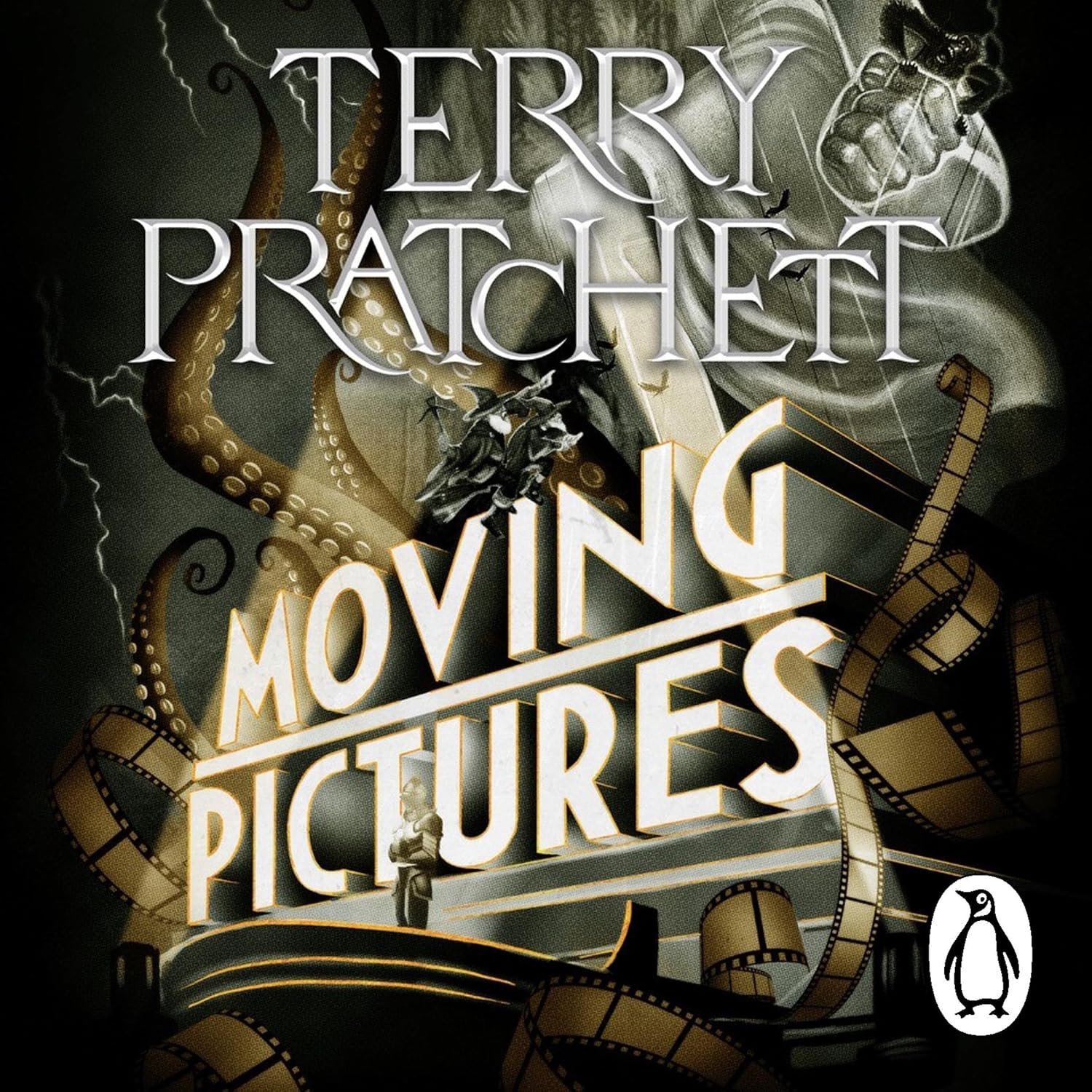
There is something wonderfully appropriate about a Discworld novel about the movies. Films have always been very good at making us believe that anything is possible, provided you have enough money, enough special effects and somebody willing to stand in front of a camera looking suitably heroic. Terry Pratchett, naturally, looks at this idea and asks what would happen if the magic behind the movies was actually magic.
The answer, in Moving Pictures, is that things get very silly indeed.
This is one of those Discworld books where the basic joke is immediately obvious, but Pratchett keeps finding new and increasingly ridiculous ways to explore it. Holy Wood has appeared from nowhere, people are suddenly becoming actors, everyone wants to be famous, and the strange creatures emerging from the silver screen are rather less fictional than anyone would like. Meanwhile, the people of Ankh-Morpork are discovering that the easiest way to become somebody important is apparently to have your face projected onto a very large piece of cloth.
What I particularly enjoy about Moving Pictures is that beneath all the jokes, Pratchett is having quite a lot to say about the world around him.
The novel is partly about the movie industry, obviously, but it is also about celebrity, ambition, advertising, consumerism and the strange human desire to become something we are not. Holy Wood offers people the chance to reinvent themselves, and they rush towards it with the enthusiasm of people who have just discovered that fame might be available without having to do anything particularly useful first.
That feels remarkably familiar.
There is also a great deal here about the machinery of entertainment. Once people discover that something attracts an audience, the natural response is to make more of it. Then bigger versions. Then louder versions. Then versions with more explosions. Pratchett understands that entertainment is rarely content to remain a simple pleasure. There is always somebody asking what the audience wants, somebody else trying to sell it to them and a third person wondering whether they can make a profit from selling the merchandise afterwards.
And, of course, once everyone wants to be famous, somebody has to decide who gets to be famous.
The characters caught up in all this give the story its heart. Victor Tugelbend is essentially an accidental hero, which is probably the only sort of hero who could survive being dropped into a Pratchett novel. Ginger is caught between the person she is and the glamorous image she has been encouraged to become, while Cut-My-Own-Throat Dibbler is doing what Cut-My-Own-Throat Dibbler does best, which is spotting an opportunity to sell something to somebody.
The jokes come thick and fast, but there is also a surprisingly thoughtful examination of identity. The movies promise people a better version of themselves, but Pratchett keeps asking whether becoming that version is actually going to make them happier. There is a difference between wanting to be somebody and wanting people to think you are somebody, and Moving Pictures has a great deal of fun with that distinction.
It also contains some wonderfully affectionate observations about the cinema itself. Pratchett clearly understands why movies work. They give us heroes, villains, romance, monsters and impossible adventures. They allow us to sit in the dark for a couple of hours and believe that the world is bigger, stranger and more exciting than the one outside the cinema.
Then he gives that idea teeth.
The Audible narration by Jason Isaacs is particularly well suited to this sort of story. There is just the right personality in his performance to handle Pratchett’s mixture of absurdity, warmth and outright silliness. The characters feel distinct without the narration ever becoming distracting, and Isaacs seems entirely comfortable with the peculiar rhythm of Discworld humour. He knows when to let a joke sit for a moment and when to simply get out of its way.
And then there are the regular appearances from two particularly welcome voices.
Peter Serafinowicz has the perfect presence as Death. There is something wonderfully appropriate about his delivery, giving Death that combination of solemnity, absurdity and complete certainty that the character requires. Meanwhile, Bill Nighy as the voice of the footnotes is sublime. His trademark nonchalance makes even the most ridiculous explanatory aside sound as though it is the most ordinary piece of information in the world.
Moving Pictures is not necessarily the Discworld novel I would hand to somebody who has never encountered Pratchett before, but for anyone already familiar with Ankh-Morpork it is enormous fun. It manages to be a story about movies, fame, ambition and commercialism while also being a very funny adventure involving magic, monsters and people who probably should not be allowed anywhere near a film set.
What I love most is that Pratchett never loses sight of the fact that all this nonsense is ultimately about people. We want to be admired. We want to escape. We want to believe there is something more exciting waiting for us somewhere else.
Sometimes that desire creates art.
Sometimes it creates Hollywood.
And sometimes, on Discworld, it creates something with far too many tentacles.
Moving Pictures is funny, clever and surprisingly sharp beneath all the silliness, which is pretty much exactly what I want from a Discworld novel.
Buy your copy here

Leave a Reply