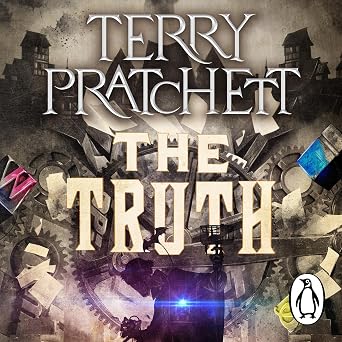
There is something wonderfully appropriate about Terry Pratchett writing a Discworld novel about newspapers. After all, if you are going to create a fantasy world populated by wizards, witches, assassins, vampires, trolls and people who think a potato is a perfectly acceptable weapon, eventually somebody is going to have to write down what happened.
Enter William de Worde, reluctant journalist, accidental newspaper proprietor and possibly the least suitable person in Ankh-Morpork to discover that telling the truth can be rather more complicated than simply finding out what happened.
The Truth is one of those Discworld novels that starts with a fairly simple joke and then keeps adding layers until you suddenly realise that Pratchett is talking about some very serious subjects underneath all the silliness. Newspapers are obviously the main target, but the novel is really about information, power, reputation, manipulation and the rather inconvenient fact that people do not necessarily want the truth when a much more entertaining version is available.
William begins publishing the Ankh-Morpork Times almost by accident, initially seeing the newspaper as a way of making a living rather than changing the world. Unfortunately, once you start printing things that people want to read, you discover that everyone has an opinion about what you should print.
And everyone wants their own version of events to be the one that appears on the front page.
Sound familiar?
Pratchett has a great deal of fun with the idea that newspapers can both inform and influence. There is a particularly sharp observation running through the book about how easily information becomes a commodity. If something is interesting, it sells. If it is sensational, it sells even better. If it happens to be true as well, that is almost a bonus.
The Truth also has plenty to say about the responsibilities that come with journalism. William has to learn that printing something because it is interesting is not necessarily the same as printing something because it is important. He also discovers that once you have put words into the world, you cannot simply pull them back again because somebody has started threatening you with a crossbow.
This being Ankh-Morpork, the threat of crossbows is not entirely hypothetical.
I particularly enjoy the way Pratchett uses the newspaper itself as a reflection of the city. Ankh-Morpork is changing. It is becoming more modern, more commercial and increasingly obsessed with information. The printing press represents progress, but Pratchett is never simplistic about progress being automatically good. New technology creates opportunities, but it also creates new ways of making mistakes, spreading nonsense and making money.
There is also a wonderfully sharp examination of public perception. The truth is one thing, but what people believe to be true can be something else entirely. Reputation can be manufactured, rumours can become facts simply through repetition and a sufficiently confident headline can make almost anything sound plausible.
The parallels with the real world are difficult to miss, and they remain one of the reasons the book works so well. Pratchett manages to poke fun at newspapers, politicians, advertisers, readers and the general human tendency to believe the story we find most satisfying rather than the one that happens to be accurate.
And then there are the characters.
William is a terrific protagonist precisely because he is not a traditional hero. He is intelligent, stubborn and occasionally rather too pleased with his own cleverness, but he is also genuinely interested in getting things right. His relationship with the newsroom and the people he gathers around him gives the story a warmth that balances the satire.
Then, of course, there is Otto Chriek, a vampire with a rather unfortunate relationship with photography, Sacharissa Cripslock, who quickly demonstrates that journalism is not exclusively a male occupation, and the inevitable appearance of a number of familiar Ankh-Morpork faces.
The Audible narration by Matthew Baynton, of Horrible Histories fame, is an absolute delight. In fact, he is exactly who I would have cast as William de Worde. There is something about his delivery that captures William’s mixture of earnestness, curiosity and occasional exasperation perfectly. Baynton also handles the wider cast brilliantly, giving the book the energetic, slightly chaotic quality that it needs.
Peter Serafinowicz has the perfect presence as Death, while Bill Nighy providing the voice of the footnotes is sublime. That trademark nonchalance makes the footnotes feel like someone has wandered into the narration purely to mention something ridiculous and expects us all to carry on as though nothing unusual has happened.
The Truth is another excellent example of Pratchett doing what he did so well. He gives us a funny story about newspapers and then quietly slips in a discussion about truth, responsibility, power, technology and the way information shapes society.
It is funny, clever and occasionally rather pointed.
Which, when you think about it, is exactly what a good newspaper ought to be.
Buy your copy here

Leave a Reply