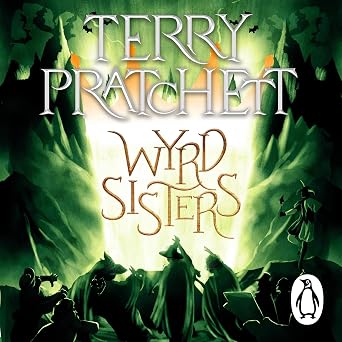
There is something wonderfully appropriate about Wyrd Sisters arriving as the book where Discworld starts to feel like it has properly found itself. The Colour of Magic and The Light Fantastic were discovering what Discworld could be, Equal Rites was beginning to work out where it might go, but Wyrd Sisters feels like Pratchett suddenly realised that he had a whole world available to him and thought, “Right, let’s have some fun with this.”
It is also, in my opinion, the real start of the Witches of Lancre subseries, and what an introduction it is.
At the heart of the story are three witches who could hardly be more different. Granny Weatherwax is already the formidable force of nature we encountered in Equal Rites, although here she gets considerably more room to demonstrate exactly why people tend to become nervous when she enters a room. Nanny Ogg is considerably more sociable, particularly when there is alcohol involved, and Magrat Garlick is the youngest and most idealistic of the three.
Together they form a rather splendid coven, although “splendid” may not be the word anyone unfortunate enough to become their target would choose.
The story itself is Pratchett’s take on Shakespeare, particularly Macbeth, Hamlet and the general theatrical tradition of kings, ghosts, prophecies, murder and people behaving terribly in castles. There are murders, mistaken identities, supernatural meddling, ambitious rulers and a great deal of stagecraft. There is even a theatre troupe, because apparently what this particular kingdom really needs when everything is going horribly wrong is a group of actors.
The result is wonderfully silly, but there is considerably more going on beneath the jokes.
One of the central themes is power and the way people use it. Wyrd Sisters is interested in kingship, legitimacy and the difference between having authority and actually deserving it. The question of what makes someone a ruler becomes increasingly important as the story progresses, and Pratchett has a great deal of fun pointing out that putting a crown on someone’s head does not magically turn them into a good person.
Then there is the question of destiny.
Pratchett takes the traditional fantasy idea that events are predetermined and gives it a good shake. Prophecies, bloodlines and ancient expectations all suggest that people are supposed to follow a particular path, but the characters repeatedly demonstrate that free will has an inconvenient habit of getting in the way of a good prophecy. It is one of those ideas that Pratchett manages to explore while making you laugh at the same time.
The social commentary is equally enjoyable. Wyrd Sisters takes aim at class, inherited privilege, monarchy, political manipulation and the assumptions people make about who is entitled to power. It also has quite a lot to say about storytelling itself. The way stories shape our understanding of heroes and villains is central to the book, and Pratchett clearly enjoys taking familiar tales apart to see what happens when you look at them from another angle.
This is one of the things that makes Discworld so effective. You can enjoy the jokes at face value, then realise several pages later that Pratchett has slipped an entire argument about society into the middle of them.
And then there is Death.
The Death of Discworld is one of those characters who becomes funnier every time he appears, partly because everyone else reacts to him as though his existence is perfectly normal. Peter Serafinowicz is superb in the role, bringing that wonderfully sepulchral delivery to Death’s lines and making every appearance feel suitably grand, ominous and faintly ridiculous.
I am also continuing to really enjoy these new Audible editions. Indira Varma feels particularly well suited to the material, handling the different characters without losing the conversational quality that makes Pratchett’s writing work so well aloud. The narration brings the characters to life and makes it all feel real, which is especially important in a book where you can go from a serious discussion about kingship to someone making an observation about a goat without any warning whatsoever.
Bill Nighy deserves another special mention too. His laid back delivery of the footnotes is absolutely perfect. There is something deeply amusing about hearing him calmly explain some bizarre piece of Discworld lore while the main story continues behaving like a particularly enthusiastic lunatic. The footnotes are part of what makes these new editions so much fun, and Nighy understands exactly how little fuss they require.
What I particularly like about Wyrd Sisters is that it feels like a proper step forward from the earlier books. The humour is sharper, the characters are becoming more fully realised, and the satire has more confidence. You can see Pratchett moving towards the Discworld that would eventually produce some genuinely extraordinary novels.
Most importantly, the witches work brilliantly together. Granny, Nanny and Magrat are not simply three variations on the same character. Their differences create the comedy, but they also give the story its heart. There is a genuine affection between them beneath all the bickering, stubbornness and occasional threats of violence.
Wyrd Sisters is funny, clever and surprisingly thoughtful, which is becoming something of a Discworld speciality. It takes Shakespeare, traditional fantasy, monarchy and the idea of destiny, throws them into a large pot, adds three witches and then stirs vigorously.
And somewhere underneath all that, Pratchett is asking some rather serious questions about power, responsibility, identity and the stories we tell ourselves.
Not bad for a book involving a ghost, a troupe of actors and a goat.
Buy your copy here

Leave a Reply