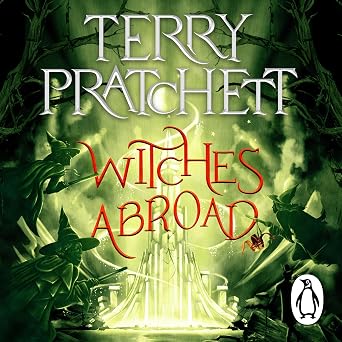
Witches Abroad is the point where the Witches of Lancre stop being merely a very good idea and start becoming one of the great Discworld institutions. Granny Weatherwax, Nanny Ogg and Magrat Garlick are back, and this time they are leaving Lancre behind and heading off on what can only be described as a fairy tale holiday. Unfortunately, when three witches go travelling, you can be fairly certain that things are not going to go according to the brochure.
The basic premise is wonderfully Pratchett. A dying witch leaves behind a request that her goddaughter, Ella, should attend a ball. This sounds straightforward enough, except that the witches discover that someone is interfering with the traditional machinery of fairy tales. Stories are being forced into the shapes they are expected to take, people are being manipulated into becoming princes, princesses, villains and victims, and everyone appears to be heading towards a predetermined happy ending.
Naturally, Granny Weatherwax is having none of it.
One of the great strengths of Witches Abroad is the way Pratchett takes familiar fairy tales and asks what happens when you stop accepting their assumptions. Cinderella, Sleeping Beauty and Little Red Riding Hood are all present in various forms, but they are not simply there as references for the reader to recognise. Pratchett uses them to explore the way stories can shape expectations and, more importantly, how those expectations can become a form of control.
The central theme is really the power of stories.
Stories tell us how people are supposed to behave. They tell us who the heroes are, who the villains are, what women should want, what men should do and, most importantly, how everything is supposed to end. Witches Abroad takes that idea and gives it a good shake. What happens when someone tries to make reality conform to the story rather than allowing people to make their own choices?
It is a very Pratchett question, because beneath the jokes there is a serious discussion about free will and identity.
The social commentary is also wonderfully sharp. The book pokes fun at traditional gender roles, romantic expectations, class and the idea that happiness can be neatly packaged into a predetermined ending. There is also a rather pointed observation about how people can be trapped by the stories society tells about them. If everyone expects you to be a princess, a wicked stepmother or a handsome prince, perhaps eventually you start behaving like one.
Pratchett is particularly good at showing how ridiculous these conventions become when examined from the outside.
And then there are the witches themselves.
Granny remains one of the finest characters in Discworld, largely because she is so completely convinced that she is right. The amusing thing is that she is very often right, but that does not necessarily make everyone around her any happier. Nanny Ogg provides the earthy, practical counterbalance to Granny’s severity, while Magrat continues to be the idealistic member of the group, still trying to reconcile what she believes with the rather less romantic reality of being a witch.
Their relationship is what gives the book much of its warmth. They bicker, argue and occasionally appear ready to murder one another, but underneath all of that there is a genuine sense of loyalty. They understand one another, even when they would rather not admit it.
The settings are also a lot of fun. The journey away from Lancre allows Pratchett to play with different versions of fantasy Europe, culminating in a particularly memorable excursion into the world of fairy tales. There is a wonderful sense throughout that Discworld has suddenly become much bigger than the little patch of countryside we have previously known.
I am continuing to really enjoy these new Audible editions as well. Indira Varma is exceptionally well suited to Discworld, particularly when dealing with characters as distinctive as Granny, Nanny and Magrat. Her narration brings the characters to life and makes it all feel real, while still allowing the humour to land naturally. There is a conversational quality to the performance that works beautifully with Pratchett’s writing.
Bill Nighy also deserves another special mention for his work as the voice of the footnotes. His laid back delivery is absolutely perfect. There is something wonderfully amusing about the calm certainty with which he delivers some completely ridiculous piece of information, as though explaining why reality has just stopped behaving sensibly is an entirely normal part of the working day.
And, of course, Peter Serafinowicz returns as Death. His sepulchral delivery remains perfect for the character, giving Death that wonderful combination of grandeur, inevitability and understated comedy. He sounds exactly like Death should sound, which is presumably the minimum requirement for playing Death, but he manages to make every appearance memorable.
What makes Witches Abroad work so well is that it manages to be both a very funny fairy tale parody and a thoughtful examination of why we tell stories in the first place. It is about destiny, free will, expectations and the dangers of assuming that everyone wants the ending you have chosen for them.
And because this is Discworld, it does all of that while throwing in witches, enchanted objects, improbable geography, extremely questionable romantic conventions and at least one wolf who really should have known better.
The Witches of Lancre are becoming a formidable force, and Witches Abroad is a terrific example of why. It is funny, clever, warmly character-driven and packed with the sort of social commentary that sneaks up behind you while you are laughing and quietly hits you over the head with a philosophical frying pan.
A very enjoyable next step for the witches, and another reminder that Discworld was becoming something rather special.
Buy your copy here

Leave a Reply