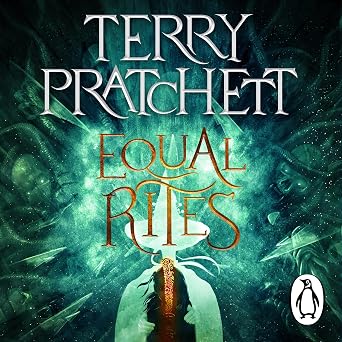
There is something rather lovely about going back to the beginning. Not the very beginning, obviously, because we have already had The Colour of Magic and The Light Fantastic, but close enough. Equal Rites is only the third Discworld book, and while it is already showing plenty of the things that would eventually make Terry Pratchett’s work so special, it has not quite reached the heights of the later entries in the series. What it does have is a rather good idea, a lot of laughs, and the beginnings of a much bigger world than anyone probably realised was being built at the time.
The central idea is wonderfully simple. A wizard dies and, in the traditional manner of wizardly death, attempts to pass his staff and magical abilities on to an appropriately selected successor. Unfortunately, he gets the gender wrong.
Enter Eskarina Smith, a young girl who happens to possess a considerable amount of magical potential. The problem is that on Discworld, magic is considered very much a male occupation. Girls can be witches, apparently, but wizards are men. This distinction is treated with all the seriousness you would expect from a society that has somehow decided that magic has a dress code.
Much of the humour comes from watching the characters attempt to maintain these arbitrary boundaries while Esk simply continues being Esk. She is not particularly interested in whether the rules say she can or cannot become a wizard. She has more pressing concerns, such as discovering what her powers actually are and why everyone around her seems determined to tell her what she is supposed to be.
That gives Pratchett plenty of opportunity for some fairly obvious social commentary, but obvious does not necessarily mean ineffective. Equal Rites takes aim at assumptions about gender, tradition and institutional thinking, particularly the tendency to turn cultural expectations into supposedly natural laws. The idea that someone cannot do something because people like them have historically not been allowed to do it is exposed as rather ridiculous, especially when the person in question is standing in front of you demonstrating precisely the ability you insist they cannot possess.
There is also an interesting examination of education and authority. The Unseen University is less a magical academy and more a collection of men who have become extremely comfortable with the idea that they know how the world works. Esk’s presence challenges that comfortable arrangement, while Granny Weatherwax provides an entirely different form of wisdom. Where the wizards are interested in theory and academic status, Granny is interested in whether something actually works. Preferably before anyone dies.
And then there is Granny herself, who is one of the great pleasures of the book. Even this early in Discworld, Pratchett has created a character who can dominate a scene simply by standing in it and looking at someone until they reconsider their life choices. Her relationship with Esk provides much of the emotional centre of the story, while also giving us a glimpse of the wonderful character work that would become such a defining part of the later books.
Equal Rites is also interesting because you can see Pratchett’s Discworld evolving. The satire is there, the absurdity is there and the jokes come thick and fast, but the world does not yet have quite the depth it would acquire. Later Discworld novels would become much more ambitious in the way they combine humour with politics, philosophy, morality and observations about ordinary human behaviour. Here, Pratchett is still working things out, and occasionally you can see the machinery beneath the joke.
That is not necessarily a bad thing. In fact, there is something charming about reading a book where you can see the author discovering what this world might become.
I am particularly enjoying these new Audible editions. Indira Varma is wonderfully suited to Discworld, with a performance that captures both the comedy and the characterisation without ever making the material feel overplayed. She has exactly the right touch for Pratchett’s mixture of ridiculousness and genuine warmth, bringing the characters to life and making it all feel real.
There are also two particularly welcome voices worth mentioning. Bill Nighy as the voice of the footnotes is inspired. His nonchalant delivery makes the footnotes feel like someone calmly explaining the obvious while the rest of the universe catches fire around them. Then there is Peter Serafinowicz as Death, whose perfect sepulchral style gives those appearances exactly the weight they need. Death can be funny simply because he is Death, but the delivery makes the character even better.
So, while Equal Rites is not yet Discworld operating at full power, it is a hugely enjoyable early entry and an important one. It establishes ideas and characters that will become increasingly significant, while demonstrating that Pratchett was already very good at using fantasy to poke holes in the assumptions we take for granted.
It is funny, warm, occasionally sharp and filled with the promise of what is still to come. The Discworld may still be finding its feet, but they are already walking in a rather interesting direction.
Buy your copy here

Leave a Reply