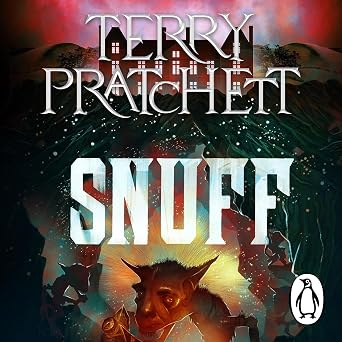
By the time we reach Snuff, Commander Sam Vimes has acquired most of the things he spent his earlier life avoiding. Respectability, wealth, a title, a wife, a child and a job that increasingly involves explaining why everyone else’s terrible ideas are terrible.
Naturally, he needs a holiday.
Snuff takes Vimes away from Ankh-Morpork and deposits him in the countryside, where he is supposed to relax, enjoy the hospitality of the local aristocracy and do absolutely nothing resembling police work.
This lasts approximately five minutes.
A suspicious death, some uncomfortable questions and the discovery that rural life is not nearly as peaceful as people with large houses would have you believe soon drag Vimes back into familiar territory. There are crimes to investigate, people who would rather those crimes remained uninvestigated and, most importantly, goblins.
Pratchett uses the goblins to return to one of the darkest themes running through Discworld: treating people as things is evil at its most base.
That idea is central to Snuff. The goblins are regarded by much of society as barely worthy of consideration. They are pushed aside, exploited and treated as though their lives have less value than those doing the exploiting. It is an uncomfortable subject, and deliberately so.
The cleverness is that Pratchett does not need to turn the story into a lecture. Instead, he shows what happens when a society decides that another group does not really count. Once you have decided somebody is less than a person, almost anything can be justified.
And that is where Snuff becomes much more than a country-house murder mystery.
The social commentary covers prejudice, class, privilege, exploitation and the way respectable society can hide unpleasantness behind polite manners. Vimes is well suited to this story because he has always had an instinctive hatred of bullies.
There is also a wonderful contrast between Ankh-Morpork and the countryside. Out in the country, old assumptions have had more time to settle into the furniture.
Vimes, naturally, starts upsetting the furniture.
His relationship with Sybil is also an important part of Snuff. Their marriage has changed him, and becoming a father has given him another reason to care about the sort of world he is leaving behind. The terrifying Commander Vimes is still there, but he is increasingly aware that being a good man involves more than protecting the people immediately around him.
The supporting cast is excellent as ever. Willikins remains magnificently capable, while Vimes’s interactions with the local characters give the story plenty of opportunities for Pratchett’s particular brand of observational humour. The Watch has also become something much larger than the drunken collection of misfits we met back in Guards! Guards!.
And then there are the goblins, who give Snuff much of its emotional weight.
Pratchett manages to make their treatment upsetting without losing the humour that makes Discworld what it is. The jokes are still everywhere, but they sit alongside some genuinely angry observations about cruelty and indifference.
The audiobook is another excellent part of the experience. John Culshaw handles the increasingly varied cast with confidence, giving the characters distinctive voices while keeping the narration lively and conversational. He brings Vimes’s irritation, determination and occasional exasperation through beautifully.
Peter Serafinowicz once again provides the voice of Death, who talks LIKE THIS, and gives those appearances exactly the right mixture of solemnity and comic timing. Bill Nighy returns as the voice of the footnotes, bringing the same wonderfully dry delivery that has become such a pleasure in these editions.
What I particularly like about Snuff is that it takes a familiar Discworld formula and uses it to explore something considerably darker. It is funny, it is a mystery, it gives Vimes another opportunity to become annoyed with people, but underneath all that is a serious examination of what happens when society decides that some lives matter less than others.
The answer, unfortunately, is not particularly funny.
Pratchett knows that. He also knows that humour can make difficult ideas easier to approach without making them less important. Snuff manages that balance remarkably well.
It is another strong City Watch novel, another fascinating stage in Vimes’s development and another reminder that Discworld is at its best when the jokes are hiding something sharp underneath.
Give Vimes a holiday and he will find a crime.
Give him a crime and he will find injustice.
Give him injustice and you had better have a very good solicitor.
Preferably one who understands that Vimes has already filled in the paperwork.
Buy your copy here

Leave a Reply