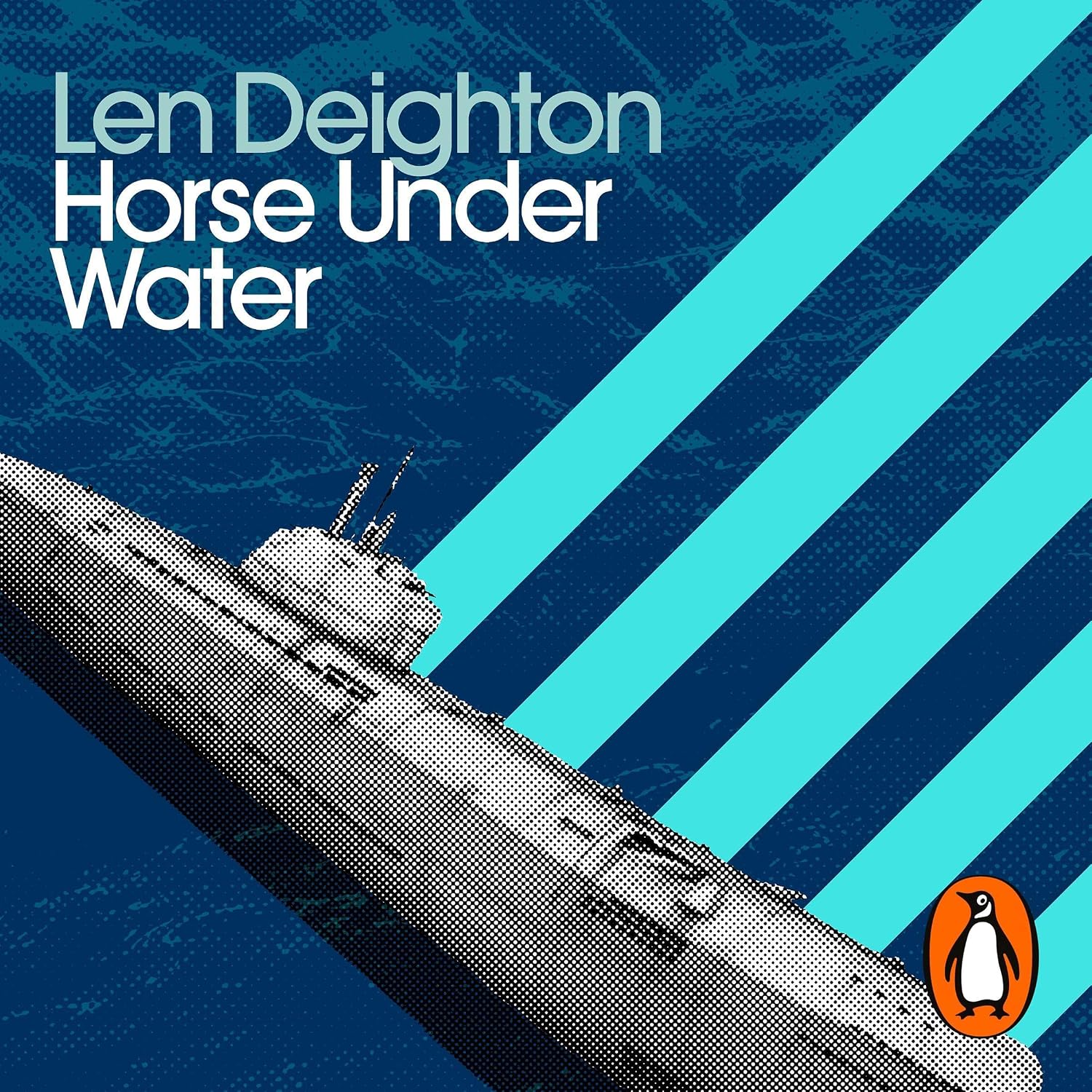
There’s something rather satisfying about a spy novel that refuses to make espionage look like a particularly sensible career choice. You’d think that after the experience of The IPCRESS File, our unnamed intelligence operative might have learnt to expect the unexpected, trust nobody and keep a close eye on the people signing his expense claims. Yet Horse Under Water finds him heading off on another assignment where the information is incomplete, the motives are questionable and the chances of everything going smoothly are, to put it mildly, limited. Len Deighton clearly has no intention of making this business easy, either for his protagonist or for the reader.
The starting point is intriguing enough. A wartime German submarine lies submerged off the Portuguese coast, and its discovery draws British intelligence into an investigation involving a potentially valuable cargo, murky international interests and people whose reasons for becoming involved aren’t always obvious. Our unnamed hero is sent to investigate, but the deeper he gets into the operation, the less straightforward the situation becomes. As with The IPCRESS File, the initial assignment is really an invitation to enter a world where almost everyone knows something they aren’t saying, and where the trick is working out which omissions matter.
What I particularly enjoyed about Deighton’s approach is that he doesn’t treat the protagonist as some all-knowing master of the intelligence game. He’s capable, resourceful and observant, but he still has to make decisions with imperfect information, and sometimes he has to live with the consequences of getting things wrong. There’s a welcome sense of vulnerability about him. He might be the person sent to investigate, but that doesn’t mean he’s the person controlling events. In fact, the suspicion that he may be little more than a useful piece on somebody else’s chessboard hangs over the story. It makes his efforts to establish what’s really happening feel more convincing than another succession of effortlessly successful deductions would have done.
His working-class background remains an important part of his character, too. He has little patience for the social pretensions and institutional hierarchies that surround him, and he’s generally more interested in what people do than in the status they claim. That attitude makes him an entertaining observer of the world he’s been dropped into. He understands that an official title doesn’t guarantee competence, just as a confident explanation doesn’t necessarily make something true. I found myself enjoying his scepticism, particularly when the people giving him instructions seemed to assume that he should simply get on with the job and stop asking awkward questions.
The Portuguese setting adds a different flavour to the series. The coastal atmosphere, the underwater wreck and the sense of history lurking beneath the surface give the story a more physical focus than the comparatively office-bound stretches of The IPCRESS File. There’s something inherently unsettling about a wreck that might contain something valuable, because its contents are hidden and its history is only partly understood. The submarine becomes more than a convenient plot device. It represents the way the past continues to exert an influence on the present, particularly in a world where the aftermath of the Second World War is still shaping political and intelligence operations.
That said, Horse Under Water isn’t always an easy book to follow. Deighton enjoys withholding information, introducing complications and allowing the reader to puzzle over the significance of seemingly incidental details. Sometimes this is wonderfully effective, encouraging you to pay attention to conversations and decisions that might otherwise pass unnoticed. At other points, the narrative feels deliberately obscure to the point of irritation. There were moments when I wanted a little more clarity about how one development connected to another, rather than having to reconstruct the situation from scattered pieces of information. The atmosphere of uncertainty is one thing, but there’s a fine line between making the reader work and making them feel they’ve missed a page.
Still, I prefer this slightly untidy approach to a thriller that explains every twist before you’ve had a chance to think about it. The confusion feels rooted in the nature of the work, where different agencies have different priorities and information is a commodity to be guarded rather than shared. The protagonist can’t simply assume that everyone involved wants the same outcome. Even when people appear to be working towards a common goal, their private interests may pull them in quite different directions. That makes the investigation feel like a contest of judgement as much as a search for facts.
The novel is also very much a product of its time. Its Cold War outlook and its assumptions about power, class and international politics belong to a particular period, and some aspects of its characterisation feel dated. Women, in particular, are not always given the depth or independence that a modern reader might hope for. The book’s attitude towards certain relationships can also feel more like a reflection of its era than a convincing exploration of the people involved. These elements occasionally distracted me, although they didn’t outweigh the pleasure of watching Deighton build his complicated little web of competing interests.
James Lailey once again proves a good fit for the audiobook. His delivery captures the protagonist’s dry, matter-of-fact outlook without flattening the tension or turning every suspicious exchange into a dramatic performance. He gives the characters enough distinction to make their conversations easy to follow, which is especially useful when the plot depends on subtle shifts in tone and the uncertainty surrounding what people are prepared to reveal. There’s a restraint to his narration that suits Deighton’s writing, allowing the humour and unease to emerge naturally. He doesn’t need to overplay the danger because the story’s atmosphere does much of that work for him.
Ultimately, Horse Under Water is an enjoyable follow-up to The IPCRESS File, even if it doesn’t always have the same immediate impact. I liked the change of setting, the historical mystery at its centre and the continued refusal to turn espionage into a straightforward adventure. The plotting can be frustratingly opaque, and the dated elements are more noticeable now, but the novel’s suspicion of authority and its interest in the messy realities of intelligence work remain appealing. Deighton understands that secrets are rarely valuable simply because of what they contain. They’re valuable because of who wants them, who is prepared to lie for them and who gets caught in the middle. I came away entertained and suitably wary of anyone offering a supposedly simple assignment. Our unnamed operative really ought to start asking for better terms and conditions.
Buy your copy here

Leave a Reply