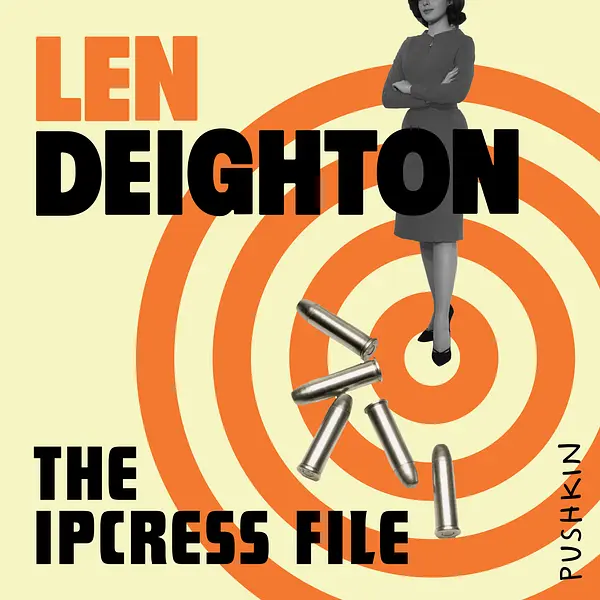
There’s something rather appealing about a spy novel that makes you work for your understanding of what’s going on, rather than handing you a polished hero, a clear mission and a convenient explanation every few chapters. The world of espionage has always been murky, but Len Deighton’s The IPCRESS File takes particular pleasure in making sure you never feel entirely comfortable with what you think you know. Reading it today is an interesting experience, not least because it’s so unmistakably a product of its time, but there’s still plenty here to enjoy if you’re prepared to meet it on its own terms.
The premise is straightforward enough, at least initially. A series of British scientists have disappeared, and our unnamed narrator, a working-class intelligence operative who has recently changed employers, finds himself investigating the latest disappearance. What follows is a journey through competing loyalties, bureaucratic rivalries and intelligence work in which the distinction between friend and enemy is rarely as clear as anyone would like. The trouble is that knowing what the investigation is about doesn’t necessarily mean knowing what’s happening, and Deighton is perfectly happy to let the reader share his protagonist’s confusion.
That uncertainty is one of the novel’s greatest strengths. This isn’t the glamorous world of international espionage populated by impeccably dressed agents who always have the right gadget and a witty remark ready. Instead, intelligence work feels like an uncomfortable mixture of paperwork, petty professional rivalries, dubious information and people who may or may not be telling the truth. The narrator is often left trying to work out who’s manipulating whom, and I found that uncertainty rather refreshing. It’s easy to forget how much modern spy fiction owes to this less glamorous approach, where the machinery of the intelligence services can be every bit as threatening as the people they’re supposed to be pursuing.
The narrator himself is a large part of the appeal. He isn’t given the sort of grand, heroic identity that might make him an obvious candidate for a series of adventures. He’s an intelligent, observant professional who understands that his colleagues have their own interests and that being useful to an organisation doesn’t necessarily mean being valued by it. His working-class background also gives the novel a different flavour from the more socially polished espionage fiction of the period. He notices the assumptions people make about him, and he’s perfectly capable of using those assumptions to his advantage. There’s a satisfying stubbornness to him, particularly when he’s confronted by people who seem to believe that rank and authority ought to settle every argument.
His lack of a name is an interesting touch, too. It gives him a slightly elusive quality, as though he’s defined less by his identity than by the job he’s expected to do. I wouldn’t want to make too much of that, because the novel doesn’t need every detail to carry a symbolic meaning, but it does suit a story in which personal identity, professional allegiance and political loyalty are all rather slippery concepts.
Deighton’s storytelling takes some getting used to. The narrative can feel fragmented, and the movement between incidents and discoveries occasionally leaves you wondering whether you’ve missed something important. There are moments when I would have appreciated a little more clarity, particularly when the various strands of the investigation start to overlap. Yet that same approach helps create the atmosphere. The reader isn’t standing safely outside the intelligence operation, watching everything fall neatly into place. We’re caught up in the same uncertainty as the protagonist, trying to decide which details matter and which are distractions. The resulting sense of unease feels appropriate for a profession built on incomplete information.
The book is also very much of its time, and that deserves to be acknowledged rather than brushed aside. Its Cold War anxieties, attitudes towards authority and assumptions about society belong to a particular historical moment. Some aspects of the characterisation and the way people interact will feel dated to a modern reader, while the treatment of women is especially limited by the conventions of its era. There are also stretches where the narrative’s emphasis on procedure and the accumulation of information makes the pace feel less urgent than the premise might suggest. I found myself occasionally wishing Deighton would move things along rather than linger over another layer of suspicion.
Nevertheless, the period detail is part of what makes the novel worthwhile. The world it depicts has a tangible sense of institutional mistrust, where national security can become an excuse for secrecy and professional loyalty can be demanded without being reciprocated. The book doesn’t need to offer a grand philosophical lecture about these things. They emerge naturally from the way the protagonist is treated and the decisions he has to make. He can’t simply assume that his superiors have his best interests at heart, nor can he afford to ignore them. That tension gives the story much of its bite.
James Lailey’s narration is a real asset to the audiobook. The delivery suits the narrator’s dry, observant manner, capturing the understated quality of a man who is rarely inclined to advertise his feelings. Lailey also handles the novel’s shifting atmosphere well, allowing the suspicion and occasional flashes of dark humour to emerge without making the performance unnecessarily theatrical. In a story where so much depends on what people say, what they leave unsaid and how much confidence we should place in either, that measured approach works particularly well. The characterisation remains clear without sacrificing the slightly detached quality that makes the protagonist interesting.
Ultimately, The IPCRESS File isn’t a flawless thriller, and I can understand why its oblique storytelling and dated elements might frustrate readers approaching it for the first time. It occasionally makes the business of following the plot harder than it needs to be, and not every aspect has aged gracefully. Even so, I enjoyed the experience. Deighton offers a compelling alternative to the fantasy of espionage as a glamorous adventure, replacing it with something messier, more suspicious and often rather more believable. The unnamed operative is an engaging guide through this uncertain world, and the novel’s willingness to leave both him and the reader questioning what they’ve been told is a large part of its appeal. It’s a fascinating piece of Cold War fiction, and while its age is evident, there’s enough intelligence, atmosphere and dry wit here to make it well worth a listen.
Buy your copy here

Leave a Reply