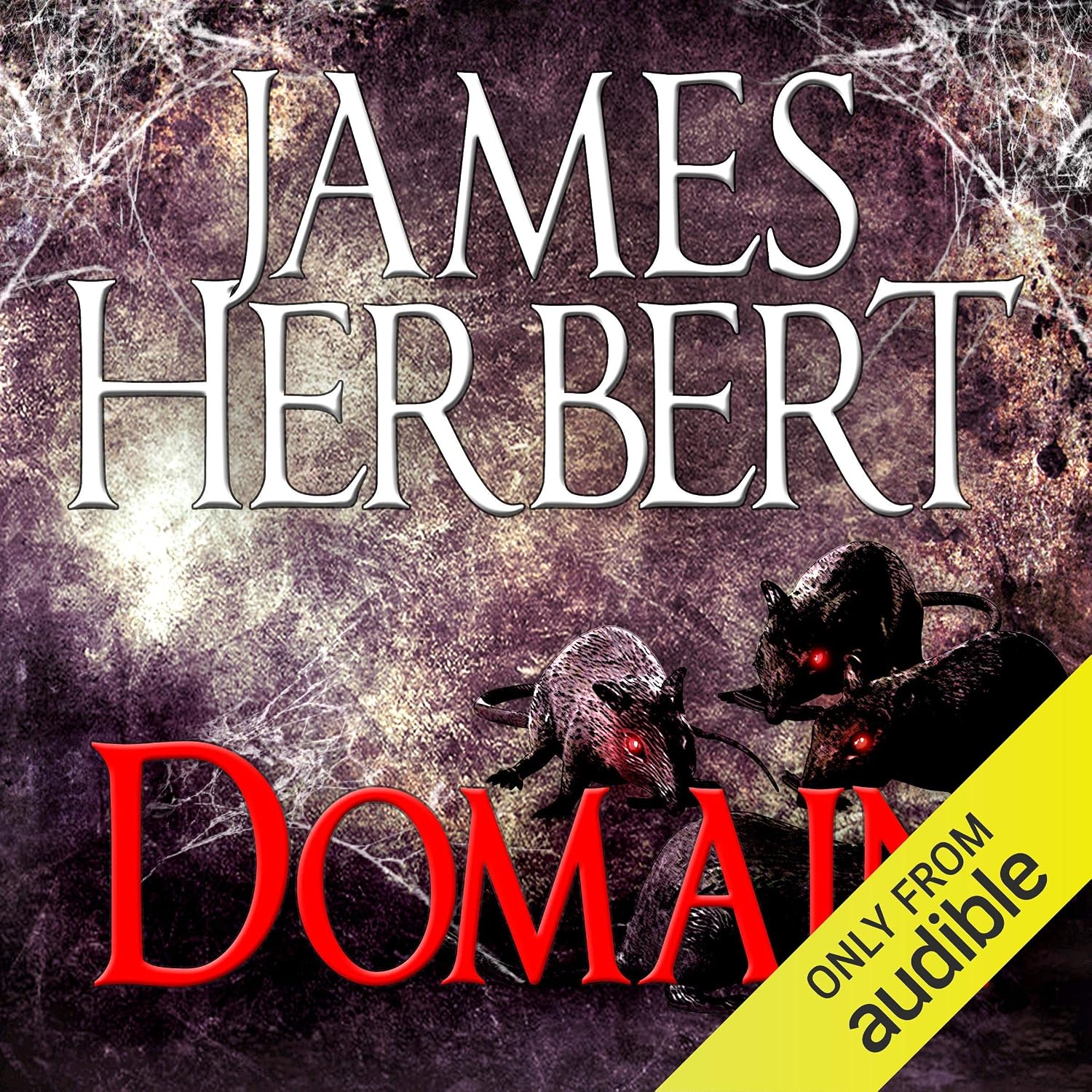
There’s something particularly chilling about the idea that the end of the world might arrive not with a gradual decline, but in a few blinding seconds. In Domain, James Herbert takes the mutant rats from The Rats and Lair and drops them into a London devastated by nuclear war. It’s a much bigger and bleaker story, and the rats are no longer the only thing humanity has to fear. In fact, for much of the novel, the nuclear aftermath is every bit as horrifying as the creatures themselves. I found it a more ambitious book than its predecessors, and a fitting conclusion to the trilogy.
The opening is brutally effective. Herbert takes us through the moments before and after the nuclear strikes from the perspectives of a variety of ordinary Londoners. Some are caught in the streets, others in their homes or workplaces, and most have little chance of understanding what’s happening before their lives are destroyed. I particularly liked this approach because it gives the catastrophe a human scale. Rather than simply telling us that London has been obliterated, Herbert shows us individual lives being interrupted in the most appalling circumstances. These brief glimpses are often more affecting than the larger action that follows, and they establish a sense of helplessness that hangs over the rest of the book.
Among the survivors are Steve Culver, a former helicopter pilot, and Alex Dealey, a government official responsible for inspecting London’s bomb shelters. Culver rescues Dealey during the initial chaos, and the two men make their way towards a supposedly secure underground refuge. Dealey has been blinded by the blast, leaving Culver to guide them through the devastated streets and underground passages. They also encounter Kate Garner, a young woman who has survived an attack by the rats. Their arrival at the bunker offers a brief possibility of safety, but it’s soon clear that surviving the initial nuclear strike is only the beginning of their problems.
I liked Culver as a central character. He’s resourceful, practical and prepared to take responsibility when circumstances demand it, but he’s also understandably suspicious of the people who have arranged to save themselves while leaving everyone else to face the consequences. His relationship with Dealey is particularly entertaining. The two have very different backgrounds and outlooks, and neither seems especially inclined to trust the other. Dealey represents the official machinery of government, while Culver has a much more immediate understanding of what ordinary people are facing. Their uneasy partnership gives the story a useful human tension, especially as the situation becomes increasingly desperate.
The bunker itself provides some of the novel’s most interesting material. It’s staffed by people who have been selected and prepared for the survival of the state, complete with supplies, communications and plans for rebuilding society. Unfortunately, the outside world has rather more pressing concerns than preserving the usual hierarchies. I enjoyed Herbert’s criticism of a system in which the powerful have made elaborate arrangements to protect themselves, while the wider population has effectively been abandoned. The people in charge are still inclined to behave as though they have authority simply because they held it before the bombs fell. Culver’s contempt for this attitude is entirely understandable, and I found the clash between official self-importance and the realities of survival one of the book’s strongest themes.
Of course, the rats haven’t gone away. The nuclear devastation has left humanity weakened and disorientated, while the creatures that have been lurking beneath London are perfectly placed to take advantage. Their attacks are savage, and Herbert makes good use of the underground setting to create a sense of claustrophobia. There is something particularly unpleasant about the thought of being trapped below ground with an enemy that knows every tunnel and passage better than you do. The rats have become the dominant species in their own environment, and the title starts to feel increasingly appropriate as the balance of power shifts.
I also appreciated the way Herbert broadens the threats facing the survivors. Once they’re forced out of the bunker, the ruined city offers little comfort, and the remaining human population isn’t necessarily any more trustworthy than the rats. A gang of violent survivors has emerged, exploiting the chaos and preying on anyone unfortunate enough to cross their path. It’s a grim reminder that catastrophe doesn’t automatically bring out the best in people. Some will cooperate, some will struggle to preserve a sense of decency, and others will simply take advantage of the absence of rules. Herbert’s picture of human behaviour is bleak, but it feels consistent with the world he’s created.
There are a few weaknesses. The relationship between Culver and Kate is rather predictable, and some of the supporting characters don’t get enough development to make their fates as affecting as Herbert clearly intends. The extended episodes involving the flooded bunker and repeated rat attacks can also become a little repetitive, with the middle section occasionally losing momentum. I would have welcomed a tighter edit in places. Nevertheless, the short vignettes showing the fate of people elsewhere in London are excellent. Some are horrifying, others unexpectedly darkly comic, and together they make the devastated city feel like a much larger and more tragic place than the small group of survivors could possibly represent.
What stayed with me most was the sheer bleakness of the setting. Herbert isn’t simply using nuclear war as an excuse to create a more spectacular playground for his monsters. He shows the physical destruction, the lingering effects of radiation and the collapse of the ordinary routines that make civilisation feel secure. The rats are an added horror, but humanity has already done an extraordinary amount of damage to itself before they even emerge. There’s a particularly uncomfortable irony in the idea that the creatures once regarded as vermin are now better equipped to survive the world we’ve created.
I came away from Domain feeling that Herbert had given the Rats trilogy a suitably ambitious and satisfying conclusion. It isn’t quite as consistently paced as The Rats, and some of the character relationships are more conventional than compelling, but the opening is gripping, the post-nuclear London is wonderfully realised and the social commentary gives the story more substance than a straightforward creature feature. The rats remain gloriously horrible, but it’s the wider picture of human desperation, selfishness and survival that gives the novel its lasting impact. It’s a grim, unsettling read, and a fitting reminder that sometimes the monsters are only waiting for us to finish destroying ourselves.
Buy your copy here

Leave a Reply