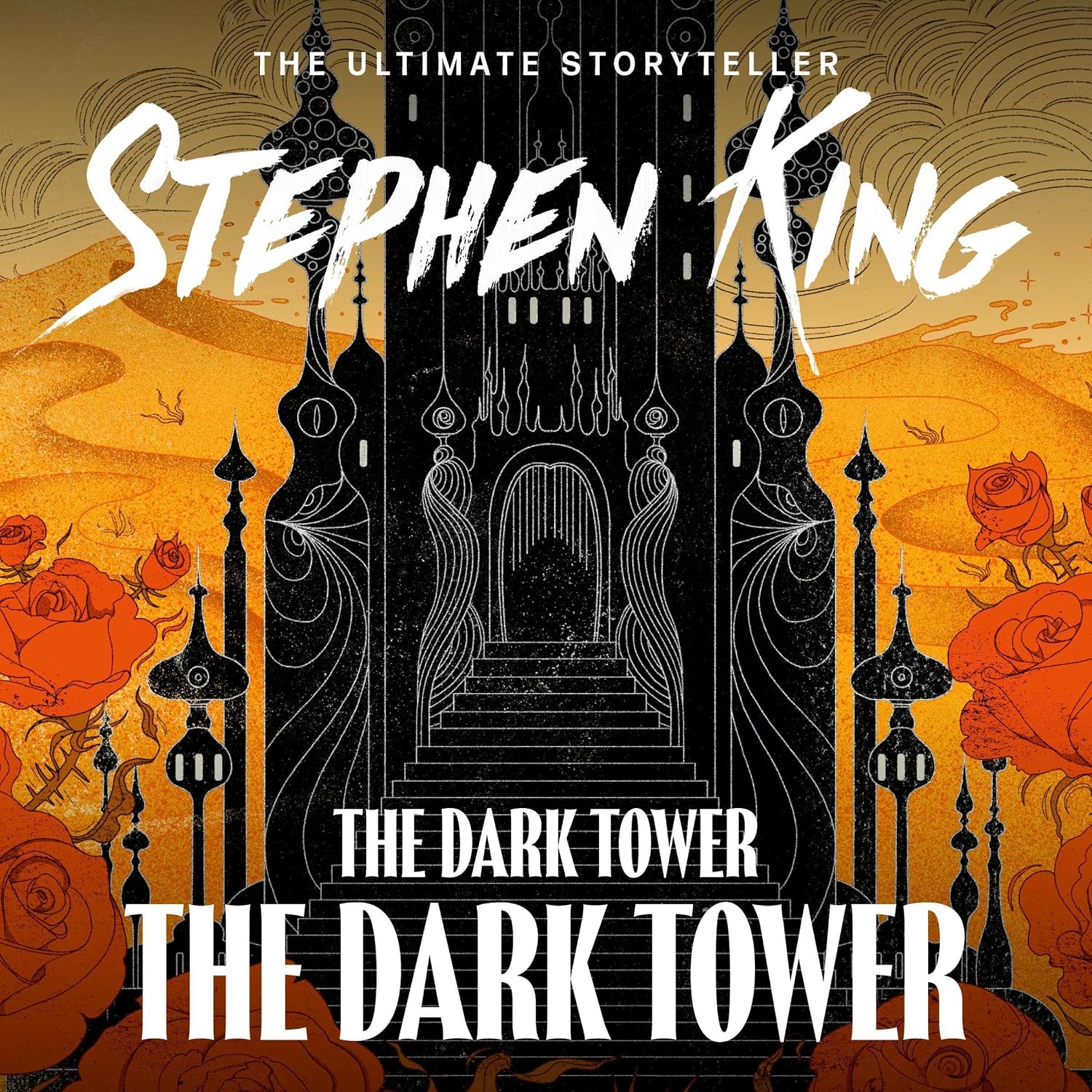
The funny thing about finally reaching The Dark Tower is that I had spent six books wondering what was actually waiting at the end of the road, and now that I have arrived, I am not entirely sure I wanted the answer. That feels strangely appropriate for a series built around obsession, destiny and the idea that the journey might matter more than the destination.
After everything Roland and his ka-tet have been through, there is a real sense of history hanging over this final book. I have followed these characters through dying worlds, alternate realities, ancient magic, talking machines, vampires, werewolves, pop culture references and some increasingly bizarre twists in the mythology. By this point, I was far too invested to approach the ending objectively. I wanted Roland to reach the Tower. I also wanted to know whether reaching it would actually give him what he had spent his entire life chasing.
That tension is really what makes The Dark Tower work for me.
Roland’s obsession has always been at the heart of the series, but here King really pushes the question of how much one person should be willing to sacrifice for a goal. Roland has spent years pursuing the Tower, and almost everything else has become secondary. Friendships, love, loyalty and even the lives of those around him can become expendable if they stand between him and his destination.
There is something both admirable and deeply disturbing about that.
We often talk about determination as though it is automatically a virtue. Roland certainly possesses more determination than almost anyone I have encountered in fiction. He simply refuses to stop. But King keeps asking where determination becomes obsession, and where obsession becomes destructive. At what point does pursuing your purpose become an excuse for hurting everyone around you?
That question gives the final stages of the journey a surprisingly bleak quality. Roland’s willingness to sacrifice everything is not presented as some heroic superpower. There is a cost, and King makes sure we understand that the people around Roland are paying it too.
The social commentary works particularly well because it can be read beyond the fantasy. The Tower can represent ambition, power, legacy or the one impossible thing someone convinces themselves they absolutely must have. We see versions of Roland’s behaviour everywhere. People become so focused on winning, achieving or proving something that the consequences to everyone else become little more than collateral damage.
And yet I still found myself rooting for him.
That is probably one of King’s greatest achievements with the character. Roland can be selfish, ruthless and frustrating, but he is also fascinating. I wanted him to succeed even while the story was making me question whether he deserved to. That contradiction has been sitting at the centre of the series for a long time, and The Dark Tower finally forces it into the open.
There is plenty here for long-term readers to enjoy as well. King brings together so many of the ideas and characters that have appeared throughout the series that the novel often feels like a giant piece of literary machinery finally clicking into place. Some of those connections work better than others, and I suspect readers will have very different reactions to just how far King takes the meta elements.
Personally, I enjoyed most of it.
There are still a few things that did not completely work for me. The sheer amount of mythology and explanation occasionally slows the momentum, and some of the emotional beats are so deliberately heightened that they come close to tipping over into melodrama. After such a long journey, though, I was willing to forgive quite a lot. I had invested too much time in Roland and the ka-tet to start being particularly precious about it now.
I listened to the Audible audiobook narrated by George Guidall, and his performance felt like a fitting way to close the journey. There is a real sense of familiarity in his voice by this stage, but he still gives the characters enough distinction to keep the enormous cast manageable. More importantly, he captures the weight of the story. This feels like the culmination of something substantial, and Guidall gives the narration an appropriately measured quality when the story needs it.
Ultimately, The Dark Tower left me with mixed feelings in exactly the way I think it should. I enjoyed the journey enormously, but I also came away thinking about what Roland has lost along the way and whether the prize was ever worth the cost.
The Tower has always been Roland’s destination. It has been the thing he believes will give meaning to everything else.
But perhaps that is the point.
If you sacrifice everyone and everything to reach your ultimate goal, eventually you have to ask yourself what exactly is left when you finally get there.
And after all these books, I am still not entirely sure Roland ever understood the question.
Buy your copy here

Leave a Reply