“His words were full of hope and threat.
Like the stars.”James SA Corey – Caliban’s War
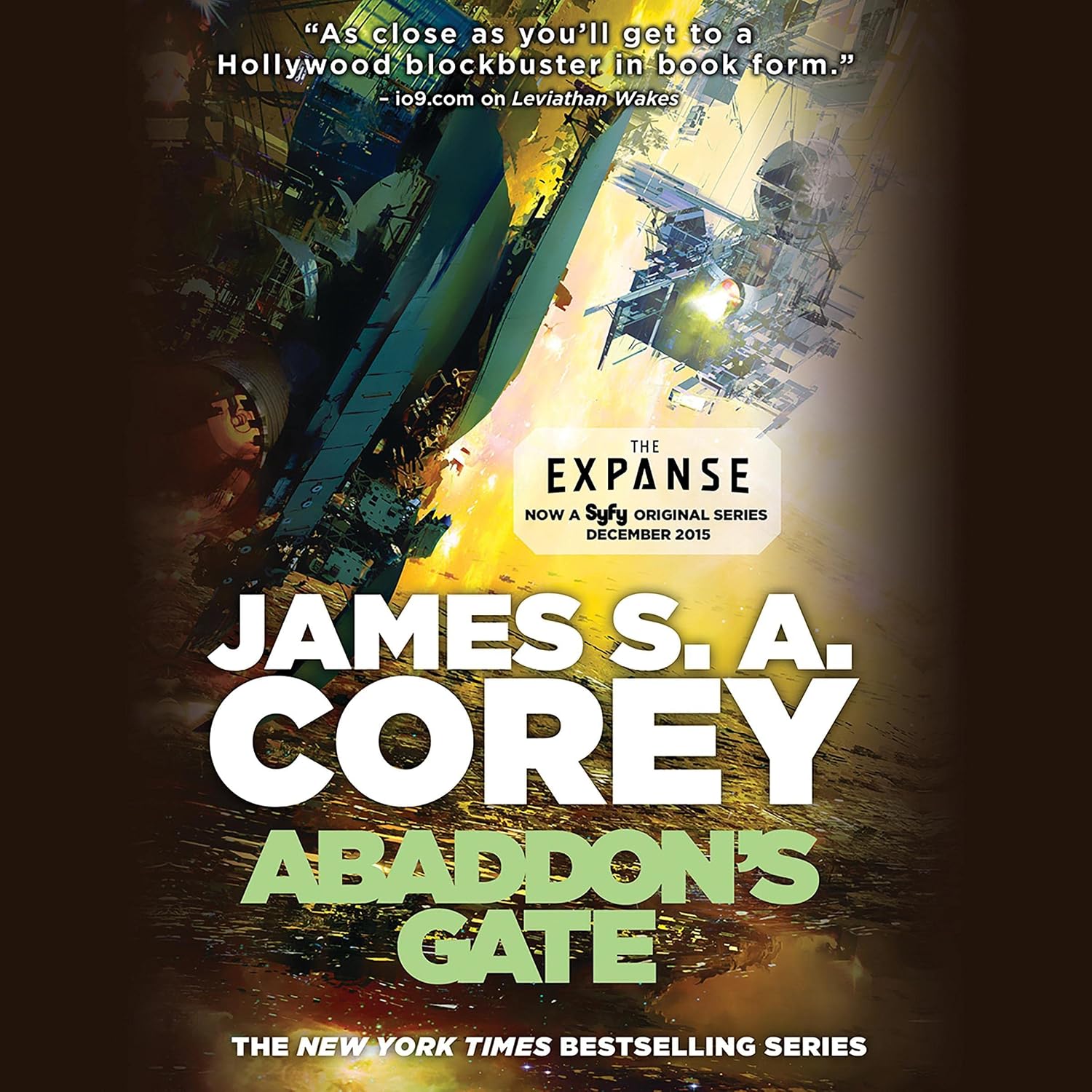
By the time I got to Abaddon’s Gate, I had already become rather invested in The Expanse. Leviathan Wakes introduced me to this grubby, believable version of the future, while Caliban’s War expanded the politics, the cast and the sheer scale of what James S. A. Corey was attempting. Abaddon’s Gate takes another enormous step forward and, rather wonderfully, makes the previous two books feel like preparation for what is coming next.
The Ring has appeared beyond Uranus, and humanity is faced with the rather awkward problem of discovering what it actually is and where it leads. Naturally, the response is not to pause, think carefully and agree on a sensible plan. Instead, we send a huge collection of military and scientific ships through it while various factions plot, scheme and attempt to gain control of whatever lies on the other side.
Honestly, I wouldn’t have it any other way.
What struck me most about Abaddon’s Gate is that Corey has taken the idea of first contact and approached it from a very human perspective. The alien technology itself is almost impossible to comprehend, but the human response to it is entirely familiar. There is wonder, fear, curiosity and excitement, but there is also an almost immediate desire to control it.
That theme of power runs right through the novel. The Ring represents an opportunity that could completely transform human civilisation, but whoever controls access to it potentially gains an extraordinary advantage. Earth, Mars, the Belt and the various factions within humanity have spent generations competing over relatively limited resources. Suddenly, there may be an entire network of other worlds waiting on the other side.
Of course everyone wants a piece of it.
I particularly enjoyed the way this turns exploration into another form of political struggle. Humanity has finally reached something genuinely extraordinary, something that should probably make every person on Earth stop and reconsider what it means to be human, and our first instinct is still to plant a flag on it.
There is a lovely bit of social commentary buried in that. Corey seems to be asking whether humanity is actually capable of encountering something bigger than itself without immediately trying to exploit it. We have carried our old arguments into space, and now we are preparing to carry them through the Ring as well.
The book also has a lot to say about authority and the abuse of power. There are people who genuinely believe they are acting for the greater good, people who want revenge, people who want control and people who are simply terrified. The interesting thing is that these motivations can look remarkably similar from the outside. Someone convinced that they are saving humanity can become just as dangerous as someone openly trying to destroy it.
And then there is the question of redemption.
This is probably the most personal aspect of the novel for me. Abaddon’s Gate is full of damaged people carrying their pasts around with them. Characters are forced to confront what they have done, what they have become and whether they can actually change. The story repeatedly asks whether somebody who has done terrible things is permanently defined by those actions, or whether there is room for forgiveness and redemption.
That gives the novel an unexpectedly human heart beneath all the spaceships, explosions and alien mysteries.
Anna Volovodov is particularly important to this. Her religious perspective could easily have become preachy, but I found her questions about morality, forgiveness and responsibility surprisingly effective. She is surrounded by people making increasingly desperate decisions, and her attempts to understand what constitutes right and wrong give the story a different perspective from the usual military and political viewpoints.
Then we have Clarissa Mao, who brings another fascinating dimension to the idea of revenge. Her obsession with Holden is deeply personal, but it is also wrapped up in the wider consequences of wealth, privilege and family power. Once again Corey demonstrates that the grand political conflicts of The Expanse ultimately come down to individual people making very human choices.
I also appreciated how much Abaddon’s Gate plays with the idea of fear of the unknown. The Ring is genuinely terrifying because nobody understands it. Humanity has discovered something that was built by a civilisation vastly older and more advanced than anything we have encountered, and the evidence suggests that whoever built it is no longer around.
That last detail is particularly chilling.
The possibility that an advanced civilisation could have built this extraordinary network and then simply disappeared forces the characters to confront the limits of human understanding. We are used to thinking of ourselves as the clever ones in the room. Here, we are very obviously not.
The pacing is probably the one area where I occasionally felt the strain. There are sections where the story slows down considerably, particularly as the various characters become trapped in an increasingly desperate situation. I did not always find every perspective equally compelling, either. But even when the pace dipped, I was still interested in where Corey was taking the story, and the eventual payoff more than justified the slower passages.
Jefferson Mays once again makes the audiobook a pleasure to spend time with. His performance has developed into something I now associate strongly with The Expanse. He handles the growing cast with impressive clarity, giving each character their own presence without resorting to distracting caricature. More importantly, he understands the emotional weight of the quieter scenes. His delivery can be tense, thoughtful, funny or genuinely unsettling when required, and the consistency of his work over such a substantial audiobook is remarkable.
What I loved most about Abaddon’s Gate is the sense that the universe has suddenly become enormous.
The first two books showed humanity fighting over its own corner of space. Now the door has opened onto something vastly bigger, and I have absolutely no idea what is waiting on the other side.
That, for me, is exactly where great science fiction should leave you.
Curious, slightly nervous and desperate to find out what happens next.
After three books, I am not merely along for the ride anymore. I am properly invested in this bloody universe.
Buy your copy here

Leave a Reply