“…If life transcends death
Then I will seek for you there
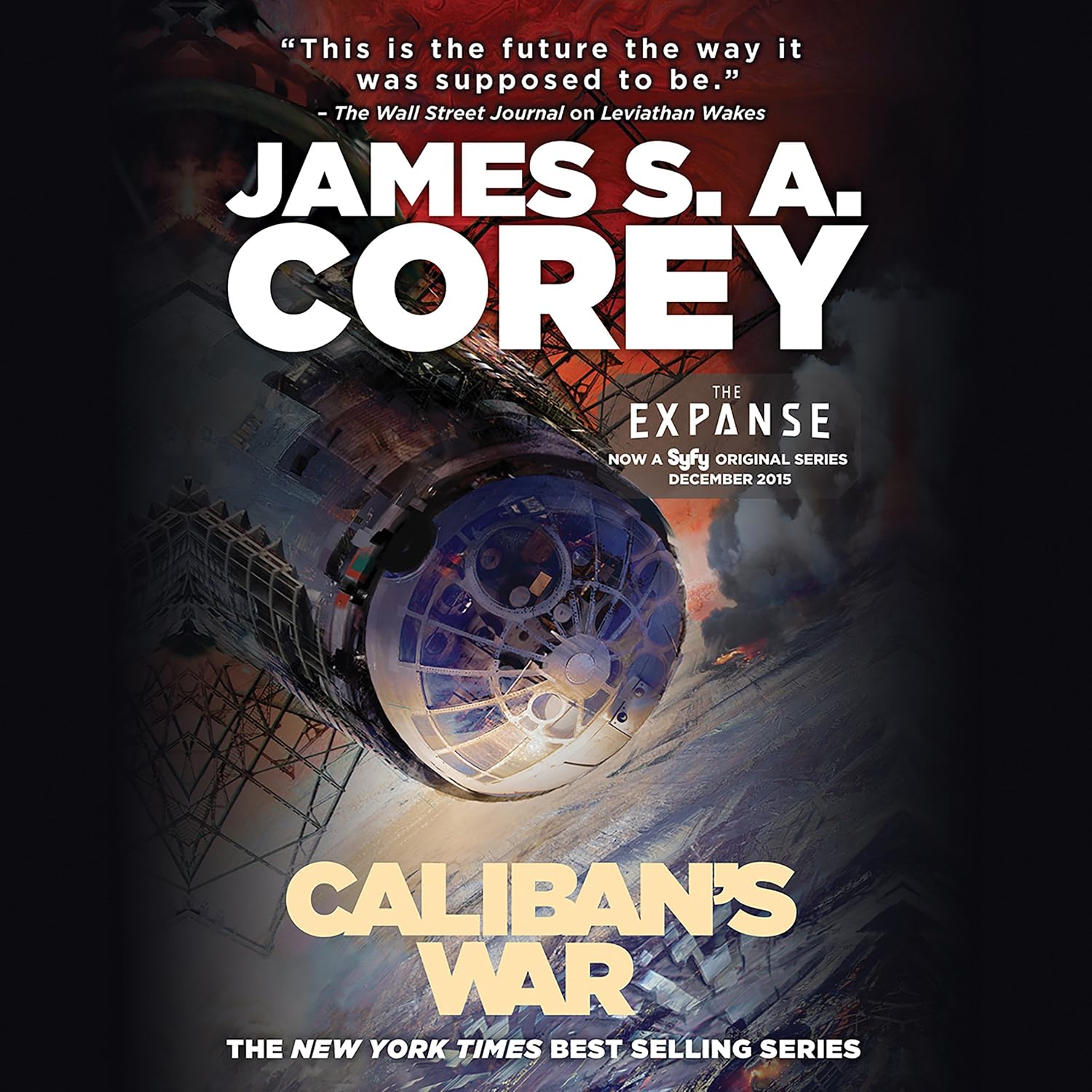
If not, then there too.”James SA Corey – Caliban’s War
Leviathan Wakes was my introduction to The Expanse and it left me thinking that James S. A. Corey had built something rather special then, Caliban’s War has gone a long way towards confirming that feeling. This is a bigger, broader and considerably more politically complicated book than its predecessor, but somehow it still retains that wonderfully scruffy, human quality that made the first novel so enjoyable.
What I particularly liked is that Corey does not simply try to make everything bigger for the sake of it. The solar system is still dealing with the consequences of the protomolecule, Earth and Mars are struggling to avoid another war, the Belt is trying to work out exactly where it stands, and everyone seems to have their own idea about what should happen next. It is a wonderfully unstable situation, and into the middle of it Corey drops a new monster, a missing child and enough political skulduggery to keep everyone very busy indeed.
For me, the strongest aspect of Caliban’s War is its exploration of power. Leviathan Wakes established the divisions between Earth, Mars and the Belt, but this book digs much deeper into what those divisions actually mean. Earth and Mars are not simply opposing sides in a political argument. They have different interests, different cultures and very different ideas about security and survival. Meanwhile, people in the Belt and outer planets remain caught somewhere in the middle.
What makes it particularly interesting is how easily fear can be turned into political capital. One horrifying event is enough to threaten an already fragile peace, and suddenly people who have every reason to distrust one another are being encouraged to see an enemy everywhere. It is not difficult to see the parallels with the way governments and institutions can use fear, particularly during periods of uncertainty, to justify military expansion or increasingly aggressive policies.
The book is also surprisingly interested in the human cost of all this grand strategy. Wars are discussed in terms of fleets, territories and political advantage, but Corey repeatedly brings things back to individuals. Bobbie Draper experiences the consequences of military conflict at ground level, while Prax is simply trying to find his daughter in the middle of an unfolding disaster. The fact that his motivation is so intensely personal gives the enormous events surrounding him a very human focus.
That family element really worked for me. Prax is not some great warrior or political mastermind. He is a scientist and a father who wants his child back. His story provides a useful counterpoint to all the people discussing the future of humanity in conference rooms. For Prax, the future of humanity is rather less abstract. It is one frightened little girl.
And then there is science.
One of the things I enjoy about The Expanse is that Corey seems fascinated by the difference between scientific discovery and what human beings inevitably want to do with that discovery. The protomolecule is an extraordinary piece of alien technology, something that fundamentally challenges our understanding of what is possible. Yet almost immediately humans begin trying to turn it into a weapon.
There is something horribly believable about that.
Caliban’s War repeatedly asks where the line sits between scientific curiosity, military necessity and outright exploitation. The people pursuing the protomolecule are not all motivated by exactly the same thing, but there is a recurring assumption that if something powerful exists, somebody needs to control it. Corey seems considerably more interested in asking whether we should be trying to control it at all.
I also really enjoyed the expanded cast. Bobbie is a fantastic addition, partly because she gives us such a different perspective on the Martian military. She is tough, disciplined and initially very much a product of the system she serves, but her experiences force her to question some of the assumptions she has taken for granted.
Avasarala, meanwhile, is tremendous fun. She brings a completely different sort of firepower to the story. Her weapons are political influence, manipulation and an ability to understand what people are likely to do before they realise it themselves. I loved the contrast between her approach and Holden’s more direct, occasionally spectacularly unsubtle way of dealing with problems.
Holden himself remains Holden. I still find him incredibly likeable, but I also occasionally want to grab him by the shoulders and tell him to stop making everything about himself. His determination to do what he thinks is right is admirable, but Caliban’s War makes it increasingly clear that being morally certain does not necessarily mean being politically sensible.
That tension between heroic action and careful strategy is one of the novel’s more interesting ideas. Sometimes you need someone willing to act immediately. Sometimes you need someone sitting several moves away from the battlefield, manipulating events to prevent something much worse. Neither approach is sufficient by itself. The characters ultimately have to learn that cooperation matters more than individual heroics.
And Jefferson Mays continues to be an excellent companion for this series. Rather than simply repeating the approach from Leviathan Wakes, his performance here feels even more confident as the cast expands. He gives each character enough individuality that I could settle into a chapter very quickly, while maintaining the conversational, natural quality that makes the audiobook so easy to listen to. His handling of the quieter emotional moments is particularly good, allowing the characters to feel like people rather than voices delivering dialogue. The sheer consistency of the performance across such a long audiobook is impressive.
If I have a criticism, it is mostly that the increased number of perspectives means the story occasionally takes a little while to get moving again when it switches away from a character I am particularly invested in. There are also moments when the political manoeuvring becomes quite dense. Neither issue bothered me for long, though, because the various strands eventually come together in a way that makes the slower sections worthwhile.
What I came away with most strongly is just how much larger The Expanse suddenly feels. Leviathan Wakes introduced me to the solar system. Caliban’s War shows me what happens when that solar system starts to realise just how much bigger the universe might actually be.
It is exciting, political, surprisingly thoughtful and, underneath all the spaceships and alien monsters, remarkably human.
After two books, I am very much along for the ride.
Buy your copy here

Leave a Reply