“…The female mind is certainly a devious one, my lord.”
Vetinari looked at his secretary in surprise. “Well, of course it is. It has to deal with the male one.”Terry Pratchett – Unseen Academicals
There are certain things you expect to find when you open a Discworld novel. Wizards, certainly. Death, obviously. Someone behaving in a manner that would have a perfectly reasonable person reaching for the emergency exit. What I was perhaps less prepared for was Terry Pratchett turning his attention to football.
Or, to give it its Discworld name, foot-the-ball.
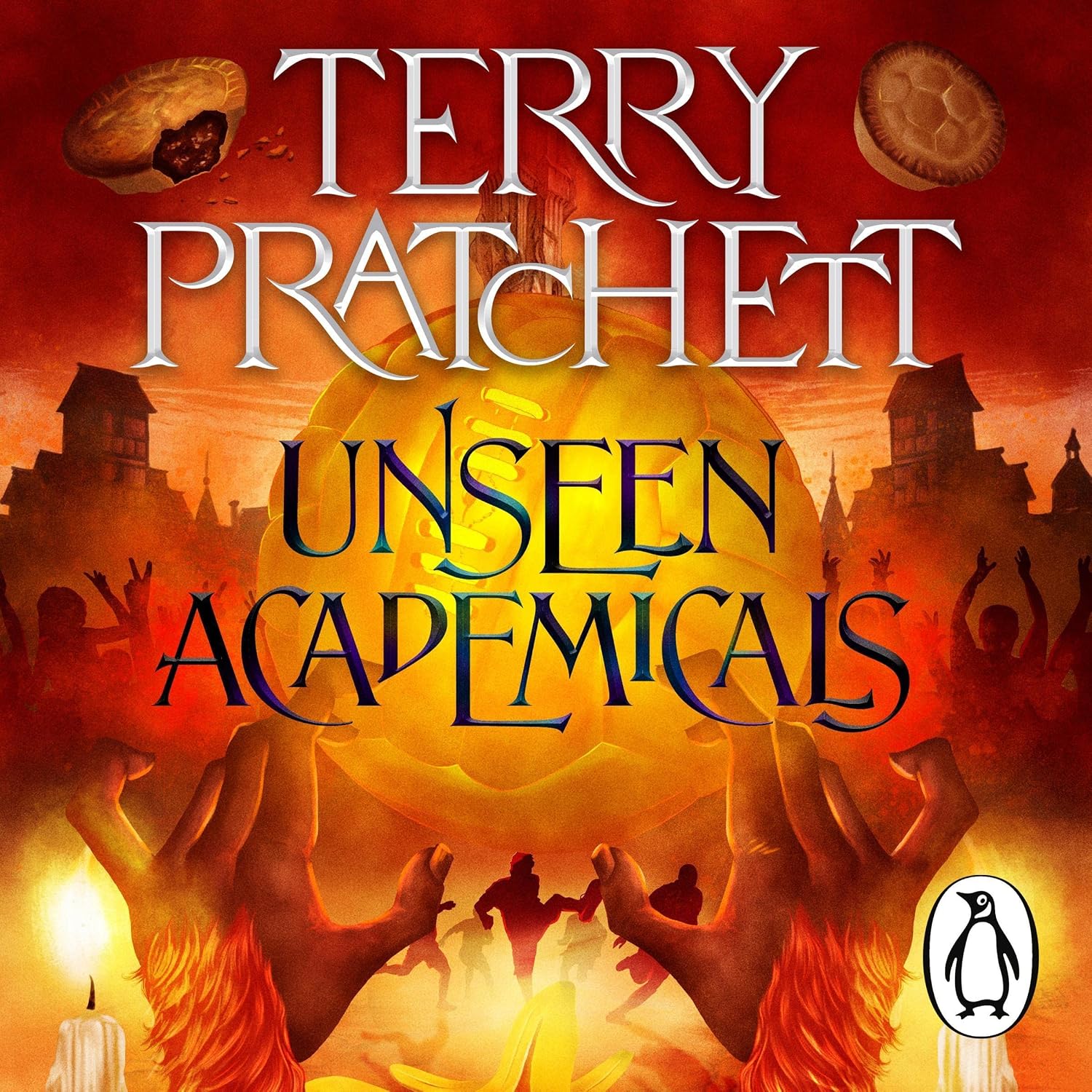
Unseen Academicals takes the famously dysfunctional faculty of Unseen University and drops them into the world of competitive sport. The university has to field a football team, which is roughly equivalent to asking a group of academics to organise a military campaign and then giving them a ball. Predictably, things become considerably more complicated than anyone anticipated.
What I particularly enjoyed about this book is that the football is really only the framework for a much broader story about people, class and belonging.
The novel spends a lot of time looking at the divide between the wealthy and the working class, particularly through the very different worlds inhabited by the wizards and the people who actually live and work around the university. Football becomes the great social leveller, at least in theory. Once everyone is standing around a pitch, wealth and academic status become rather less useful than being able to kick a ball in roughly the right direction.
There is plenty of satire in that idea, especially when the university’s privileged inhabitants start discovering that there are things they simply do not understand about ordinary life.
I found that aspect particularly enjoyable because the story does not simply present one side as good and the other as bad. It is much more interested in how people make assumptions about each other. Class, tradition, masculinity, celebrity and the strange tribal loyalties that grow up around sport all come under scrutiny.
And then there is the question of change.
The wizards are deeply attached to tradition, naturally, because when you have been doing something for hundreds of years it becomes rather difficult to admit that somebody else might have a better idea. The football team becomes a catalyst for change, forcing people who would normally never interact to actually meet one another.
That is where I think the book works particularly well. Beneath all the jokes, it is about people discovering that the boundaries they thought were fixed are actually rather more flexible than they imagined.
There is also a lovely thread running through the story about identity. Several characters are trying to work out who they are supposed to be versus who they actually want to become. Some are constrained by family expectations, some by class and some by the roles society has handed them.
Of course, this being Discworld, nobody is allowed to have these revelations without considerable amounts of chaos getting in the way.
I particularly enjoyed the football itself. I am not remotely the sort of person who can discuss formations without eventually sounding like I have accidentally wandered into somebody else’s conversation, but the book manages to make the sport entertaining even if you are not particularly invested in it.
There is something wonderfully British about using football as a way to examine society. It is simultaneously trivial and enormously important, capable of generating intense loyalty, ridiculous arguments and the occasional sense that civilisation itself has come to an end because somebody misplaced a ball.
Colin Morgan’s narration suits this story beautifully. His performance has a warmth and flexibility that works particularly well with the mixture of characters. There is a real sense that he understands the rhythm of the comedy by now, but he never makes the jokes feel overplayed.
What I especially noticed here was how well he handles the contrast between the university scenes and the much more grounded characters outside it. The wizards have their own rhythm and sense of importance, while the footballers and working-class characters bring a very different energy. Morgan gives both sides enough personality that the social differences become part of the performance rather than simply something described in the text.
And then Peter Serafinowicz arrives as Death and somehow manages to make even a conversation about football feel faintly momentous. His performance has that wonderful sense of absolute certainty. Death never sounds like he needs to prove anything, which makes his appearances all the more amusing.
Bill Nighy’s footnotes are a different pleasure altogether. His delivery feels almost conspiratorial, as though he has been handed the commentary box and is quietly enjoying the opportunity to point out what everyone else has missed. That trademark nonchalance is still there, but here it feels particularly well suited to the book’s observational humour. The footnotes become their own little stream of dry amusement running alongside the main story, and I found myself actively looking forward to them.
Listening to Unseen Academicals, I found myself enjoying just how much the book manages to juggle. It is a football story, a university comedy, a romance, a social satire and a story about people finding their place in a world that is changing around them.
Not every element gets equal attention, but that did not bother me. There is enough warmth in the characters and enough humour in the situations to keep the whole thing moving.
For me, the real success is that football never feels like an excuse to write a book about football. It is the mechanism that brings people together who would otherwise remain separated by class, wealth and tradition.
And, naturally, it also gives a collection of wizards an excuse to argue about a ball.
Honestly, given the choice between that and another committee meeting, I know which one I would pick.
Buy your copy here

Leave a Reply