“Mission motto, sir,” said Carrot cheerfully. “Morituri Nolumus Mori. Rincewind suggested it.”
“I imagine he did,” said Lord Vetinari, observing the wizard coldly. “And would you care to give us a colloquial translation, Mr Rincewind?”
“Er…” Rincewind hesitated, but there really was no escape. “Er… roughly speaking, it means, ‘We who are about to die don’t want to’, sir.”Terry Pratchett – The Last Hero
There is something rather wonderfully awkward about calling a book The Last Hero when its central character is an elderly barbarian who has spent a lifetime being very good at hitting things with a sword. Eventually, even the most enthusiastic adventurer has to confront the fact that knees have opinions, eyesight becomes negotiable and getting out of a chair can become an adventure in itself.
That is where The Last Hero finds Cohen the Barbarian.
Cohen has reached the stage of life where he has done pretty much everything a traditional fantasy hero is expected to do. He has fought monsters, stolen treasure, rescued people and generally made a career out of solving problems with a combination of violence and confidence. Now he and the Silver Horde have decided that there is one final adventure left.
Naturally, they intend to go out with a bang.
I found myself enjoying this one almost immediately. There is something particularly satisfying about seeing the Silver Horde given centre stage, especially because they are so gloriously unsuited to the idea of a dignified retirement. They are old, battered and increasingly aware that their bodies are not quite keeping pace with their memories, but they still have the enthusiasm of men who have just been told there is something worth hitting.
The trouble is that Cohen and his companions are not particularly interested in quietly accepting that their heroic days are coming to an end. They have spent their lives being celebrated as heroes, and the idea that the world might now have moved on without them is considerably harder to swallow than any dragon they have previously encountered.
That is where I found the social commentary in The Last Hero particularly effective.
There is a genuine sadness beneath the comedy. The book looks at what happens when people who have spent their entire lives being useful suddenly find themselves regarded as obsolete. It is an idea that goes well beyond fantasy heroes. What happens when the skills that once defined you are no longer valued? What happens when younger people arrive with different ideas and you discover that the world no longer automatically makes room for you?
I found myself thinking about that quite a lot while listening. It is surprisingly easy to recognise the feeling of being left behind, even if most of us have never attempted to storm a castle or steal a dragon’s treasure. The fear of becoming unnecessary is a very human one, and the book manages to explore it without becoming gloomy.
Cohen is not entirely wrong to feel aggrieved, either.
He has earned his reputation. He has survived things that would have killed most people several times over. Yet the world has changed, and the heroic model he represents is beginning to look rather old-fashioned. There is something quite poignant about that, even when the characters involved are discussing their retirement plans while carrying swords.
The Silver Horde themselves are a wonderful collection of ageing adventurers. I found their scenes some of the most entertaining parts of the story because there is such a good mixture of camaraderie, stubbornness and sheer bloody-mindedness between them. They know they are getting older. They simply refuse to let that become someone else’s decision about what they are capable of doing.
The book does not simply laugh at them, though. It gives them dignity as well as ridiculousness. That balance is important, because The Last Hero is ultimately less interested in saying that old heroes are useless than in asking who gets to decide what usefulness looks like in the first place.
And then there is the artwork.
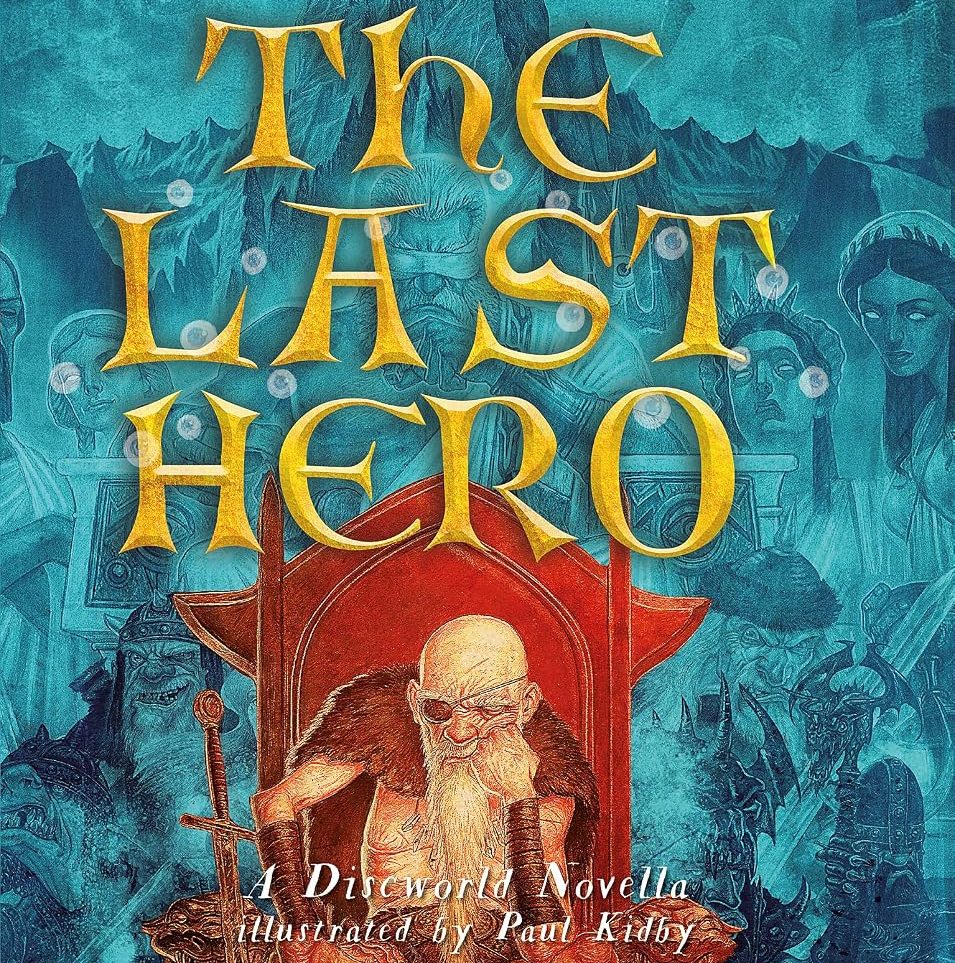
Paul Kidby’s beautiful illustrations are a huge part of what makes The Last Hero such a distinctive Discworld experience. This is a book where the visual element is not simply decoration around the text. Kidby’s artwork gives the characters, creatures, machinery and increasingly ridiculous situations a real sense of scale and personality.
I particularly enjoyed being able to see the Silver Horde properly represented. There is something wonderfully comic about a group of elderly barbarians preparing for one final glorious expedition, and Kidby’s illustrations capture both their ridiculousness and their dignity. I found myself going back to some of the illustrations after listening to particular scenes because they added another layer to what I had just heard.
The humour remains one of the biggest pleasures, of course. I had several moments where I found myself actually laughing rather than simply smiling at a clever observation. There is something particularly enjoyable about listening to Discworld because you can be doing something completely mundane and suddenly find yourself stopping for a second because a line has caught you completely off guard.
Rincewind’s involvement is also very welcome. He is almost uniquely qualified to demonstrate the difference between being a hero and desperately trying not to become one. His presence gives the story another perspective on heroism, particularly when placed alongside Cohen’s determination to make his final adventure count.
I also found the audiobook surprisingly easy to sink into. The combination of the larger-than-life characters, the ridiculous situations and the visual quality of Kidby’s illustrations gives it a real sense of occasion. It feels less like a straightforward adventure and more like a celebration of a particular corner of Discworld.
What stayed with me most, though, was its warmth.
For all the jokes about ageing, incompetence and the questionable wisdom of allowing elderly barbarians access to experimental machinery, there is a real affection for these characters. The story understands that becoming older does not automatically make someone irrelevant. Experience still matters. Memories still matter. People still matter, even when the world has stopped applauding quite so loudly.
That gave me considerably more to think about than I expected from a book about a bunch of ageing barbarians attempting one last heroic escapade.
The Last Hero is funny, beautifully illustrated and gloriously ridiculous, but it is also a thoughtful story about ageing, identity and the fear of becoming unnecessary. I thoroughly enjoyed listening to it, and I suspect I appreciated the quieter observations even more because they arrived wrapped in so much wonderfully silly adventure.
Sometimes the last adventure is not about proving you are still a hero.
Sometimes it is about working out what being one actually meant.
Buy your copy here

Leave a Reply