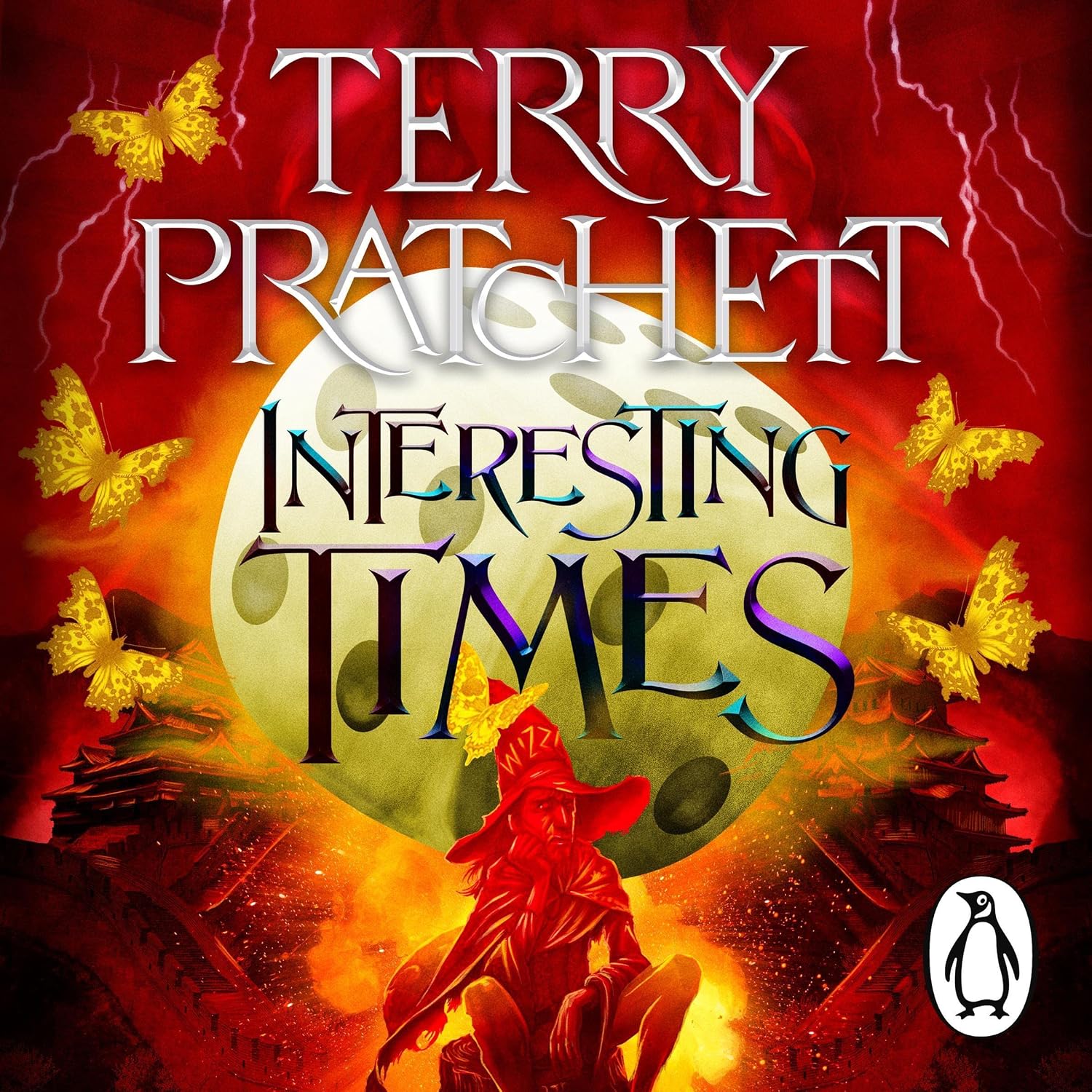
“Whatever happens, they say afterwards, it must have been fate.
People are always a little confused about this, as they are in the case of miracles. When someone is saved from certain death by a strange concatenation of circumstances, they say that’s a miracle. But of course if someone is killed by a freak chain of events — the oil spilled just there, the safety fence broken just there — that must also be a miracle. Just because it’s not nice doesn’t mean it’s not miraculous.”Terry Pratchett – Interesting Times
There is something deeply appropriate about Rincewind being sent to a country in the middle of a revolution. If there is one person you would not want anywhere near a political uprising, it is the man whose usual response to danger is to run in the opposite direction and hope nobody notices.
Unfortunately for Rincewind, Interesting Times has other ideas.
This is another Rincewind adventure, but by this point the character feels considerably more established than he did in the early Discworld books. He is still cowardly, reluctant and astonishingly good at surviving situations he has absolutely no business surviving, but there is a little more depth to him now. Perhaps repeated exposure to catastrophe has worn him down. Or perhaps he has simply become very good at recognising catastrophe when it is heading towards him.
The plot sends him to the Agatean Empire, where revolution is brewing, a prophecy needs fulfilling and various factions are discovering that overthrowing a government is considerably easier when someone else is doing the dangerous bits.
Naturally, Rincewind gets involved.
What I particularly enjoyed about Interesting Times is the way it takes the familiar ingredients of political revolution and turns them into a rather uncomfortable comedy about power. There are rebels, emperors, aristocrats, revolutionaries and ordinary people, all of whom have slightly different ideas about what should happen next.
The interesting thing is that none of them are quite as straightforward as the labels suggest.
The novel has plenty to say about class, privilege and the mythology surrounding political change. There is a recurring tension between those who want to control society and those who want to change it, with the rather depressing suggestion that replacing the people at the top does not necessarily alter the behaviour of the people who end up there.
That feels uncomfortably relevant.
There is also a great deal of fun to be had with political ideology itself. Grand principles are easy to proclaim when someone else is responsible for putting them into practice. Once actual people, resources and competing interests become involved, things become considerably messier. Revolution, it turns out, is not especially tidy.
Who knew?
The book also has plenty to say about history and the stories societies tell themselves. Heroes are created, legends are manufactured and people are remarkably willing to believe whatever version of events best suits the moment. It is one of those Discworld ideas that starts as a joke and gradually becomes something rather more pointed.
And then there are the wizards.
The appearance of the Unseen University crowd adds another layer of comedy, particularly because their idea of helping with a revolution seems to involve approximately the same level of planning you would expect from a group of people trying to organise a picnic during a hurricane.
Colin Morgan is particularly good with this audiobook. By this stage, his narration feels completely settled into the world, and I found myself enjoying the performance almost as much as the story itself. There is an easy rhythm to the narration that makes the large cast and frequent changes of location surprisingly effortless to follow.
What works especially well for me is his handling of Rincewind. There is a wonderfully weary quality to his voice when Rincewind realises that things have once again gone horribly wrong. It never becomes overplayed. Instead, there is a sense that Rincewind has reached the stage where he is no longer surprised by disaster, merely disappointed that it has found him again.
Morgan also handles the broader comedy beautifully. There are moments where the story becomes gloriously ridiculous, but the narration never treats the characters as though they are part of a joke. Everyone behaves as if their circumstances are perfectly serious, which makes the absurdity considerably funnier.
The audiobook also benefits enormously from the supporting performances.
Peter Serafinowicz gives Death a wonderfully distinctive authority. His appearances have become moments I actively look forward to, partly because the voice instantly changes the atmosphere. There is no need for dramatic bombast. Death sounds entirely comfortable with his role, which somehow makes everyone else’s panic seem even more ridiculous.
Bill Nighy’s footnotes are a different kind of pleasure. His delivery has that unmistakable relaxed quality that makes the interruptions feel almost conversational. I particularly like the way his performance creates the impression that the footnotes are being delivered by someone who has wandered into the story, surveyed the chaos and decided that commenting on it is probably more sensible than attempting to stop it.
For me, that is one of the joys of listening to these books rather than simply reading them. The audiobook has become its own version of the story in my head. I can put it on while doing something else, but inevitably I end up paying more attention than intended because a particular exchange catches me out with a laugh.
Interesting Times is also another example of Discworld becoming increasingly confident about using comedy to tackle serious subjects. It is not simply making fun of revolution. It is examining the people, assumptions and power structures surrounding it, while still remembering that a joke is generally more effective than a lecture.
The result is another thoroughly enjoyable Rincewind adventure, but one with considerably more substance underneath the silliness.
There are stronger Discworld books, certainly, but Interesting Times feels like a series that knows exactly what it is doing. The satire is sharper, the characters are more confident and the absurdity feels increasingly purposeful.
And Rincewind?
Well, he is still trying to escape.
At this point, I suspect that is probably the most sensible political position available.
Buy your copy here

Leave a Reply