“Any wizard bright enough to survive for five minutes was also bright enough to realize that if there was any power in demonology, then it lay with the demons. Using it for your own purposes would be like trying to beat mice to death with a rattlesnake.”
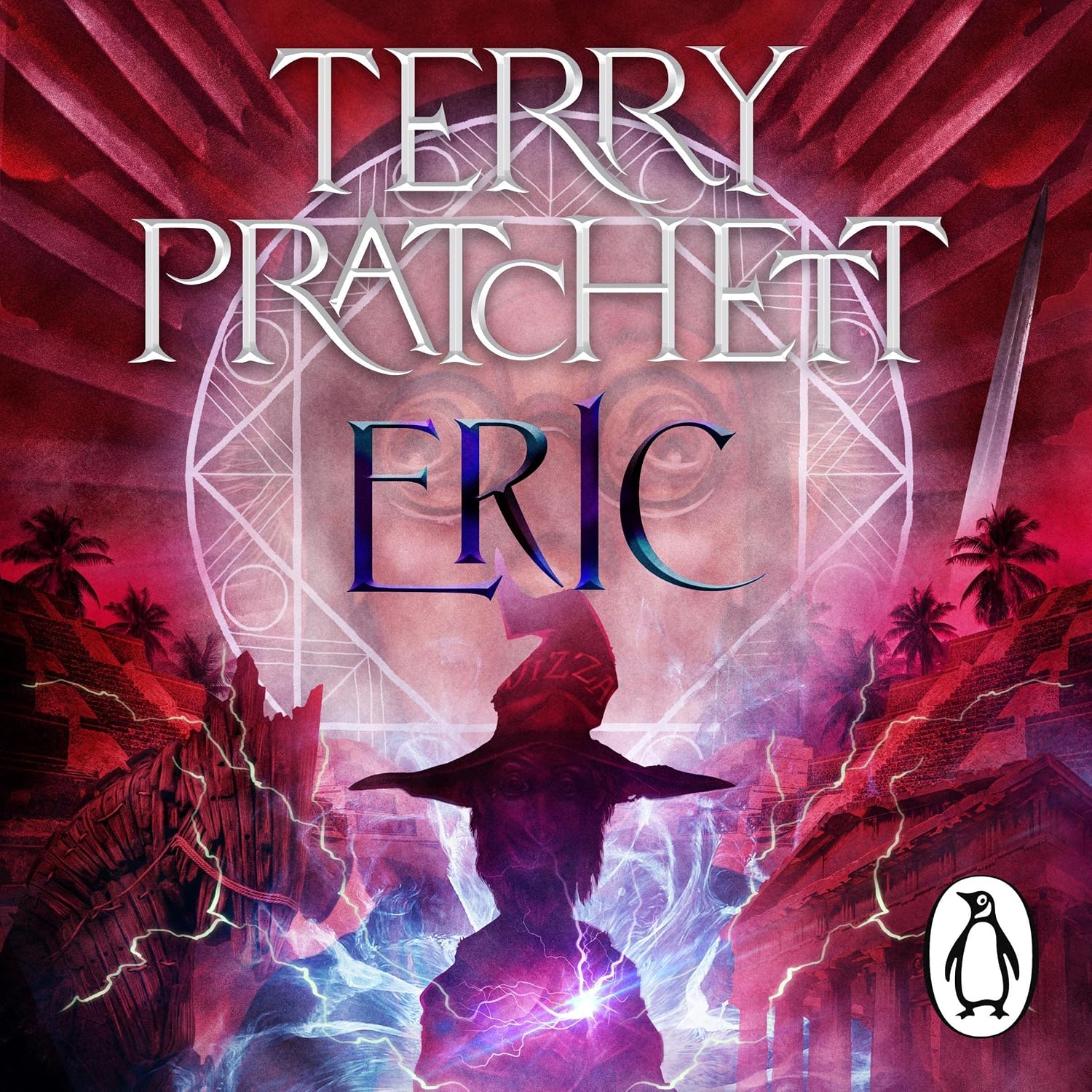
Terry Pratchett – Eric
There is something rather appropriate about Eric being a story about someone who gets exactly what he wishes for and then discovers that reality has taken the opportunity to read the small print.
Eric is a teenage demonologist who wants three fairly straightforward things: wealth, power and the most beautiful woman in the world. Frankly, for someone who has managed to summon Rincewind, he should probably have aimed considerably lower. Unfortunately for Eric, getting your wishes granted on the Disc is not quite the same thing as ordering something from a catalogue and waiting for it to arrive.
Instead, he finds himself stuck with Rincewind, travelling through time and space while various forces of creation, destruction and general administrative incompetence get involved.
What I particularly enjoy about Eric is just how much it manages to pack into such a small package. This is a very short Discworld novel, almost novella length, but it has plenty going on. It takes the usual fantasy adventure ingredients, throws in a bit of mythology, adds some historical satire and then sends Rincewind running through the middle of it all looking understandably concerned.
The humour is certainly a big part of the appeal, but there is more underneath it than might initially be obvious.
The central idea of getting what you want is used to explore the rather human problem of never quite knowing what you actually want. Eric thinks wealth, beauty and power will solve everything, which is hardly an unusual theory. The fact that it immediately goes spectacularly wrong is the sort of lesson humanity has been learning since someone first discovered that eating an entire cake is not necessarily an achievement.
There is also plenty of commentary on the way people construct myths around themselves. History, heroism and the idea of the great man all get gently prodded. Eric is particularly interested in the gap between what people believe happened and what might actually have happened, which gives the historical elements a suitably mischievous edge.
The depiction of the Hell is another highlight. Rather than presenting eternal damnation as some grand, terrifying supernatural machine, the book turns it into an exercise in administration and pointless bureaucracy. It is a remarkably British approach to the afterlife. You could imagine Satan having a queueing system and being furious because somebody has submitted form 27B instead of form 27A.
It also provides one of the book’s better observations about power. The machinery of authority often survives not because it is particularly effective, but because everyone involved has accepted that this is simply how things are done.
That feels increasingly familiar.
Rincewind remains the perfect character to throw into this sort of situation because he has absolutely no interest in grand destiny. He does not want to conquer worlds or become a legendary hero. He would quite like to survive the afternoon. There is something deeply relatable about that, particularly when everyone else seems determined to make his life considerably more complicated.
Colin Morgan’s narration works wonderfully with this material. By now, he sounds completely at home in Discworld, and there is a real confidence to the performance. What I especially like is his ability to switch between the absurdity of the situation and the very real exasperation of the characters without making either feel exaggerated.
Rincewind’s reactions are a particular pleasure. Morgan gives him that perfect combination of panic and weary resignation, making it very easy to understand why he would rather be anywhere else. I also found myself enjoying the little changes in tone between characters, which make the short audiobook feel surprisingly rich.
There is a theatrical quality to the narration that suits Eric especially well. The story is almost structured like a small comic stage production, with characters arriving, making increasingly questionable decisions and disappearing again before the consequences become entirely their problem.
Peter Serafinowicz continues to make every appearance feel like an event. His Death is not performed as some roaring embodiment of doom. Instead, there is a calm authority to the voice that makes the character all the more effective. He sounds completely certain that eventually everything will be dealt with, preferably without anyone making too much fuss in the meantime.
Bill Nighy’s footnote narration is another lovely touch. Rather than simply treating the footnotes as additional jokes, his delivery gives them their own personality. There is that wonderfully relaxed Nighy quality, as though he is mildly amused by the entire situation but cannot quite bring himself to become emotionally invested in it.
I particularly enjoy the contrast between the escalating chaos of the main narrative and the almost casual observations coming from the footnotes. It makes the audiobook feel like it has its own running commentary.
Listening to Eric, I found myself appreciating how much character Colin Morgan gets into such a compact story. It is easy to think of short books as somehow lesser experiences, but this one never feels underdeveloped. If anything, the brevity helps. The story arrives, causes a considerable amount of trouble, makes its observations and gets out before it has a chance to wear out its welcome.
It is another step forward from those earliest Discworld books too. The comedy is more controlled, the satire is more focused and the world feels increasingly comfortable being its own strange thing rather than simply parodying fantasy.
Eric may not be one of the biggest or most important Discworld stories, but I think that is part of its charm. It is a quick, funny, surprisingly thoughtful adventure with enough social commentary to make you realise that, beneath all the demons and historical nonsense, it is actually asking some rather sensible questions about power, desire and the stories we tell ourselves.
And if you ever find yourself wishing for everything you have ever wanted, just remember Eric.
There is always a catch.
Usually involving Rincewind.
Buy your copy here

Leave a Reply