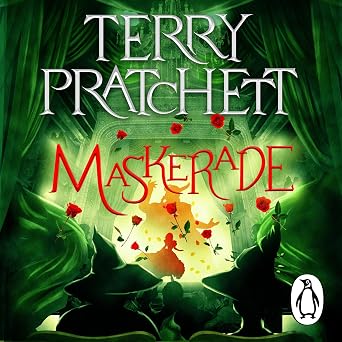
There are few things more dangerous than putting a group of witches anywhere near an opera house. Opera already contains most of the ingredients required for disaster: enormous egos, complicated costumes, passionate declarations, people bursting into song at inappropriate moments and enough melodrama to power a small city.
Add Granny Weatherwax and Nanny Ogg to the mixture and things were never going to end well.
Maskerade is another terrific entry in the Witches of Lancre sequence, although this time there is a noticeable absence at the centre of the coven. Magrat is busy Queening, leaving Granny and Nanny with a problem. A coven is traditionally made up of three witches, and Granny is not about to let something as inconvenient as a missing witch interfere with tradition.
Their solution is Agnes Nitt.
Agnes is already a memorable character from her earlier appearance, and Maskerade gives her plenty of opportunity to develop. She is intelligent, practical and possessed of a very powerful singing voice, although she is also rather more comfortable being the sensible person at the back of the room than being the person everyone is looking at.
Unfortunately, the Opera House has a problem.
There is a ghost.
Or at least there appears to be a ghost.
This is where Pratchett gets to have an enormous amount of fun with opera and, more specifically, The Phantom of the Opera. What I particularly love about Maskerade is how effortlessly and delightfully he deconstructs not only the pomposity of opera itself, but the entire Phantom of the Opera story. He takes all those grand gestures, mysterious figures, doomed romances, secret passages and tortured artists and asks the fairly obvious question that nobody in a traditional gothic melodrama seems interested in asking.
“Yes, but what would this actually look like if ordinary people had to deal with it?”
The answer is hilarious.
Opera is treated with exactly the sort of affection that allows Pratchett to make fun of it mercilessly. The grandeur, the self-importance and the belief that everything must be taken enormously seriously are all ripe targets. Yet there is also a genuine appreciation for the craft involved. The joke is not simply that opera is ridiculous. It is that people are ridiculous when they become convinced that their particular form of art is terribly important.
Which leads neatly into one of the book’s bigger themes: identity.
Maskerade is fascinated by the difference between who we are and who other people expect us to be. Agnes has spent much of her life being judged by her appearance, while Nanny and Granny have very different ideas about what a witch should be. There is also the question of performance. The people on stage are pretending to be someone else, but so are many of the people watching them.
Perhaps, Pratchett suggests, everybody is wearing a mask of some sort.
The social commentary comes thick and fast, particularly around beauty, body image, gender and the way women are expected to present themselves. Agnes is an especially effective vehicle for this because she does not fit neatly into the conventional idea of what a heroine should look like. Pratchett manages to make the subject funny without making Agnes the butt of the joke.
There is also plenty of commentary about institutions and the people who inhabit them. The Opera House is full of traditions that have survived largely because nobody has thought to question them. This is another familiar Discworld target: the idea that something must be sensible simply because it has been done for a very long time.
Then there is Granny Weatherwax, who is probably the last person in the multiverse you would want investigating a mysterious phantom. Not because she is particularly good at detective work, but because she is absolutely unwilling to accept anyone else’s explanation of what is happening.
Nanny Ogg, meanwhile, remains gloriously Nanny Ogg. She has an almost supernatural ability to find the most inappropriate thing to say at precisely the right moment, and her relationship with Granny continues to be one of the great pleasures of the series.
I am still really enjoying these new Audible editions. Indira Varma is extremely well suited to the material, handling the different characters with a lightness that allows the humour to work naturally. Her narration brings the characters to life and makes it all feel real, particularly when the story moves between the ridiculousness of the Opera House and the more personal moments involving Agnes.
Bill Nighy also continues to be excellent as the voice of the footnotes. His nonchalant delivery is exactly right for Pratchett’s asides. He sounds as though he is calmly explaining some perfectly reasonable fact about the universe while everyone else is running around screaming.
And then there is Death.
Peter Serafinowicz remains absolutely perfect in the role, with that wonderfully sepulchral delivery that somehow makes Death both imposing and funny and TALKS LIKE THIS.
It is difficult not to hear those lines and immediately picture the character.
Maskerade is another excellent Witches novel. It is funny, sharply observed and surprisingly thoughtful beneath all the silliness. The Phantom of the Opera gets taken apart, opera receives a thorough roasting, and Pratchett manages to explore identity, appearance, performance and social expectations while apparently just having a laugh at people singing very loudly in expensive costumes.
Which, frankly, is probably the best way to approach opera.
Especially when there is a witch in the audience.
Buy your copy here

Leave a Reply