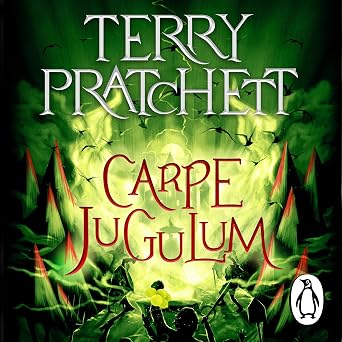
There are few things more reassuring than knowing that, when the forces of darkness arrive in Lancre, Granny Weatherwax will probably be there to tell them to go away.
Unfortunately, in Carpe Jugulum, the forces of darkness have come prepared.
The vampires have discovered modernisation.
This is, naturally, terrible news.
Carpe Jugulum is another excellent entry in the Witches of Lancre sequence, and one of the things I particularly enjoy about it is that Pratchett takes the familiar vampire story and gives it the Discworld treatment. The vampires are not simply ancient aristocratic bloodsuckers hiding in a castle and waiting for villagers to wander past at convenient intervals. These vampires have read the rule book and decided that the problem with being a vampire is that there are far too many rules.
So they intend to change the rules.
No garlic. No religious symbols. No inconvenient invitations. No sleeping during the day. No traditional weaknesses at all. They want to be modern vampires, which is exactly the sort of thing that happens when the undead discover self-help literature.
Naturally, Granny Weatherwax is not impressed.
The story begins with the Lancre royal family preparing for the christening of Magrat and King Verence’s daughter, which means that everyone is already busy, everyone is already stressed and nobody has the slightest idea that they are about to be invaded by vampires.
The witches, of course, become involved.
Granny, Nanny Ogg and Agnes Nitt are once again at the centre of the action, although this time Granny’s role is rather more personal. She is forced to confront something that she has spent a very long time avoiding, and that gives the story considerably more emotional weight than the usual witchcraft and vampire nonsense might suggest.
One of the major themes running through Carpe Jugulum is the idea of choice. The vampires believe they have found a better way to live, but their version of progress involves imposing their own rules on everyone else. Pratchett is particularly interested in the difference between freedom and control, and the uncomfortable question of whether having more choices actually makes us freer.
There is also a lot going on around belief.
Pratchett has always enjoyed poking fun at organised belief, superstition and certainty, and here he takes a particularly good swipe at the idea that people must be divided neatly into believers and non-believers. Religion, magic and rationality all bump into one another, and nobody comes away looking entirely sensible.
Which is probably the point.
The social commentary is especially sharp when it comes to the idea of progress. The vampires believe themselves to be enlightened because they have abandoned the old ways, but Pratchett is careful to show that changing the surface of something does not necessarily change what lies underneath. Sometimes modernisation is simply old-fashioned control wearing a smarter suit.
There are also questions about prejudice, tradition and the assumptions we make about other people. The vampires are convinced that they understand humans, just as humans are convinced they understand vampires. Both sides have ideas about what the other is supposed to be, and both discover that reality is considerably more complicated.
And then there is Granny.
Carpe Jugulum gives her one of her most interesting stories. The formidable certainty that normally defines Granny is challenged, and we get to see what happens when the person everyone assumes has all the answers is suddenly confronted with a problem she cannot simply solve by glaring at it.
It makes her feel more human without making her any less formidable.
Nanny Ogg remains gloriously Nanny Ogg, naturally. Her ability to deal with vampires, family members and social situations using approximately the same combination of common sense, alcohol and inappropriate remarks is as reliable as ever. Agnes continues to develop as well, becoming increasingly confident and demonstrating that she is far more capable than she tends to believe.
There is also a wonderful sense throughout the book that the witches are not merely fighting a supernatural threat. They are defending the messy, imperfect, complicated business of being human.
I am still really enjoying these new Audible editions. Indira Varma is extremely well suited to the material, and her narration brings the characters to life and makes it all feel real. She handles the humour naturally while giving the more serious moments enough weight, and the witches in particular feel wonderfully distinct.
Bill Nighy also continues to be excellent as the voice of the footnotes. His easy going delivery makes those little excursions into Discworld lore feel completely effortless. He sounds as though he is explaining the strangest facts imaginable while remaining entirely unconcerned that the rest of the universe has descended into chaos.
And then there is Peter Serafinowicz as Death. His wonderfully sepulchral delivery remains perfect for the character, giving Death the necessary grandeur while allowing the comedy to sit underneath it.
There is something deeply satisfying about hearing Death sound exactly like Death should sound.
Carpe Jugulum is funny, thoughtful and packed with the sort of social observation that Pratchett hides beneath an impressive pile of jokes. It takes vampires, religion, modernisation, tradition and the nature of evil, throws them all into the same cauldron and then gives Granny Weatherwax a very large spoon.
The result is another strong Witches novel, with plenty of laughs but also a surprising amount to say about freedom, belief, prejudice and the dangers of assuming that progress automatically makes things better.
The vampires may have modernised.
The witches, thankfully, have not.
And perhaps that is exactly why they are so difficult to beat.
Buy your copy here

Leave a Reply