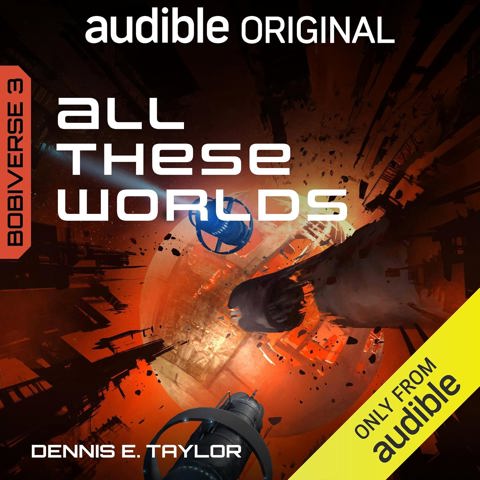
All These Worlds is the point where the Bobiverse starts to feel like it has grown beyond the original joke. That is not to say the humour has disappeared, because thankfully it has not, but the story has become something considerably bigger and more ambitious than the premise of a man being turned into a computer and sent into space might suggest. By this stage, there are Bobs everywhere, the stakes are enormous, and Dennis E Taylor is having a thoroughly good time seeing just how far he can push the idea.
The basic appeal of the series remains intact. Bob Johansson is still Bob, even though there are now enough versions of him floating around the universe to make that statement increasingly complicated. Each copy has developed in slightly different ways, and that becomes one of the most entertaining aspects of the whole concept. These are technically the same person, but their experiences, personalities and priorities keep pulling them in different directions. It gives Taylor plenty of opportunities to explore questions about identity and individuality without ever turning the book into a heavy philosophical lecture.
At the same time, the Bobiverse continues to expand at an impressive rate. What began as a fairly straightforward exploration and colonisation story has become a much more complicated web involving humanity, alien civilisations, competing interests and some rather serious consequences. The underlying lore keeps getting deeper and more intricate, and I really enjoyed the feeling that there is always another layer waiting to be uncovered. Taylor manages to introduce new pieces of the universe without making the earlier material feel irrelevant, which is quite an achievement when the scale of the story has become this enormous.
And, crucially, it is still funny. The Bobiverse is a more than worthy entry into the sci-fi humour field, because Taylor understands that the comedy works best when it grows naturally from the characters and situations rather than simply being bolted on. There are plenty of references, geeky observations and moments where you can practically hear Bob thinking, “Well, this has gone rather badly.” The humour also helps keep the increasingly grand storyline grounded. However cosmic the problem becomes, there is usually a Bob somewhere worrying about the practicalities, making a sarcastic observation or getting distracted by something wonderfully nerdy.
That balance between enormous science fiction ideas and very human reactions is probably what I enjoy most about the series. The technology can become increasingly elaborate, and the strategic problems can involve consequences on a galactic scale, but the characters remain very recognisable. Their disagreements, mistakes and occasional flashes of brilliance give the story its emotional centre. It also helps that Taylor is willing to let things go wrong. The Bobs may have considerable advantages, but they are not magically competent at everything, and their attempts to solve problems often create new ones.
The audiobook is once again hugely helped by Ray Porter. His narration has been one of the consistent strengths of the series, and here his quality of expression is particularly effective. Porter has a knack for delivering dialogue so that even relatively small changes in emphasis can make a character feel distinct. With so many Bobs, that is no small task. He does not need to turn every character into a cartoon to make them recognisable. Instead, his timing, rhythm and expression do much of the work, and the result is a performance that feels natural while still keeping the cast easy to follow.
If I have one criticism, it is that the increasing amount of technical and strategic detail can occasionally slow the pace. I enjoy the science and the problem solving, but there are moments when I was more interested in what the characters were doing than in every detail of how they intended to accomplish it. Even so, that is a minor complaint, particularly because the larger story keeps moving forward and the ideas remain interesting.
All These Worlds feels like a satisfying continuation of everything that came before while also opening the door to something much larger. It has the humour, the big science fiction concepts, the wonderfully geeky details and the growing cast of Bobs that make the series so much fun. More importantly, it leaves me with the feeling that the universe still has plenty of stories left in it. By now, I am thoroughly invested in the Bobs, the humans and the increasingly complicated mess they have created, which is probably the best recommendation I can give.
Buy your copy here

Leave a Reply