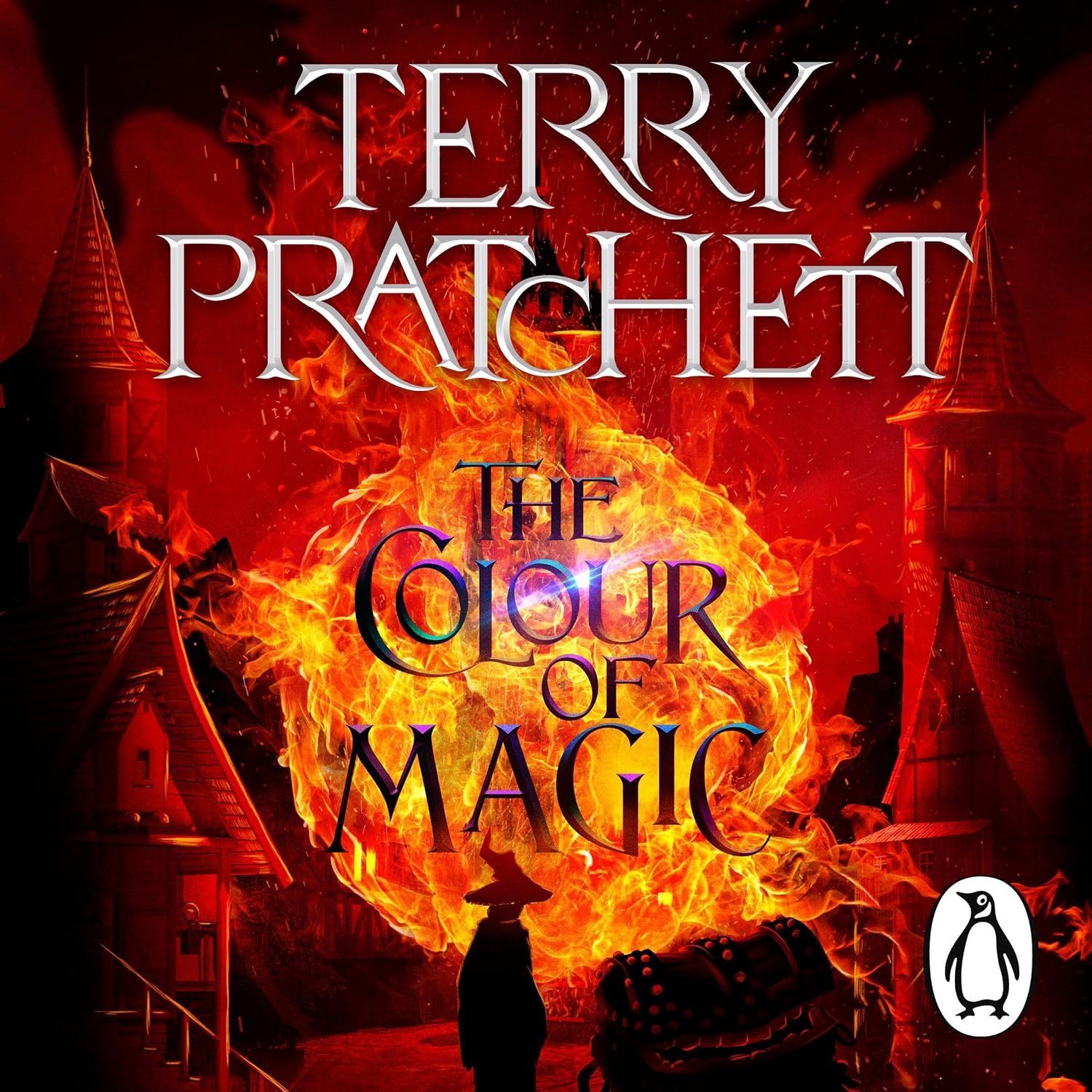
“It was octarine, the colour of magic. It was alive and glowing and vibrant and it was the undisputed pigment of the imagination, because wherever it appeared it was a sign that mere matter was a servant of the powers of the magical mind. It was enchantment itself.
But Rincewind always thought it looked a sort of greenish-purple.”Terry Pratchett – The Colour of Magic
There are books that introduce you gently to a fictional world, holding your hand as you wander through the scenery and explaining the rules before anything too exciting happens. Then there is The Colour of Magic, which takes one look at you, throws you off the edge of the Disc and leaves you to work out which way is up.
And honestly, I think that is exactly how it should be.
It is worth acknowledging that The Colour of Magic has a reputation for being one of the weaker entries in the Discworld series. Having now spent a fair amount of time wandering around this increasingly ridiculous planet, I can understand why. The Discworld would become considerably more sophisticated, more emotionally nuanced and, in places, considerably sharper as the series progressed. The first book is comparatively rough around the edges.
But here is the thing. If you have never visited the Disc before, I still think The Colour of Magic is the best place to start.
It introduces us to Rincewind, a wizard whose relationship with magic is rather like my relationship with exercise. There is technically an understanding that it exists, but neither party is particularly keen on getting involved. Alongside him comes Twoflower, an enthusiastic tourist whose understanding of danger is somewhat hampered by his complete lack of it. Together they set off on an adventure involving assassins, dragons, thieves, death-defying escapes and enough general chaos to make you wonder why anyone on the Disc bothers having a normal Tuesday.
What makes the book work for me is that it is not really interested in pretending that fantasy worlds are sensible places.
Pratchett takes the conventions of heroic fantasy and starts poking them with a stick. Wizards are not necessarily wise. Heroes are not necessarily competent. Tourists can be more dangerous than barbarians, particularly when equipped with enough money to encourage everyone around them to make extremely poor decisions. Even the idea of a grand quest gets treated with a healthy degree of suspicion.
There is plenty of social commentary lurking underneath all the silliness too. Class, wealth, tourism, commerce and the rather human tendency to turn everything into a transaction all get their moment in the spotlight. Twoflower’s innocent enthusiasm becomes a particularly effective way of looking at the world from outside its normal assumptions. What one person considers terrifying, another can regard as an interesting cultural experience, especially if someone has remembered to charge admission.
That is one of the things I enjoy most about Discworld. The jokes are rarely just jokes. There is usually something underneath them, whether it is a dig at fantasy conventions, human greed, bureaucracy or the way people convince themselves that completely absurd behaviour is perfectly reasonable because everybody else is doing it.
The story itself is episodic and occasionally feels more like a collection of mad adventures than a tightly constructed novel. Again, I can see why some readers find that frustrating. Personally, I find it rather charming. This is a book discovering what its world can do, and there is something wonderfully exuberant about that process. It feels like Pratchett is opening cupboards simply to see what happens when he pulls out whatever happens to be inside.
The audiobook is particularly enjoyable thanks to Colin Morgan, best known to many of us as Merlin. His performance suits the material beautifully. There is an energy and expressiveness to his narration that works with the constant changes of pace, character and situation. He understands that the humour often works best when it is delivered as though everyone involved is taking the increasingly ridiculous circumstances completely seriously.
And then there is Death.
Peter Serafinowicz has exactly the right presence for the character. There is something wonderfully imposing about the performance without it becoming overblown. Death needs to sound like someone who has all the time in the universe, because, well, technically he does.
Bill Nighy’s performance as the voice of the footnotes is another delight. His trademark nonchalance is absolutely sublime here, adding another layer of understated comedy to an already ridiculous story. The footnotes become part of the experience rather than simply something to skip over, and Nighy delivers them with precisely the sort of dry confidence they deserve.
So yes, The Colour of Magic may not be the most polished Discworld novel. It would be a little unfair to judge the entire series by it because later books would develop considerably beyond what is found here.
But as a first trip around the Disc, I genuinely think it is hard to beat.
It is funny, chaotic, inventive and gloriously silly, while quietly setting up many of the ideas that would become central to the series. More importantly, it makes you want to see what happens next.
And once you have met Rincewind, Twoflower, Death and the Disc itself, walking away is really not much of an option.
Buy your copy here

Leave a Reply