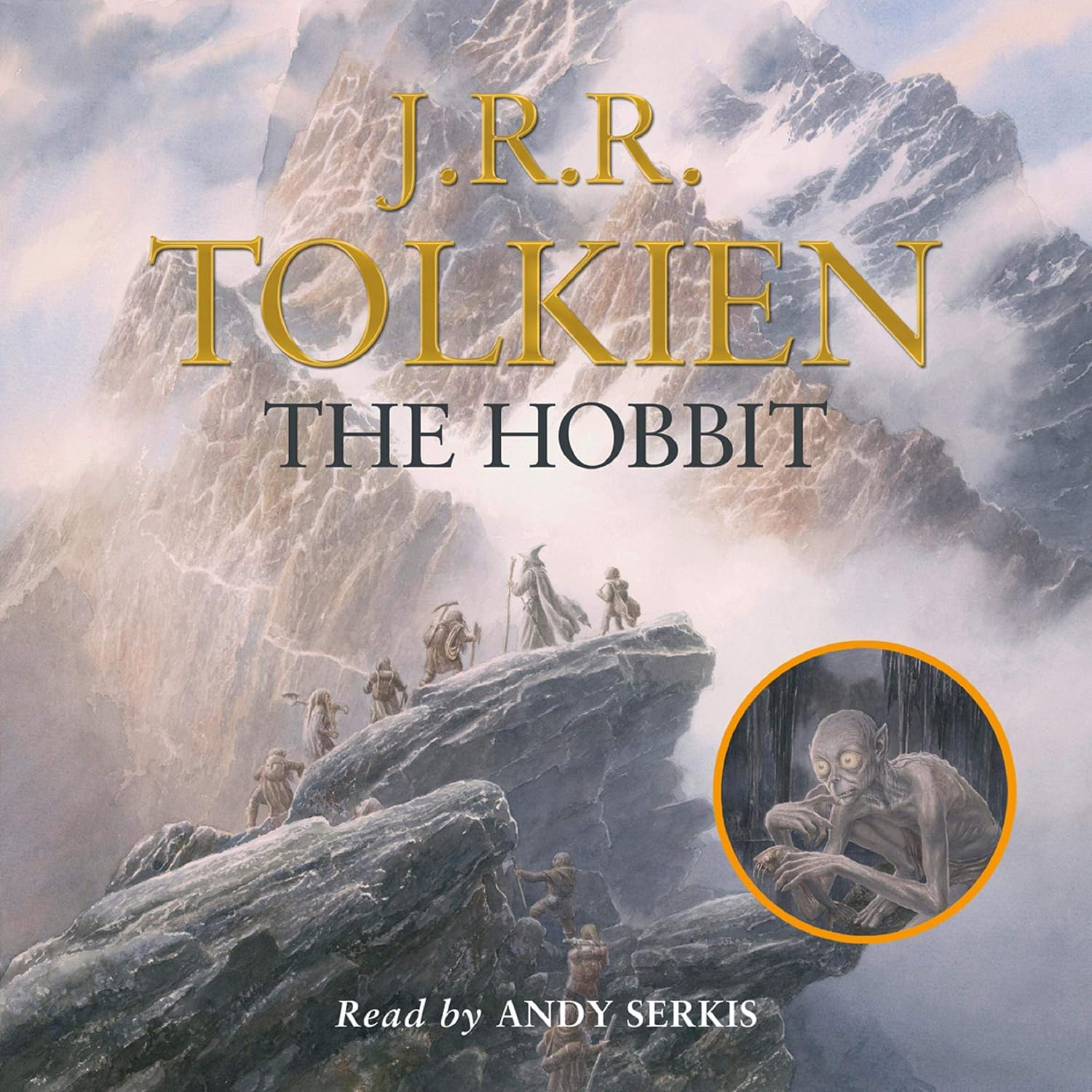
I can’t remember a time when The Hobbit wasn’t lurking somewhere in the back of my imagination. I first read it when I was seven or eight, and became so obsessed that I borrowed it from the library on thirty-six consecutive visits. Thirty-six! You’d think somebody might eventually have suggested I try something else, but clearly I knew what I liked. By the early ’80s, I’d even written my first review of it at secondary school. I suspect that particular literary masterpiece was rather more enthusiastic than insightful, but we all have to start somewhere. Returning to Tolkien’s Middle-earth all these years later, this time with Andy Serkis narrating the Audible edition, has been a rather wonderful experience. There’s something special about revisiting a book that helped shape your imagination as a child and discovering that, despite everything you’ve read since, it still has the power to captivate you.
The premise is deceptively simple. Bilbo Baggins is a thoroughly respectable hobbit who enjoys his comfortable home, regular meals and an entirely predictable existence. Unfortunately for Bilbo, Gandalf has other ideas, and before he quite knows what’s happening, he’s accompanying thirteen dwarves on a quest to reclaim their ancestral home and treasure from the dragon Smaug. It’s a wonderfully absurd beginning, particularly because Bilbo is so spectacularly unsuited to the business of adventuring. He’s not brave, particularly resourceful or even especially interested in being there. He’d much rather be at home with a decent cup of tea, thank you very much.
What I’ve always loved about Bilbo is that his transformation into something approaching a hero never feels entirely inevitable. Tolkien allows him to be frightened, confused, occasionally rather foolish and frequently homesick. His courage develops through necessity rather than some sudden discovery of hidden greatness. Whether he’s matching wits with Gollum, confronting the dangers of Mirkwood or trying to navigate the increasingly complicated ambitions of his companions, Bilbo succeeds because he learns to think for himself. More importantly, he gradually discovers that doing what’s right isn’t necessarily the same as doing what’s expected of him.
That distinction becomes particularly important in his relationship with Thorin Oakenshield. As a child, I remember admiring Thorin enormously. Here was a proud, determined leader trying to reclaim everything that had been stolen from his people. What wasn’t to admire? Returning to the story now, I found his gradual decline surprisingly upsetting. I still understand his anger and his longing to restore his family’s legacy, which somehow makes watching his pride and possessiveness overwhelm his better judgement all the more frustrating. There were moments when I wanted to give him a good shake and remind him of everything he’d supposedly been fighting for. It’s difficult watching a character you’ve admired since childhood become increasingly difficult to sympathise with, particularly when you can still glimpse the honourable person beneath all that stubbornness. Tolkien makes that deterioration feel genuinely tragic rather than simply turning Thorin into an antagonist. Meanwhile, Bilbo’s growing willingness to challenge him becomes something I admire all the more. Standing up to someone you respect, especially when you know it might cost you their friendship, takes a different kind of courage from confronting monsters. I doubt I appreciated that distinction when I was eight, but it struck a very personal chord this time around.
And then there’s Gollum. Good grief, what a magnificent creation. The encounter beneath the Misty Mountains remains one of my favourite sequences, not simply because of the riddles or the introduction of a certain rather important ring, but because Tolkien manages to create genuine tension through what is essentially a conversation. Gollum is simultaneously ridiculous, sinister and strangely pitiable, while Bilbo’s response to him reveals something fundamental about his character. Compassion, even when it would be easier to act otherwise, matters enormously in Tolkien’s world. It’s a lesson that becomes considerably more significant when you consider what follows in The Lord of the Rings.
One thing that struck me on this revisit is just how different The Hobbit feels from its more famous successor. There’s a playful, almost conversational quality to Tolkien’s storytelling, with frequent asides, songs and an occasionally mischievous narrator who seems positively delighted by the absurdities of his own creation. That said, the episodic structure can sometimes make the adventure feel a little uneven, and some encounters are resolved rather conveniently. The songs, too, occasionally interrupt the momentum, although I’ve grown rather more tolerant of them over the years. Perhaps that’s one of the advantages of getting older. Or perhaps I’m simply becoming more hobbit-like myself.
Andy Serkis deserves considerable credit for making this return journey so enjoyable. His narration is wonderfully expressive, shifting effortlessly between the warmth and humour of Tolkien’s prose and the genuine menace lurking beneath its more whimsical moments. Naturally, his Gollum is extraordinary, capturing that unsettling mixture of malice, desperation and vulnerability. But concentrating solely on Gollum would do the rest of his performance a disservice. His Bilbo is beautifully realised, particularly in those moments when nervous uncertainty gives way to quiet determination, while his characterisation of the dwarves helps distinguish personalities that might otherwise blur together. There’s real emotional understanding behind the performance, and Serkis knows when to let Tolkien’s words carry the moment without unnecessary theatrics.
What I appreciate most about The Hobbit now is its underlying belief that greatness isn’t necessarily measured through strength, wealth or grand achievements. Bilbo begins his journey believing that comfort and security are everything, yet discovers a wider world without entirely abandoning the values that make him who he is. His kindness, loyalty and common sense ultimately prove more valuable than the grand ambitions surrounding him. It’s a surprisingly thoughtful message beneath all those trolls, goblins, spiders and dragons.
Ultimately, I don’t think I can separate The Hobbit from the person I’ve become, and I’m not entirely sure I’d want to. That little boy who borrowed the same book thirty-six times was discovering just how extraordinary reading could be, and Tolkien helped ignite a lifelong love of fantasy that has never really left me. Returning to it now, I found myself unexpectedly saddened by Thorin’s decline, while admiring Bilbo’s quiet courage more than ever. But what surprised me most was how easily Serkis’s narration brought back something of that childhood excitement. There are books I’ve admired more for their complexity or ambition, but very few mean quite as much to me personally. The Hobbit isn’t simply a childhood favourite I’ve revisited for nostalgia’s sake. It’s one of the reasons I became the reader I am, and I’m enormously grateful for that. More than four decades after writing my first school review, here I am writing about it again, which feels rather fitting. Bilbo may have returned to Bag End at the end of his adventure, but I don’t think I ever really left Middle-earth. And frankly, I hope I never do.
Buy your copy here

Leave a Reply