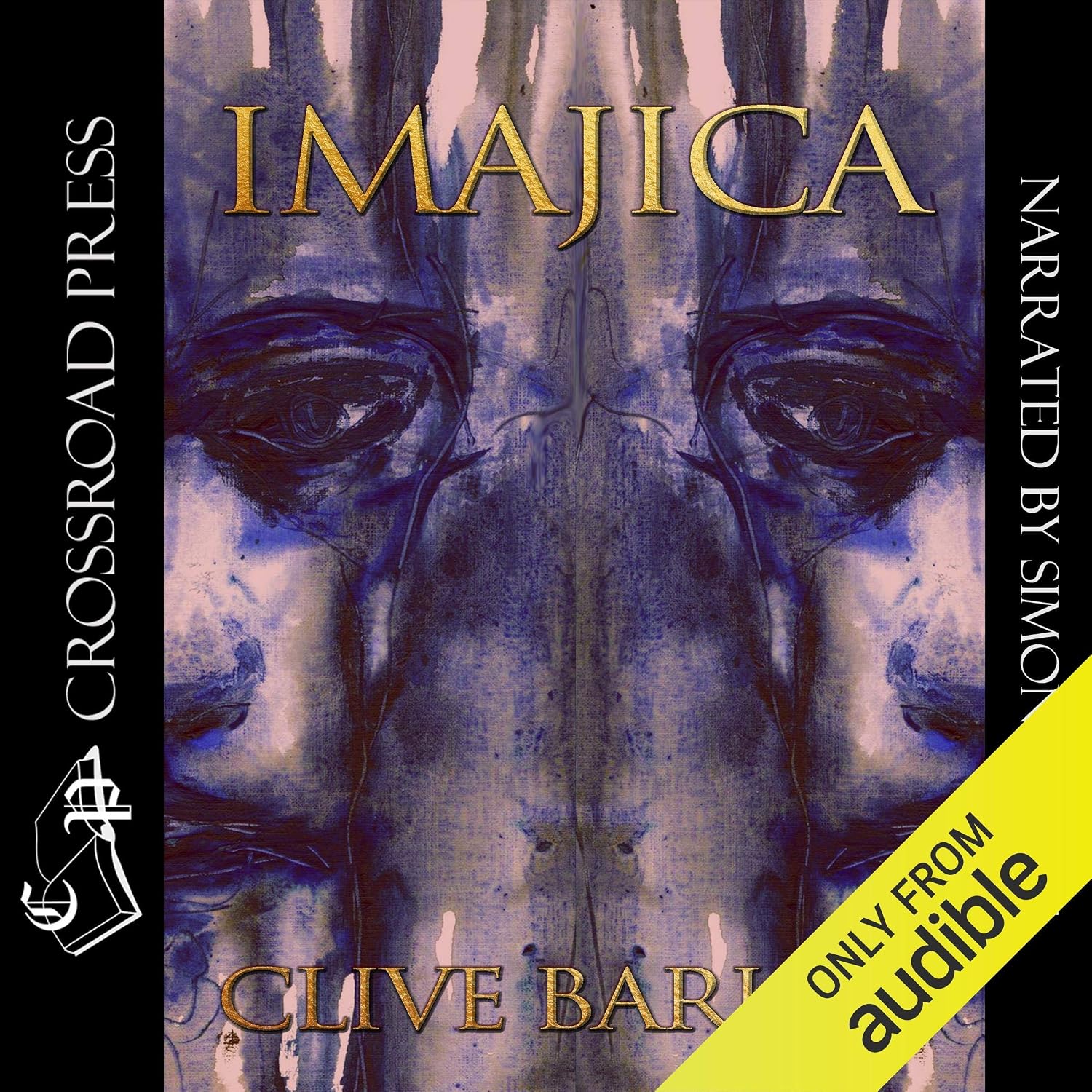
There are some books that are difficult to describe without making them sound rather more peculiar than they actually are, and Imajica is very much one of them. Clive Barker has never been particularly interested in keeping his imagination within sensible boundaries, but here he seems to have decided that boundaries themselves are the problem. What begins as something resembling a supernatural mystery gradually expands into an enormous, strange and frequently unsettling exploration of creation, identity, love, religion and the nature of reality. It’s a remarkable piece of storytelling, although one that occasionally seems determined to test just how much strangeness a reader can absorb.
At the centre of the story is John Furie Zacharias, generally known as Gentle, a talented but rather unremarkable artist whose life takes an unexpected turn when he becomes involved in a series of events that suggest the world is considerably larger than he has ever imagined. His relationship with Judith Odell, a woman whose importance to the unfolding events is far greater than either initially understands, becomes one of the driving forces behind the narrative. Meanwhile, Pie ‘oh’ Pah, an extraordinary and enigmatic being from beyond the familiar world, introduces Gentle to possibilities that challenge everything he believes about himself and existence.
That’s about as much of the premise as I’d want to explain, because half the pleasure of Imajica comes from discovering just how far Barker is prepared to take things. The familiar world is only one part of a much larger reality, and the existence of other dimensions, their histories and the forces that govern them gradually becomes central to the story. Barker builds this mythology with extraordinary ambition, creating a universe that feels ancient, complicated and occasionally downright terrifying.
Gentle is an interesting central character precisely because he doesn’t initially seem particularly remarkable. He’s flawed, uncertain and frequently frustrating, especially when his decisions appear driven more by instinct and desire than any sensible consideration of the consequences. Yet there’s something engaging about watching him discover that his seemingly ordinary existence has been shaped by forces he barely understands. His journey isn’t simply about acquiring knowledge or power. It’s about confronting his own nature and accepting responsibilities that he might much rather avoid.
Judith is equally important, although I found her rather more compelling as the story developed. She has her own motivations, her own emotional baggage and a complicated relationship with the events surrounding Gentle. She isn’t simply there to provide a romantic interest or someone for the protagonist to rescue. Her choices have consequences, and her involvement in the unfolding events gives the story a much-needed emotional anchor.
Then there’s Pie ‘oh’ Pah, whose presence adds an entirely different dimension to the narrative. The character’s nature, identity and relationship with Gentle raise some of the book’s most interesting questions, particularly around the distinction between appearance and reality. Barker handles this with considerable sensitivity, exploring ideas of love, acceptance and identity without reducing them to simple statements. I found this relationship one of the most affecting aspects of the book, partly because it challenges both Gentle and the reader to reconsider assumptions that are usually taken for granted.
Barker’s imagination is undoubtedly the main attraction. The worlds he creates are astonishingly vivid, populated by strange creatures, elaborate civilisations, ancient rivalries and supernatural forces that operate according to their own rules. There’s a wonderfully unsettling quality to the way he mixes the beautiful with the grotesque, often placing moments of genuine wonder alongside imagery that feels as though it has crawled out of a particularly unpleasant nightmare. His descriptions can be lavish, sometimes almost excessively so, but there’s no denying his ability to make the impossible feel tangible.
There is, however, a price to be paid for such ambition. Imajica is a substantial novel, and Barker isn’t particularly interested in hurrying anyone towards the destination. The mythology becomes increasingly elaborate, the cast expands, and the narrative occasionally wanders into territory where keeping track of everything requires a little concentration. There were moments when I felt the story could have benefited from a firmer editorial hand, particularly when Barker’s enthusiasm for explaining the intricacies of his creation threatens to overwhelm the forward momentum. Some passages are also considerably more graphic and disturbing than others, which won’t necessarily appeal to everyone. For me, though, these are relatively minor frustrations in a book whose ambition is so much of its appeal.
What I particularly enjoyed was the way Barker uses this extraordinary fantasy setting to explore ideas that are surprisingly recognisable. Beneath all the supernatural machinery is a story about the dangers of unquestioned authority, the consequences of religious certainty and the damage caused by those who believe they have the right to decide how everyone else should live. His treatment of creation and the relationship between creator and creation is especially interesting, questioning whether something made by another can ever truly belong to its maker. There’s also a strong argument for embracing difference rather than fearing it, with love and understanding repeatedly challenging the divisions imposed by power and tradition.
Simon Vance deserves considerable credit for bringing all of this to life in the audiobook. With such a large cast and an assortment of characters drawn from very different worlds, there’s plenty of opportunity for a narration to become muddled or lose its sense of individuality. Vance handles it impressively, giving the principal characters distinct voices and personalities while maintaining a consistent narrative flow. His delivery has just the right combination of atmosphere, expression and restraint, allowing Barker’s more extravagant passages to work without becoming overblown. He also handles the emotional moments particularly well, giving the relationships genuine depth rather than simply treating them as another part of the fantastical spectacle.
Imajica isn’t a book I’d recommend to someone looking for a quick, straightforward fantasy adventure. It’s sprawling, occasionally indulgent and sometimes rather demanding, but that’s also what makes it so distinctive. Barker has created something that feels genuinely individual, a story that combines dark fantasy, supernatural horror, philosophical speculation and an unexpectedly tender exploration of love and identity. I found myself occasionally wishing he’d get to the point a little sooner, but I was never short of reasons to keep listening. Ultimately, Imajica is a wonderfully imaginative, ambitious and thought-provoking novel, and one that demonstrates just how extraordinary fantasy can become when an author is prepared to follow his imagination wherever it leads.
Buy your copy here

Leave a Reply