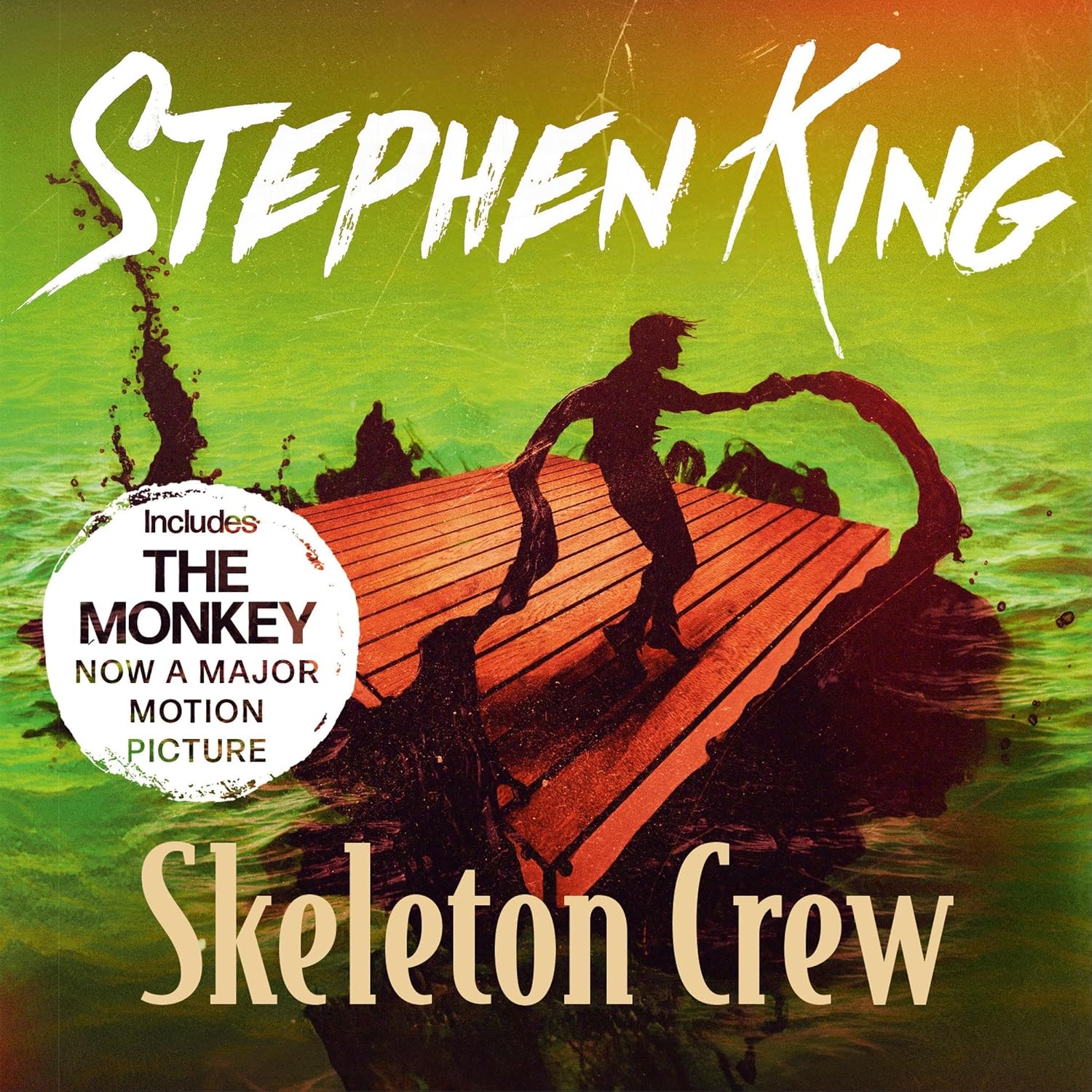
There’s a particular pleasure in a good short story collection, especially when the writer is Stephen King. You can settle into a familiar voice, let yourself be drawn into a strange situation, and then find the whole experience turned on its head before you’ve had time to get comfortable. Skeleton Crew is an excellent example of King’s range as a storyteller, bringing together horror, dark comedy, science fiction and the occasional moment of surprising tenderness. Not every story lands with the same force, but the collection’s variety is part of its appeal. It feels like being invited into the author’s imagination and discovering that there are rather more unpleasant things lurking in there than you’d initially suspected.
Published in 1985, Skeleton Crew gathers stories written across several years, and that gives it an interesting mixture of moods and approaches. Some pieces are compact exercises in terror, built around a single disturbing idea. Others take their time, developing characters and situations until the unease has properly settled in. There are also poems and a novella, The Mist, which gives the collection a substantial opening statement. Rather than following one particular theme, the book demonstrates how readily King can turn ordinary anxieties into something extraordinary, whether he’s working with an isolated community, a domestic nightmare or an everyday object that has acquired an altogether sinister personality.
The Mist is one of the collection’s most memorable pieces, and a fine demonstration of King’s ability to make people frightening as well as whatever happens to be lurking outside. When a mysterious mist descends on a small town, bringing terrifying creatures with it, a group of people take refuge in a supermarket. It’s a wonderfully effective setting because it’s so ordinary. These aren’t trained survivors or people prepared for the end of the world. They’re shoppers who happen to be in the wrong place when things go horribly wrong. As the threat outside grows, the divisions inside become increasingly dangerous, and King explores how quickly fear can turn into a demand for certainty, leadership and someone to blame. I found the behaviour of the trapped townspeople every bit as compelling as the monsters. Faced with something they can’t explain, some people become more humane, while others cling to the first person willing to promise them answers. It’s a grimly recognisable response to a crisis, and one of the reasons the story remains so effective.
Elsewhere, King shows that he doesn’t need a sprawling narrative to make an idea stick. The Jaunt takes a concept rooted in science fiction and pushes it towards a deeply unsettling conclusion, playing on the difference between what we understand intellectually and what we can bear to imagine. Survivor Type is a much nastier piece of work, built around a desperate struggle for survival that becomes increasingly grotesque. It’s difficult to read without wincing, but the horror isn’t merely in the physical details. King’s use of a narrator who records his own deterioration gives the story a horrible intimacy, forcing us to confront how far self-preservation can go when every other consideration has fallen away.
Then there’s The Monkey, which turns a seemingly innocuous toy into a source of dread. King understands that childhood objects can be unnerving precisely because they’re so familiar. A toy should be harmless, something that belongs to a world of comfort and play. Give it an unexplained connection to death, however, and it becomes difficult to look at it in quite the same way. The story also touches on the way fear can follow us into adulthood, with the past refusing to stay neatly where we left it. It’s a simple premise, but King knows how to make simplicity work in his favour.
I also enjoyed the collection’s lighter and more eccentric moments. King can be funny in a thoroughly dark fashion, and the tonal shifts help prevent the book from becoming an exhausting procession of misery. Some stories are more successful than others, and a few feel more like intriguing ideas than fully satisfying narratives. That’s an occupational hazard of short fiction, particularly when a writer is experimenting with different forms and moods. Occasionally, I wanted a little more time with a character or a more developed conclusion. But I would rather have a collection willing to take those chances than one where every story follows the same reliable pattern.
What ties the book together is King’s interest in the things that frighten us beneath the surface. His monsters are often memorable, but the deeper unease comes from familiar human weaknesses: panic, isolation, selfishness, obsession and the need to impose meaning on events that may have none. He also has a knack for choosing ordinary settings and then making them feel permanently altered. After a story like The Mist or The Monkey, the everyday world seems just a little less dependable, and that’s a considerable achievement.
Skeleton Crew is a rewarding listen as well as a strong collection to read. The different styles and lengths keep the experience varied, and the longer pieces provide a satisfying counterbalance to the shorter shocks. It isn’t uniformly brilliant, and I wouldn’t pretend every entry deserves equal attention, but the weaker moments never obscure the inventiveness on display. For me, the collection’s greatest strength is its unpredictability. You can move from a thoughtful science-fiction premise to something gruesome, then find yourself caught up in a story that makes the ordinary feel threatening all over again. Skeleton Crew is Stephen King at his most versatile, and a reminder that sometimes the most effective horror isn’t about what goes bump in the night. It’s about what happens when the world stops making sense, and the people around us decide they know exactly what to do about it.
Buy your copy here

Leave a Reply