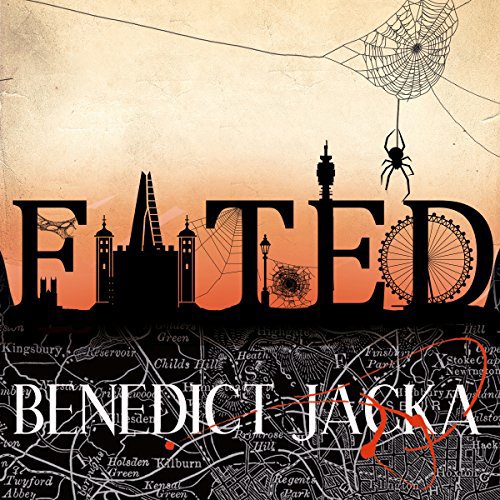
Fated by Benedict Jacka is an entertaining start to what will, hopefully, become a very enjoyable urban fantasy series, even if it is fairly obvious that this is an author still finding his feet. There is plenty here to like, from the imaginative approach to magic to the central character’s rather complicated relationship with his own abilities, and while the writing occasionally feels a little rough around the edges, the seeds of a great series are most definitely present.
Alex Verus is a London-based mage with the ability to see possible futures. Unlike many of the powerful magical types who populate this world, Alex is not particularly interested in getting involved in the political games and power struggles of the magical community. He runs a shop selling magical odds and ends, keeps his head down and tries to avoid trouble. Unfortunately, trouble has a habit of finding him, especially when the people who wield the most power decide that his particular talents might be useful to them.
I took to Alex fairly quickly, largely because he feels like someone who has learnt the hard way that being clever is generally more useful than being powerful. He knows he cannot win every fight, and he is sensible enough to recognise that getting involved in magical politics is a good way to end up dead. I rather liked his instinct to look for an escape route rather than charge straight into danger. There is something refreshingly human about a protagonist who would prefer to live another day rather than risk everything just to prove how brave he is. It also makes his moments of courage more meaningful, because he has a genuine appreciation of what he stands to lose.
The central premise is a good one. Alex’s ability to see possible futures gives him a rather different set of advantages from the usual collection of fireballs, enchanted weapons and spectacular magical destruction. He can anticipate an opponent’s next move, spot danger before it arrives and work out which of several possible courses of action might keep him alive. I particularly enjoyed the idea that knowing what someone is likely to do does not automatically mean you can stop them doing it. Alex still has to make decisions, take risks and live with the consequences, which keeps the action interesting. His talent also creates an appealing contrast between what he can see happening and what he is actually prepared to do about it.
What makes Alex interesting to me is the tension between his cautious nature and the situations that force him to take a stand. I can understand why he is wary of getting involved in other people’s affairs. He has built a life for himself away from the magical establishment’s power games, and there is no reason why he should casually throw it away because someone more influential has decided he would be useful. When powerful people start treating him as a resource to be exploited, I find myself wanting him to tell them exactly where they can put their demands. There is a satisfying stubbornness to his refusal to accept that somebody else’s authority automatically gives them a claim on his abilities or loyalty.
The theme of obligation works best when we look at what Alex actually does rather than simply what he believes. His involvement in the conflict surrounding the powerful mages puts him in a position where keeping his head down is no longer enough. He has to decide whether to cooperate with people whose motives he has every reason to question, or risk the consequences of refusing them. I found myself sympathising with his reluctance to be drawn into their schemes, but I also enjoyed watching him recognise that avoiding a problem does not necessarily mean escaping its consequences. His decisions are shaped by the uncomfortable reality that he cannot always protect himself simply by staying out of other people’s business.
That is where Alex’s gift for seeing possible futures adds something to the moral dilemma. He can consider the likely outcomes of different actions, but he cannot simply calculate his way to a painless solution. Choosing the safest course for himself might leave someone else to face the consequences, while getting involved could put him directly in danger. I liked that tension because it makes his choices feel personal. He is not an idealistic hero who automatically puts everyone else first, nor is he so concerned with his own survival that he can ignore everything happening around him. He has to work out which risks he is prepared to take and which responsibilities he is willing to accept.
I also found the magical hierarchy an effective backdrop for these decisions. The people at the top have the power to make demands, while those with less influence are left to deal with the fallout. Alex’s reluctance to accept their expectations is understandable, particularly when cooperation does not necessarily guarantee fair treatment. At the same time, he cannot expect every difficult situation to resolve itself without his involvement. For me, that is the most interesting question running through the novel: not whether Alex has a duty to obey the powerful, but when his own judgement tells him that walking away is no longer the right answer. I would have welcomed even more time spent exploring the consequences of those decisions, but the groundwork is there.
There is even a cheeky little implication that this might be the same universe inhabited by Jim Butcher’s Dresden Files characters. I will leave it at that rather than spoil the joke, but it raised a smile. I enjoy these little nods to the wider urban fantasy genre, especially when they feel like a wink from the author rather than an attempt to lean too heavily on somebody else’s success.
That said, this is Benedict Jacka’s first published novel, and it shows. Some conversations feel a little functional, and a few characters could do with more depth. There are moments when the plot moves on before I have had quite enough time to absorb what has happened, while aspects of the magical world could have been developed more naturally. I also wanted more time with the supporting cast, as there are hints of interesting personalities that do not always receive the attention they deserve. These are shortcomings I can forgive in a debut, particularly when the central ideas are strong enough to make me want more.
Gildart Jackson deserves credit for his narration. He gives the characters distinct voices without making the performance feel overdone, and his delivery suits the combination of dry humour, magical intrigue and sudden danger. I found him an engaging companion for Alex’s adventures, helping the dialogue flow and giving the characters enough individuality to make their interactions work.
Overall, Fated is an enjoyable introduction to the Alex Verus series. It is not the most polished urban fantasy novel I have read, but I came away liking Alex, intrigued by his abilities and curious about the world Jacka has created. What really works for me is that his predicament forces him to choose between protecting himself and accepting the risks that come with getting involved. He cannot see every consequence, control every outcome or leave every difficult decision to somebody else. The writing has some rough edges, but the potential is obvious, and I am keen to see how Jacka develops both his storytelling and his central character. A promising beginning, then, and one that has given me good reason to carry on with the series.
Buy your copy here

Leave a Reply