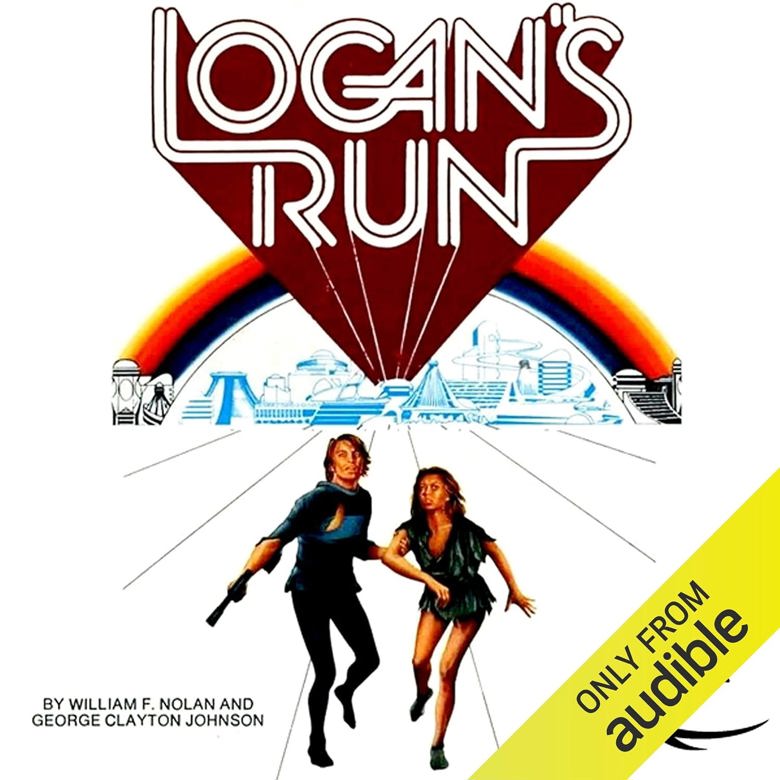
I first came to William F Nolan’s Logan’s Run through the rather roundabout route of the 1970s television series. Like quite a few people, I suspect, my first impression of the story was shaped by that slightly surreal TV version, with its shiny futuristic world and very seventies take on dystopian science fiction. Coming back to the original novel was therefore an interesting experience, because while some of the basic ideas are familiar, the book itself is considerably darker and, more importantly, much more interested in what those ideas actually say about society.
At its heart, Logan’s Run takes one particularly disturbing idea and builds an entire civilisation around it. In this future, people are only allowed to live until the age of twenty-one. When your time is up, you report for your final day and are supposedly rewarded with a glorious rebirth. The reality is considerably less pleasant, but the really unsettling thing is how completely this system has been accepted. People have been taught that death at twenty-one is simply the natural order of things.
That gives Nolan plenty of opportunity to poke at some fairly big ideas about society, and this is where I think Logan’s Run remains surprisingly relevant. The novel is essentially asking what happens when a society decides that individual freedom, personal responsibility and even life itself can be sacrificed in the name of maintaining social order.
The citizens of this future are not living under the sort of obvious totalitarian regime we might expect. They have entertainment, sex, consumer goods and plenty of opportunities to amuse themselves. They are encouraged to enjoy life to the fullest. On the surface, it sounds almost like the ultimate hedonistic utopia. The catch, of course, is that their freedom exists entirely within boundaries established by somebody else.
That contrast is one of the novel’s strongest ideas. You can give people enormous amounts of freedom in some areas while exercising absolute control over others. In Logan’s Run, the population has effectively been persuaded that its own oppression is actually liberation. Don’t worry about the future. Don’t worry about getting old. Don’t worry about responsibility. Just enjoy yourself while you can.
There is an obvious commentary here about societies obsessed with youth and the pursuit of pleasure, but Nolan goes further than simply saying that getting older is good for you. Age represents experience, memory and continuity. By eliminating older generations, this society has also eliminated a huge amount of accumulated knowledge. Every generation is effectively starting again, making the population much easier to control.
And then there is conformity. The most disturbing aspect of the system is not simply that people die at twenty-one, but that almost everybody accepts it. The machinery of the society works because people believe in it. Anyone who questions the rules becomes an outsider, and once Logan begins to question what he has been taught, his entire understanding of the world starts to unravel.
There is also an interesting commentary on the way governments and societies can manipulate fear. People are given a comforting explanation for something horrifying, and because everybody around them accepts it, challenging that explanation becomes almost unthinkable. It is a particularly effective piece of dystopian storytelling because the system doesn’t need everyone to be violently coerced. It simply needs enough people to believe that obedience is normal.
The story itself moves at a brisk pace, with Logan’s journey gradually becoming a confrontation with the society he once accepted. Nolan doesn’t spend enormous amounts of time explaining every aspect of his future, which occasionally leaves the world feeling underdeveloped, but I actually think that helps keep the novel focused. This is less interested in building an encyclopaedic future history and more interested in presenting an idea and seeing what happens when somebody finally starts asking awkward questions.
The characters are another area where the book can feel dated. Some could certainly have been developed further, and the speed of the story occasionally means emotional moments don’t receive quite as much attention as they might in a modern novel. But there is something refreshing about its directness. Nolan has an idea, throws you into it and lets the consequences unfold.
The Audible audiobook is helped considerably by Oliver Wyman’s narration. He brings an energy to the performance that suits the pace of the story, while also allowing the darker and more unsettling elements to come through. His narration makes the transition from apparently carefree future to increasingly oppressive nightmare particularly effective.
Ultimately, Logan’s Run is much more than the curious science fiction story I remembered from the 1970s TV show. Beneath the futuristic setting and fast-moving plot is a surprisingly pointed examination of conformity, social control, the cult of youth and the dangers of allowing a society to decide what is best for everyone.
It is certainly showing its age in places, and I would have liked more depth from some of the characters and ideas, but the central premise still works remarkably well. In fact, revisiting it now makes some of its warnings feel rather uncomfortable. Logan’s Run may be an old-fashioned dystopian adventure, but its questions about freedom, conformity and who gets to decide how we should live remain very much alive.
Buy your copy here

Leave a Reply