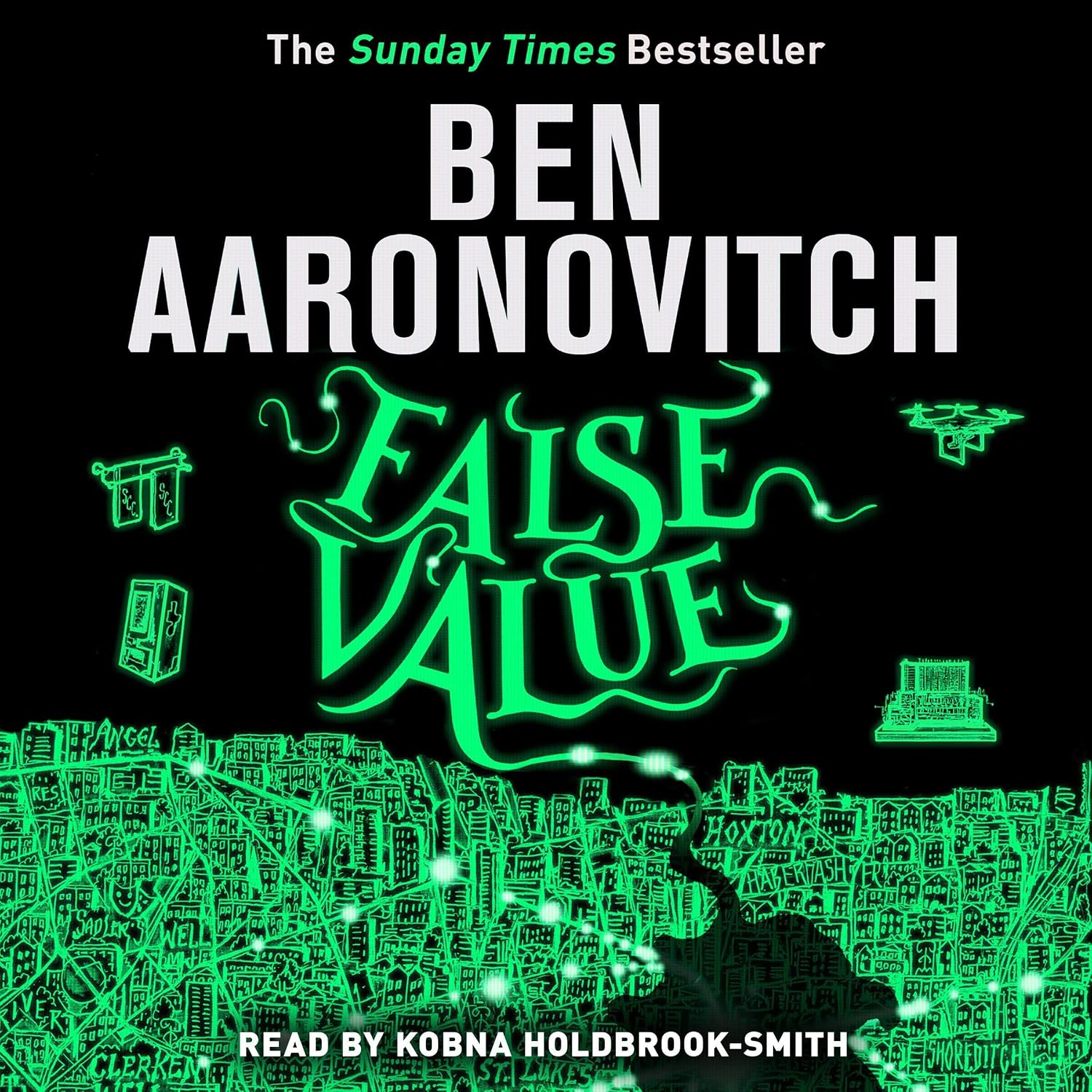
There are probably easier ways for a Metropolitan Police officer to prepare for fatherhood than going undercover inside a mysterious technology company, but Peter Grant has never been particularly good at choosing the easy option.
False Value takes Peter into yet another unfamiliar corner of London, this time into the world of artificial intelligence, software development and technology startups. Having spent the earlier books dealing with ghosts, gods, wizards and various things that would make most people question their life choices, Peter now has to get his head around programmers, corporate culture and the possibility that someone has discovered a rather interesting way of combining modern technology with some very old magic.
Because apparently that is a thing now.
The story gives Peter his first full-on undercover assignment, and I really enjoyed watching him try to negotiate a world that is about as far removed from conventional policing as you could reasonably get without leaving the planet. There is something inherently funny about Peter having to pretend to be someone he isn’t while simultaneously trying to work out what exactly is going on around him.
He is still Peter, though, which means that however strange the surroundings become, he approaches them with the same mixture of curiosity, scepticism and increasingly well-practised resignation.
I particularly liked the way Aaronovitch uses the technology setting to expand the series rather than simply changing the wallpaper. False Value is interested in the relationship between magic and technology, and that gives the supernatural elements a very different flavour. Instead of ancient spells being hidden away in dusty rooms, we have magic potentially interacting with algorithms, artificial intelligence and modern scientific thinking.
It is a wonderfully odd combination.
The police procedural detail remains present too, although by now it feels more like part of the natural fabric of the story rather than something Aaronovitch needs to draw attention to. Peter still has to think like a copper, work within an organisation and deal with the practical consequences of an investigation. There is an appreciation of how information is gathered, how people are questioned and how difficult it can be to establish what is actually happening when everyone involved has their own interests.
That realism is particularly useful when the story starts getting fantastical.
The more outrageous the supernatural elements become, the more believable they feel because Peter is still approaching them from a recognisable professional perspective. Magic may be involved, but Peter cannot simply wave a wand and declare the investigation solved. There are people to convince, evidence to interpret and consequences to consider.
That balance has become one of my favourite things about the series.
Peter’s personal life is also becoming considerably more complicated, with fatherhood looming on the horizon. His relationship with Beverley has developed steadily throughout the books, and the prospect of becoming parents adds another layer to Peter’s already crowded existence.
Because apparently investigating magical conspiracies wasn’t enough.
I like the fact that this isn’t treated as a simple romantic subplot. Peter and Beverley are trying to work out what their future looks like while existing in two very different worlds. Beverley’s supernatural nature and Peter’s increasingly unusual career make the prospect of raising a child rather more complicated than it might be for most couples.
Then again, most couples don’t have river gods in the family.
The supporting cast continues to be one of the great pleasures of the series. By this stage, these characters feel properly established, and their relationships with Peter give the story a sense of continuity. There is a feeling that his world exists beyond whatever mystery happens to occupy the current book, which makes the series increasingly satisfying to spend time in.
The humour remains excellent too. Peter’s dry observations and ability to treat supernatural absurdity as another irritating feature of the working day are still a constant source of amusement. The contrast between ancient magic and modern technology gives Aaronovitch plenty of opportunities to have fun with both.
And then there is Kobna Holdbrook-Smith.
Once again, he is fantastic.
His narration has become so closely associated with Peter Grant that I can now hear the character’s voice in my head even when I’m not listening to the audiobook. Holdbrook-Smith captures Peter’s conversational style perfectly, but he also gives the wider cast enough individuality to keep everyone distinct without descending into theatrical caricature.
His timing is particularly effective with the humour, but he is equally good when things become tense or more reflective. He understands the rhythm of these books and knows when to let a line breathe, when to push the comedy and when to allow a darker moment to land.
At this point, his performance feels less like narration and more like having someone guide you through Peter’s increasingly bizarre life.
If I have any complaint, it is only that the combination of magic and technology occasionally leaves me wanting to know rather more about how everything fits together. But that is hardly a serious problem. The unanswered questions are part of what keeps the series moving forward, and I would much rather have a world that continues to surprise me.
False Value is another thoroughly enjoyable addition to the series. It gives Peter a fresh environment, lets him tackle his first proper undercover assignment and explores what happens when the supernatural meets the modern technology industry.
It also continues to balance the extraordinary with the everyday remarkably well. The police realism keeps the story grounded, while the fantasy makes the familiar world of policing feel anything but ordinary.
Add in Peter and Beverley preparing to become parents, an increasingly enjoyable supporting cast, plenty of dry humour and Kobna Holdbrook-Smith’s superb narration, and there is very little to complain about.
Peter Grant may have survived magic, murder and supernatural conspiracies.
Now he has to survive parenthood.
Good luck, Peter.
Buy your copy here

Leave a Reply