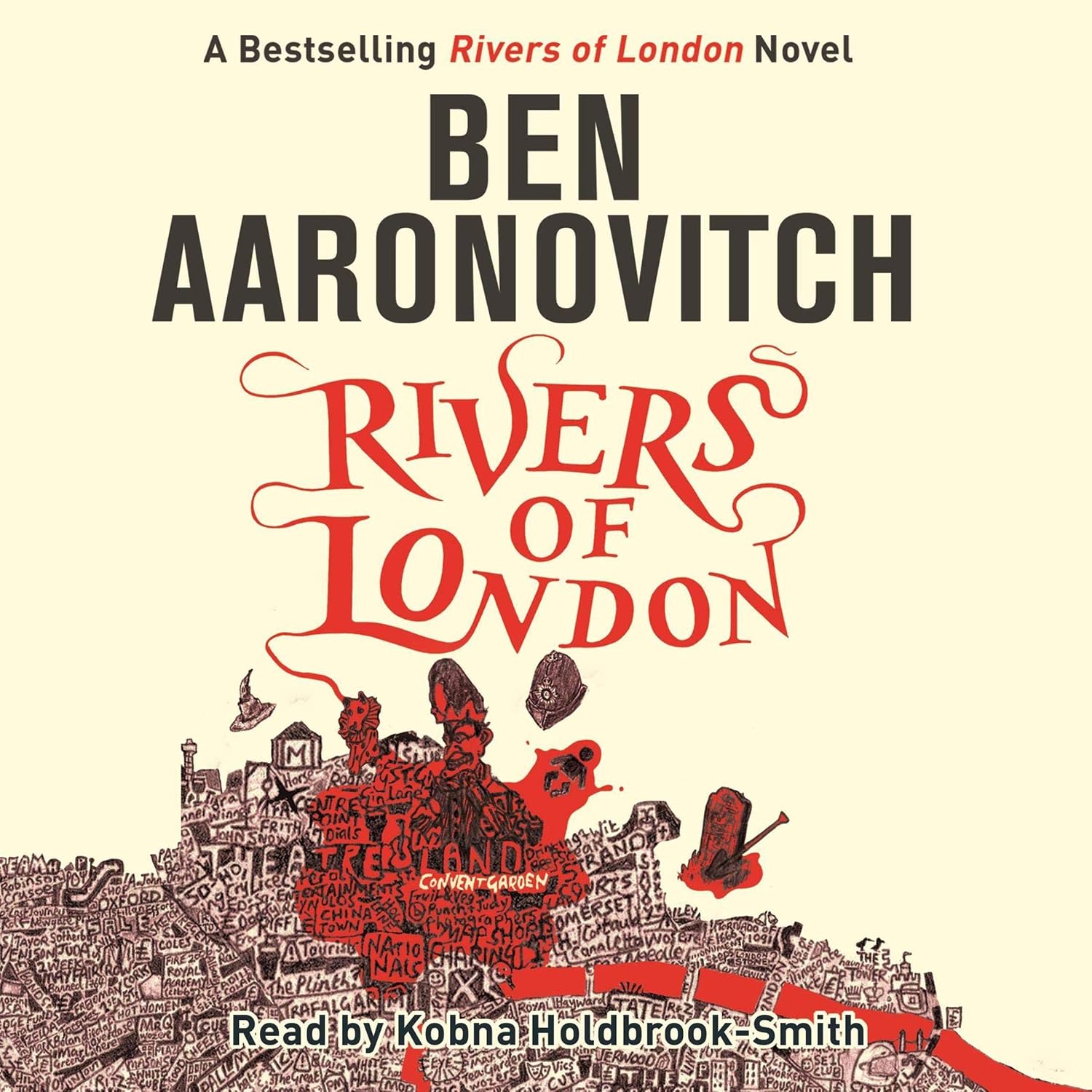
There are certain books that make you wonder why nobody thought of the idea before. Rivers of London is one of those books. Take a fairly ordinary Metropolitan Police officer, throw him into a murder investigation involving a ghost, introduce him to the last wizard in England, add some river gods, and a rather unhealthy amount of supernatural weirdness, and somehow make the whole thing feel completely plausible. That last part is the clever bit.
Ben Aaronovitch’s Rivers of London is urban fantasy, certainly, but it is also very much a police procedural. Peter Grant begins the story as a probationary constable hoping to become a detective, only to discover that his ability to see and communicate with ghosts has rather unexpectedly made him a candidate for something considerably stranger. Before long he is apprenticed to Detective Chief Inspector Thomas Nightingale, learning magic while investigating a series of increasingly bizarre murders.
And I absolutely love the way Aaronovitch handles that collision between the mundane and the magical.
There is a remarkable amount of attention to detail in the police procedural side of the story. This isn’t a case of the police merely existing as convenient scenery while Peter runs off to investigate the supernatural. There are reports to write, evidence to collect, witnesses to interview, databases to search, colleagues to deal with and all the other bureaucratic joys that presumably make up a significant proportion of modern policing.
It sounds like it might slow the story down. In practice, it does the exact opposite.
The procedural realism gives the fantasy something solid to push against. When Peter is dealing with magical murders, river gods and ancient supernatural forces, the fact that he is still thinking like a policeman makes the whole thing feel grounded. He doesn’t suddenly become a fantasy hero who happens to wear a police uniform. He remains a copper trying to work out what the hell is going on.
That distinction makes all the difference.
There is also something wonderfully British about the way the supernatural is treated. Magic isn’t presented as some grand revelation that completely transforms reality. It is more like discovering that reality has always contained a load of weird bollocks that nobody thought to mention. London already has ghosts, legends, strange old buildings and centuries of accumulated history. Apparently it also has wizards and river deities. Fair enough. Carry on.
Peter is an excellent protagonist for this world because he is curious without being endlessly amazed by everything. He asks questions, makes observations, gets things wrong and occasionally finds himself in situations where the sensible response would probably be to run away very quickly. Naturally, he doesn’t always do that.
His relationship with Nightingale is another highlight. There is something wonderfully entertaining about putting a very traditional, rather mysterious wizard alongside a modern police officer who has to learn magic while still dealing with the practical realities of police work. It creates a lovely contrast between old and new, tradition and bureaucracy, spells and paperwork.
And then there is London itself.
Aaronovitch clearly knows the city, and the book makes excellent use of it. The locations aren’t simply convenient names dropped into the narrative to establish that this happens in London. The city feels lived in, layered and occasionally downright strange. Familiar places acquire another dimension once Peter starts looking at them through the eyes of someone who knows that the supernatural is hiding just around the corner.
The humour is a big part of the appeal too. It is dry, observational and often wonderfully understated. Peter has the sort of internal commentary that makes even fairly mundane situations entertaining, while the contrast between his increasingly bizarre circumstances and his fairly practical approach to them provides much of the comedy.
But for me, the audiobook takes everything up another notch.
Kobna Holdbrook-Smith is superb.
There is a real sense that he isn’t simply reading Peter’s narration but inhabiting it. His delivery captures Peter’s conversational personality beautifully, while his handling of the wider cast gives the characters their own identities without turning the performance into a parade of exaggerated voices. His command of accents, characterisation and timing adds an enormous amount to the experience.
Most importantly, he gets the tone. The humour lands naturally, the police procedural elements retain their grounded quality and the more fantastical scenes never feel disconnected from the world around them. That balance is not easy to achieve, but Holdbrook-Smith makes it sound effortless. His narration has become so closely associated with the series that it is difficult to imagine Peter Grant sounding any other way.
There really isn’t much I can complain about here. The story occasionally has a lot of information to juggle as Peter learns about magic, the history behind it and the various supernatural players involved, but even that feels appropriate. After all, Peter is learning this stuff at the same time we are.
Rivers of London is funny, clever, atmospheric and just plain entertaining. More importantly, it understands that the best way to make the fantastic believable is to surround it with the ordinary. Police procedure, paperwork, London traffic and office politics might not sound like the natural companions of magic, but somehow they make the magic work even better.
This is a cracking start to a series, and with Kobna Holdbrook-Smith behind the microphone, it is an even better listen. I went into Rivers of London expecting urban fantasy and came away with something that feels like a genuinely convincing supernatural police procedural.
Which, when you think about it, is probably exactly the sort of thing Peter Grant would be hoping for.
Buy your copy here

Leave a Reply