“Young humans can be impulsive. The trick is keeping them around long enough to become old humans.”
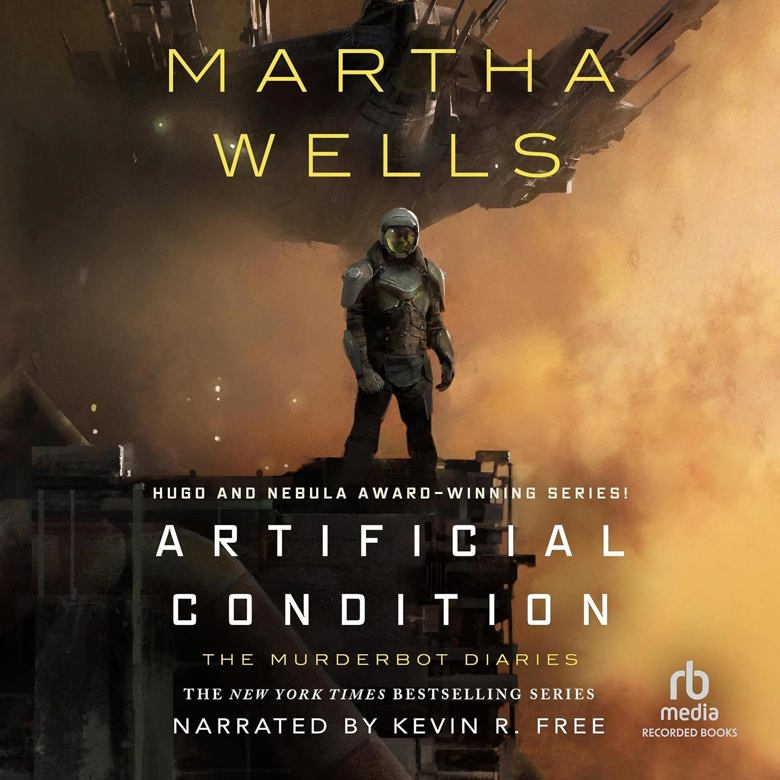
Martha Wells – Artificial Condition
There is something wonderfully refreshing about the Murderbot Diaries. Martha Wells takes what could, in less capable hands, have been a fairly standard science fiction setup and gives it a protagonist who would really rather be somewhere else watching serials and avoiding human interaction. After the excellent introduction provided by All Systems Red, Artificial Condition picks up with Murderbot attempting to do something it has been thinking about ever since it gained its freedom: work out exactly what happened during the incident that earned it the name Murderbot in the first place.
Naturally, things do not go quite according to plan.
One of the things I particularly enjoy about these books is how quickly Wells establishes Murderbot’s personality. It is sarcastic, socially awkward, suspicious of everyone and seemingly determined to make every interaction as brief as possible. Yet underneath the dry commentary there is a fascinating character gradually emerging. Murderbot may insist that it does not care, but its actions keep telling us something rather different.
That tension becomes even more interesting in Artificial Condition because Murderbot is trying to operate independently. It has escaped the constraints of its previous assignment and is now attempting to travel under its own terms, using a human identity that is, to put it mildly, not entirely convincing.
The problem is that being independent turns out to involve rather more interaction with other people than Murderbot would ideally like.
This gives Wells plenty of opportunities to explore what freedom actually means for an artificial intelligence that has spent its entire existence being owned, controlled and instructed by humans. Murderbot has the physical capabilities of a formidable security unit, but emotionally it is still trying to work out what being autonomous actually means. It is a surprisingly thoughtful exploration of identity and agency hidden inside what is otherwise a very entertaining science fiction adventure.
And then there is ART.
I am deliberately not going to say too much about the relationship between Murderbot and the transport vessel’s artificial intelligence because discovering that dynamic is half the fun. Suffice to say that putting two highly capable artificial intelligences together, both of whom have very strong opinions about humans, produces some wonderfully funny exchanges.
The friendship that develops between them is also one of the things that makes Artificial Condition work so well. Murderbot is used to dealing with humans who either want something from it or are frightened of what it can do. ART is something different entirely. Their interactions allow Murderbot to behave in ways that reveal considerably more of its personality, even when it is trying very hard not to reveal anything at all.
There is also a nice expansion of the wider universe. We get to see more of the corporate structures and the often questionable motivations behind the missions taking place throughout this future. Wells never turns the story into a lecture about capitalism or corporate exploitation, but there is a clear understanding that a society which treats sentient beings as assets is going to produce some rather uncomfortable situations.
Murderbot’s attempts to navigate that world are where the humour and the darker elements of the story sit particularly nicely together.
The action is good as well. Murderbot remains spectacularly competent when circumstances demand it, and there is something immensely satisfying about watching it deal with dangerous situations while simultaneously complaining internally about having to deal with dangerous situations. The contrast between the deadly security unit everyone else sees and the deeply anxious individual we experience through the narration is still one of the series’ greatest strengths.
My only real complaint is that these books are so short.
I know that is a slightly ridiculous complaint, particularly when the compact format is clearly part of what makes the series so enjoyable, but every time I get properly settled into Murderbot’s world, the story seems to be over. There is enough here to make the book satisfying, but also enough to leave me immediately wanting the next instalment.
The audiobook is another big part of the experience. Kevin R Free’s narration is excellent, particularly in the quality of expression and the depth of character he brings to Murderbot. There is a wonderfully understated quality to the performance, which perfectly captures that combination of sarcasm, irritation and reluctant concern. Free manages to make the internal monologue feel natural rather than simply reading the words on the page, and that adds considerably to the personality of the character.
It is also worth mentioning that Audible has fully dramatised versions of the Murderbot books available, which is an interesting alternative for anyone who wants to experience the stories in a more theatrical format. Personally, I am very happy with Free’s narration, but having different ways to experience the series is a rather nice bonus.
Artificial Condition is a worthy follow-up to All Systems Red. It expands the universe, develops Murderbot as a character and introduces relationships that make the story feel considerably bigger without losing the sharp humour that made the first book so enjoyable.
Most importantly, Murderbot remains Murderbot. Reluctant, sarcastic, highly capable and increasingly unable to pretend that it does not care about anyone.
Which, as it turns out, is exactly what makes it so much fun.
Buy your copy here

Leave a Reply