“Distributed responsibility is the problem. One person gives the order, another carries it out. One can say they didn’t pull the trigger, the other that they were just doing what they were told, and everyone lets themselves off the hook.”
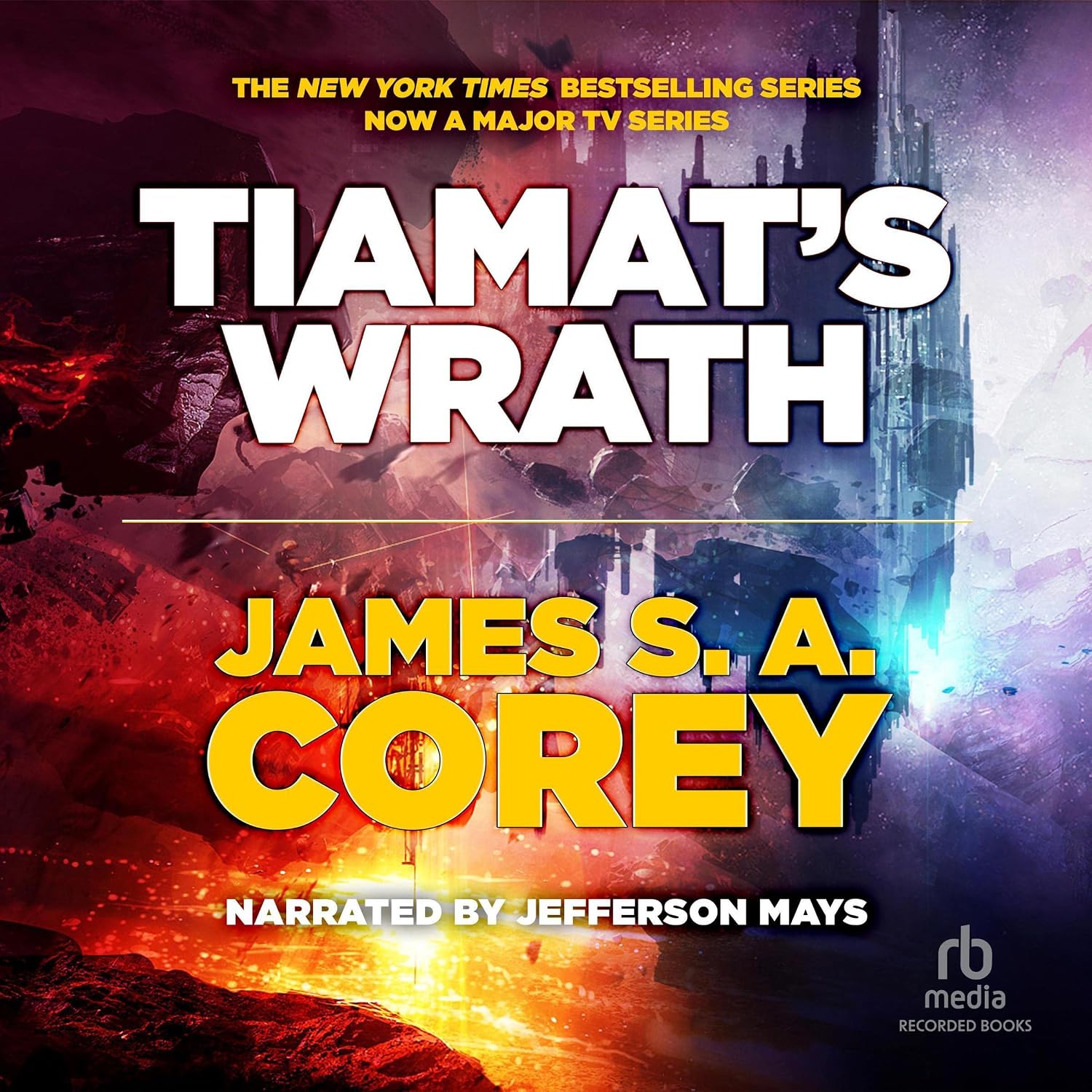
James SA Corey – Tiamat’s Wrath
Tiamat’s Wrath is one of those books where I found myself repeatedly thinking, “Well, this has escalated rather dramatically.” After the enormous change of direction in Persepolis Rising, I was already expecting The Expanse to be operating on a completely different scale. What I was not quite prepared for was just how personal James S. A. Corey manages to make that enormous story.
The Laconian Empire now controls most of humanity, Duarte has effectively reshaped the political landscape and the old resistance is desperately trying to work out how to fight an enemy that appears almost impossible to defeat. On paper, this should be a story about fleets, technology and the fate of civilisation.
Instead, I found myself thinking about family, ageing, grief and what happens when people are forced to live with the consequences of decisions made decades earlier.
And that really worked for me.
One of the things I particularly enjoyed about Tiamat’s Wrath is how it explores the difference between power and control. Laconia has almost everything going for it. It has superior technology, military dominance and an authoritarian system that can make decisions quickly. The old political structures of humanity have been reduced to something considerably less threatening.
Yet the Laconian system is also incredibly fragile.
That is because controlling people is not the same as convincing them. You can occupy worlds, control communication and dictate policy, but that does not mean people actually accept your authority. Corey has been exploring this idea throughout the series, but here it becomes even more important. Resistance is not simply about winning battles. It is about maintaining the belief that another future is possible.
There is some interesting social commentary in the way Laconia presents itself as a solution to humanity’s problems. Duarte’s empire offers security and stability after centuries of political chaos, and there is an understandable attraction to that. If someone could genuinely make the universe safer, more prosperous and more orderly, how many people would be willing to overlook the fact that they had surrendered their freedom to achieve it?
That question feels uncomfortably relevant.
The book also digs deeply into the consequences of technological power. The protomolecule and the Ring network have given humanity access to capabilities that would have been unimaginable at the beginning of the series. Instead of making us wiser, however, they have simply given us much bigger tools with which to make mistakes.
That may be one of the things I like most about The Expanse. Corey rarely suggests that technology itself is the problem. The problem is what people decide to do with it.
Tiamat’s Wrath also feels much more interested in the passage of time. Persepolis Rising introduced the thirty-year jump, but here the consequences of that decision really start to sink in. The characters have lived through decades of history, and they carry those experiences with them. Nobody gets to simply reset themselves because the plot has moved on.
I found that particularly affecting with the Rocinante crew.
There is something rather bittersweet about seeing these characters I have spent so long with becoming older while still refusing to behave sensibly. Holden remains gloriously Holden, of course, but there is a sense throughout the book that the people we first met in Leviathan Wakes are gradually becoming part of history themselves.
And then there is Teresa Duarte.
Her story gives the novel another fascinating perspective on power because she is growing up inside the system that everyone else is trying to overthrow. She has been raised to believe that Laconia represents humanity’s future, yet she is also beginning to see the contradictions and cruelty underneath that system.
For me, that makes her story work particularly well alongside the wider themes. Political systems are not just machines operated by leaders. They are environments in which people grow up, form their beliefs and decide what they are willing to accept.
There is also a strong sense of inheritance running through the novel. Not simply inheritance in the literal sense, but the things we pass on to the next generation. Ideals, mistakes, grudges, responsibilities and expectations all survive long after the people who created them have gone.
That gives the book an emotional weight that I was not expecting.
If I have a small criticism, it is that the sheer amount of political and technological information can occasionally make the story feel dense. There are moments where I had to remind myself exactly where certain pieces fitted into the larger picture. But the character work kept pulling me back in, and once the major threads started converging, I was completely hooked.
Jefferson Mays is superb throughout the audiobook. By this point, his performance feels less like straightforward narration and more like a complete understanding of the world and the people inhabiting it. He gives the different characters enough vocal identity to make the shifting perspectives effortless to follow, but never lets those distinctions become distracting. I particularly enjoyed the emotional restraint in his delivery during the quieter scenes. There is a lot of weight in this story, and Mays trusts the writing enough to let that weight come through naturally.
What I came away with most strongly is that Tiamat’s Wrath is really a book about what happens when the future arrives before people are ready for it.
Humanity has spread across the stars, built an empire, discovered technologies beyond its understanding and encountered forces that could potentially destroy everything.
And underneath all of that, people are still trying to work out who they are.
That is what keeps The Expanse feeling so human for me.
Tiamat’s Wrath is bigger than ever, more dangerous than ever and considerably more personal than I expected.
Nine books in, I am now genuinely nervous about where this is all heading.
Which, I suspect, is exactly where James S. A. Corey wants me.
Buy your copy here

Leave a Reply