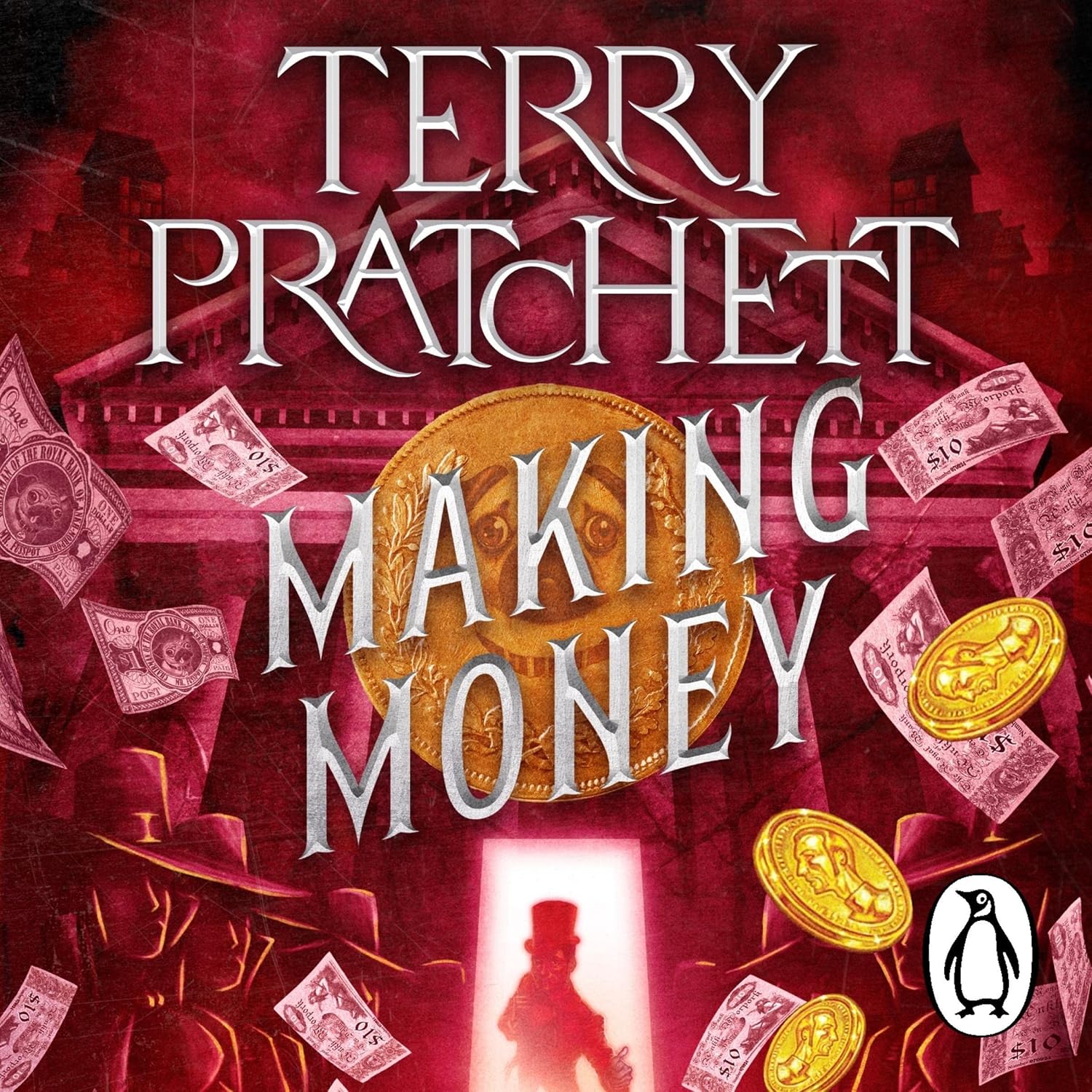
If Going Postal was Terry Pratchett taking a good long look at the postal service and wondering what would happen if you put a professional conman in charge of it, Making Money takes the next logical step.
Give the same man a bank.
Because obviously that is going to end well.
Moist von Lipwig is back, and having successfully transformed the Ankh-Morpork Post Office from a creaking relic into a functioning and surprisingly popular institution, he has attracted the attention of Lord Vetinari once again. This time, however, the task awaiting him is rather more complicated than delivering letters.
The Royal Bank of Ankh-Morpork is in trouble.
The solution, naturally, is to put Moist in charge.
What could possibly go wrong?
Quite a lot, as it turns out.
Making Money is another excellent example of Pratchett taking something that most of us have learned to regard as impossibly complicated and then reducing it to a series of ridiculous people making increasingly alarming decisions. Money, banking, debt and economics might sound like subjects that would make even a wizard reach for the nearest sleeping potion, but Pratchett manages to make them surprisingly entertaining.
More importantly, he uses the subject to poke some very sharp sticks at the way money actually works.
The central joke is that money is, in many respects, an idea. We agree that something has value, we trust somebody else to recognise that value and then we all carry on as though this arrangement is perfectly sensible. Until, of course, somebody loses confidence in it.
Then everybody starts shouting.
Making Money has a lot of fun with the strange psychological relationship people have with money. Coins feel real because we can hold them. Notes feel real because they look official. But increasingly, money becomes something represented by numbers, promises and confidence. Pratchett takes this concept and gives it the full Discworld treatment.
If money is largely about belief, then the person who can control belief has an enormous amount of power.
That leads neatly into some of the novel’s social commentary. Pratchett explores banking, debt, inflation, financial confidence, corporate power and the relationship between money and social status. There is also plenty here about the tendency of financial institutions to make simple things look complicated.
This is perhaps one of my favourite aspects of the book.
There is a wonderful absurdity in the idea that everyone trusts banks because they are complicated, while banks trust everyone because they have complicated paperwork.
And if you have ever looked at a financial statement and wondered whether somebody has deliberately designed it to prevent you understanding where your money has gone, Making Money will probably make you feel slightly better about the whole thing.
Only slightly.
The story also continues Pratchett’s fascination with progress. Ankh-Morpork is changing rapidly, and Moist finds himself at the centre of another technological and social transformation. The introduction of paper money challenges long-established ideas about what money should look like, while the traditionalists react in much the way traditionalists everywhere tend to react when somebody suggests changing something.
By shouting.
The novel understands that progress is rarely straightforward. New ideas can be useful, but they can also be exploited. The people who control new systems can gain enormous influence, and the people who do not understand those systems can find themselves at a considerable disadvantage.
There is also an interesting thread running through the story about trust. Banks cannot function without it, governments cannot function without it and, rather surprisingly, neither can Moist. His entire career has been based on deception, yet his new job requires him to convince people that he is trustworthy.
This gives the character a nice contradiction.
Moist remains Moist. He lies, cheats, improvises and generally treats the laws of probability as personal suggestions. But there is a growing sense that he actually wants to build something rather than simply exploit it. That development makes him considerably more interesting than the traditional charming rogue who spends the entire story learning absolutely nothing.
The supporting cast is just as enjoyable. Adora Belle Dearheart remains one of the strongest characters in the series, and the golems continue to provide both comedy and some surprisingly thoughtful observations about identity, work and what it means to be considered a person. Then there are the assorted bankers, politicians and citizens of Ankh-Morpork, all of whom seem to have their own perfectly reasonable reasons for doing things that are clearly going to cause trouble.
Richard Coyle once again does a fantastic job with the narration. His performance suits Moist particularly well, capturing the character’s quick thinking and effortless charm while also allowing the moments of uncertainty to come through. There is a nice confidence to Coyle’s delivery that makes the whole story feel as though Moist is standing beside you explaining why everything is completely under control.
Even when it very clearly isn’t.
The familiar additional voices are another treat. Peter Serafinowicz gives Death that wonderfully distinctive mixture of solemnity and understated comedy, making every appearance land beautifully. Bill Nighy, meanwhile, brings his trademark laid-back delivery to the footnotes, sounding almost entirely unconcerned by the fact that the narration occasionally wanders off into increasingly bizarre territory. It works brilliantly, particularly because the more absurd the aside becomes, the more casually he seems to deliver it.
Making Money is not quite as immediately accessible as Going Postal, simply because banking and economics are less instinctively entertaining than stamps and letters, but Pratchett makes the subject work remarkably well.
It is funny, clever and surprisingly relevant, with plenty to say about money, trust, progress, bureaucracy and the institutions we allow to control enormous parts of our lives.
And once again, Moist von Lipwig proves that there is no problem in Ankh-Morpork that cannot be solved by throwing a professional fraudster at it and hoping for the best.
Which, when you think about it, is probably the most honest description of economics you are likely to get.
Buy your copy here

Leave a Reply