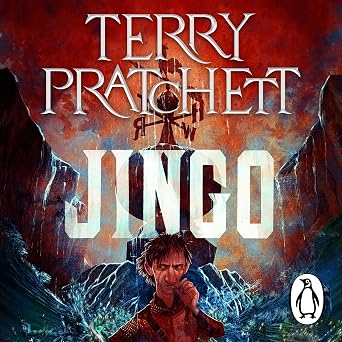
By Jingo, the City Watch has stopped being a collection of people in uniforms and started becoming a proper force. This is progress, obviously, which means Ankh-Morpork is about to become dangerous.
Jingo takes the Watch out of the city and drops them into an international crisis involving a newly discovered island, two nations and enough patriotism to fill several very large hats. Ankh-Morpork and Klatch are heading towards war, and Commander Vimes finds himself trying to prevent a conflict while being surrounded by people who seem remarkably keen to have one.
A perfectly normal day on the Disc, in other words.
Pratchett takes the machinery of war and nationalism and reduces it to its component parts. Pride, fear, propaganda and ordinary people being encouraged to dislike people they have never met. It is social commentary delivered with a raised eyebrow.
The central joke is that nobody seems sure why the two sides are fighting, but everybody is certain their side is right. Once the drums start beating, facts become inconvenient things that can be ignored in favour of flags and stirring speeches.
Pratchett shows how easily patriotism can become tribalism. There is a difference between loving where you come from and assuming everyone else is an enemy. Jingo explores that distinction without ever turning into a lecture. Instead, it gives us Vimes, who is much more interested in stopping people getting killed than in discovering whose flag looks most impressive.
There is also quite a lot of Nobby, which is rarely a sign that civilisation is functioning properly.
The Watch itself continues to develop beautifully. Vimes is now an increasingly capable commander, although he remains deeply suspicious of the idea that anyone should actually call him one. Carrot is still Carrot, Angua is becoming an increasingly important part of the Watch, and Detritus continues to demonstrate that diplomacy works considerably better when everyone knows you are carrying a very large weapon.
Leonard of Quirm adds another layer of wonderfully eccentric genius. One pleasure is watching the Watch become a genuine team. Their different backgrounds become strengths rather than obstacles, and none of them quite fit the traditional idea of a policeman.
There is also a lovely examination of bureaucracy and authority. Vimes has little time for people who believe a uniform automatically makes them right. He is interested in what happens to actual people when decisions are made by people sitting comfortably somewhere else.
This gives Jingo a surprisingly modern feel.
And, naturally, Pratchett cannot resist filling the book with jokes.
The humour ranges from obvious visual gags to throwaway lines that only register several seconds later. One running gag I particularly enjoyed was Wilson Keppel and Betty. I am far too young to have any personal memory of the act, but the sheer absurdity of the reference made it even funnier. It is exactly the sort of cultural joke that makes Discworld feel as though it contains several generations of comedy all piled into the same cupboard.
The audiobook is an excellent addition. John Culshaw does a superb job of handling the increasingly large cast and the different voices of the story without losing the pace or conversational feel.
Peter Serafinowicz once again provides the voice of Death, who talks LIKE THIS, bringing that familiar mixture of solemnity and comedy to every appearance. Bill Nighy also returns with his trademark nonchalance as the voice of the footnotes, which is still one of my favourite touches in these editions. On Discworld, even the footnotes deserve a professional actor.
What I particularly like about Jingo is that it manages to be an entertaining adventure while still having something worthwhile to say. It pokes fun at nationalism, war, political posturing and the tendency of people to become very enthusiastic about conflicts that other people will actually have to fight.
It is funny, clever and pointed, without ever losing sight of the fact that this is supposed to be fun.
Most importantly, the Watch continues to evolve. These characters are no longer simply there to provide jokes while somebody else gets on with the adventure. They are the heroes, although Vimes would probably object.
Jingo proves that you can make serious points about war and prejudice without losing the jokes.
You just need a few policemen, an island, two armies and a camel.
Buy your copy here

Leave a Reply