“It looked like the sort of book described in library catalogues as ‘slightly foxed’, although it would be more honest to admit that it looked as though it had been badgered, wolved and possibly beared as well.”
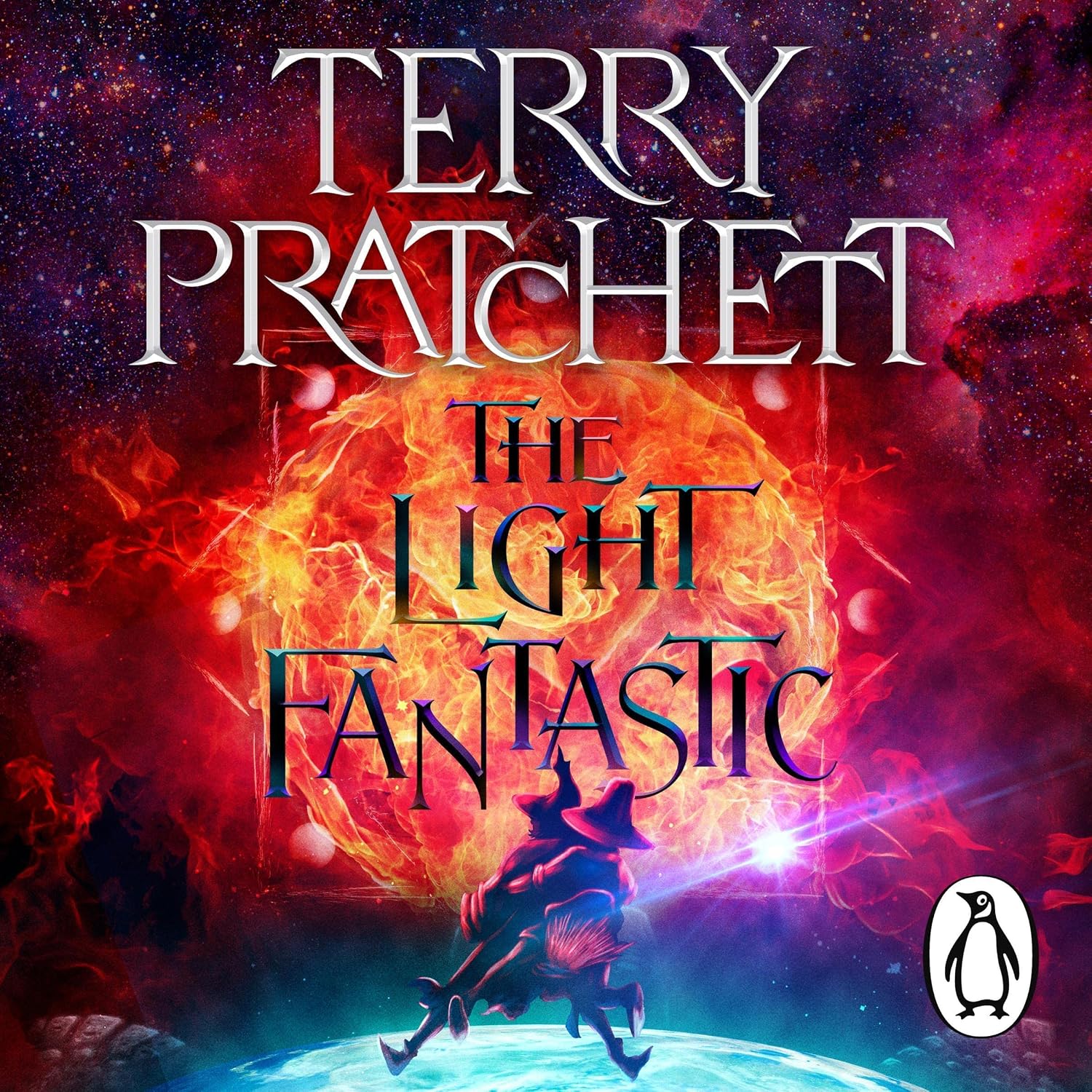
Terry Pratchett – The Light Fantastic
If The Colour of Magic was the Discworld equivalent of throwing everything at the wall to see what stuck, The Light Fantastic feels like someone has come along afterwards, looked at the wall and thought, “Actually, some of that is pretty good.”
It is still very much an early Discworld novel, and it is still one of the weaker entries in the series. There is a certain looseness to the plotting, some of the humour feels like it is still finding its feet, and the whole thing occasionally resembles a collection of amusing ideas that have been encouraged to go for a walk together. But there are glimmers here of what Discworld would become, and those glimmers are rather exciting.
Picking up almost immediately from The Colour of Magic, we find Rincewind in precisely the sort of situation he would probably have avoided if anyone had bothered asking him. Unfortunately, nobody does. The result is another increasingly chaotic adventure involving magic, wizards, Death, trolls, dragons and an impending catastrophe that is considerably less interested in respecting sensible planning than most catastrophes tend to be.
Rincewind remains one of my favourite things about these early books because he is such an unlikely protagonist. He is not brave in the traditional sense, although he does have an impressive ability to keep moving when a more sensible person would have accepted their fate. He is not particularly powerful. He is certainly not wise. His main survival strategy appears to be being somewhere else as quickly as possible.
Which, admittedly, is not a bad strategy when the alternative is being eaten.
What I find particularly interesting about The Light Fantastic is that you can see the series beginning to understand what it wants to be. The first book was often more concerned with playing with fantasy conventions. Here, the satire starts to feel a little more purposeful. There is still plenty of silliness, but beneath it are observations about power, authority, belief and the tendency of people to become remarkably foolish when they are convinced they know how the world works.
The wizards are especially entertaining in this respect. There is something wonderfully familiar about powerful men sitting around discussing enormously important matters while demonstrating that competence is not necessarily a prerequisite for authority. It is fantasy bureaucracy, essentially, which is perhaps the most terrifying magical system of them all.
There is also an interesting thread running through the story concerning knowledge and ignorance. People want answers, but they are not always particularly keen on discovering what those answers might mean. There is a recurring tension between those who believe they understand the universe and those who simply accept that it is probably best not to poke it too hard.
Unfortunately, on the Disc, someone is always going to poke it.
The social commentary is still comparatively broad compared with later Discworld novels, but the foundations are there. Ideas about hierarchy, institutional power, religious belief and the arbitrary nature of authority are woven into the comedy. It is not delivering a lecture, thankfully. The jokes generally arrive first, with the thought-provoking bits quietly following behind and pretending they were not invited.
But, for me, a large part of the pleasure of this audiobook comes from hearing it performed rather than simply reading it. Colin Morgan is becoming part of how I picture this version of Discworld in my head. His narration has an infectious energy that suits the frantic nature of the story, particularly whenever Rincewind finds himself in yet another situation that would be improved considerably by running away.
I also found myself enjoying the character work more than I expected. Morgan gives the cast enough distinction that I can settle into the story without constantly having to remind myself who is speaking. There is a theatrical quality to the performance that feels particularly appropriate for Discworld, as though everyone involved has turned up for a rather chaotic stage production and agreed not to ask too many questions about the scenery.
It also helps that Morgan understands when to let a joke land. Some of the humour in these early books is quite broad, and a less sympathetic narration could make it feel dated or overly silly. Instead, there is a sense of affection behind the performance. Even when the story is being ridiculous, it never feels as though the narrator is laughing at the characters for being ridiculous.
And then there is Death.
Peter Serafinowicz has the perfect presence for the character. I genuinely look forward to his appearances. There is something wonderfully imposing about the voice, but it is never pushed too hard. Death does not need to make an entrance. He simply arrives, and suddenly the audiobook feels as though someone has turned the lights down.
Bill Nighy’s performance as the voice of the footnotes is another absolute highlight. His trademark nonchalance is sublime. I found myself particularly enjoying the little moments when a footnote interrupts the story with the conversational equivalent of someone leaning through a doorway to point out something absurd and then wandering off again.
It gives the audiobook another layer of comedy. You are not just listening to the story. You are occasionally listening to the story being quietly heckled from the sidelines.
That is probably what makes this version work so well for me. There are certainly weaknesses in The Light Fantastic, but the performances make it incredibly easy to settle into. I found myself putting it on when I had jobs to do, then conveniently discovering that the jobs could wait another five minutes because I wanted to hear what happened next.
So, yes, The Light Fantastic is still one of the weaker Discworld books. I would not pretend otherwise. It lacks some of the polish, emotional depth and precision that would become hallmarks of the series.
But it is also considerably more than just an early curiosity.
The potential is beginning to show. The world feels bigger, the satire is becoming sharper and the characters are starting to feel like more than vehicles for jokes. And in audiobook form, with Colin Morgan bringing the whole thing to life, it becomes an especially enjoyable way to watch that potential begin to emerge.
It is not quite there yet.
But you can hear it coming.
Buy your copy here

Leave a Reply