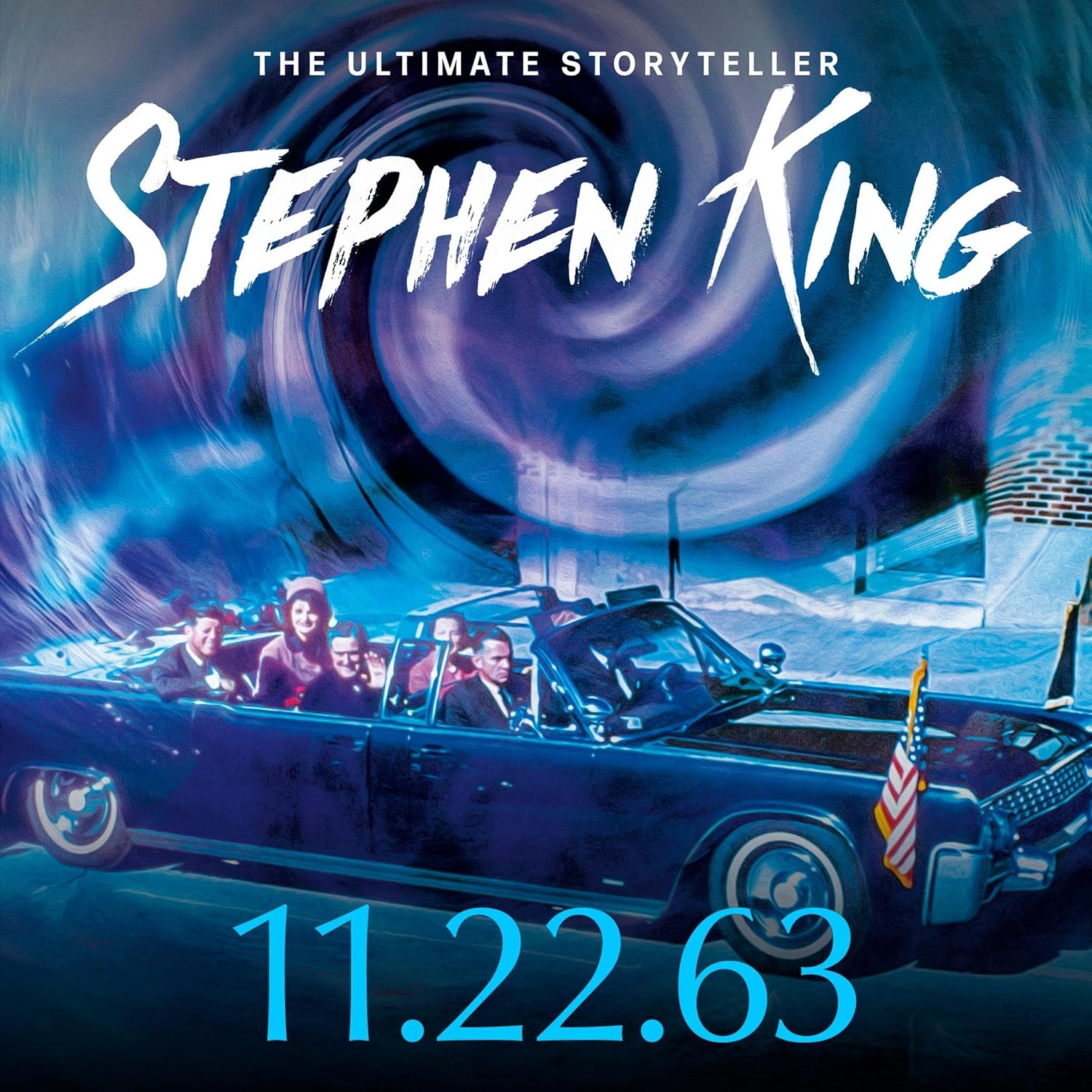
Stephen King’s 11/22/63 is a cracking example of what happens when a brilliant “what if?” question is given the room to develop into something far more interesting than its original premise might suggest. What if you could travel back in time and prevent the assassination of John F. Kennedy? Would changing one of the most significant events in modern American history really make the world a better place? And, perhaps more importantly, could you ever know whether the consequences of your actions were worth the price? King takes these questions and builds a wonderfully absorbing story around them, combining time travel, historical fiction, romance and suspense into a novel that I found surprisingly difficult to put down.
The basic premise is deliciously straightforward. Jake Epping, an English teacher living in the present day, discovers a way to travel back to 1958. His friend Al has been using this remarkable discovery to pursue a mission of his own, but circumstances leave Jake with the opportunity to take up the challenge. The target is 22 November 1963, the day Kennedy was assassinated in Dallas, Texas. Preventing that event becomes the objective, but getting there is another matter entirely.
What makes this work so well is the way King combines the familiar time traveller conceit with the possibilities offered by that enormous historical “what if?”. Time travel stories have an obvious appeal, allowing us to imagine visiting another era or correcting mistakes that have shaped the world. Add the assassination of Kennedy, an event surrounded by decades of speculation, conspiracy theories and competing explanations, and you have the ingredients for a compelling adventure before the story has properly got going.
King, however, is far too good a storyteller to rely on the central mystery alone. The assassination provides the destination, but the journey is where much of the pleasure lies. Jake cannot simply pop back to Dallas, make a few adjustments and return home for tea. He has to learn how to live in a world that is both familiar and wonderfully different, and the closer he gets to his objective, the more complicated things become. The past has its own stubborn momentum, and changing it is considerably harder than it might first appear.
I particularly enjoyed how King makes the late 1950s and early 1960s feel like a place Jake actually has to inhabit rather than a historical backdrop assembled for convenience. There is a tremendous amount of detail here, from the everyday routines of American life to the attitudes, prejudices and social expectations of the period. King captures the appeal of an apparently simpler time without pretending that it was necessarily a better one. The nostalgia is there, certainly, but so are the uncomfortable realities that can get overlooked when we look backwards through rose-tinted spectacles.
That balance is one of the things I appreciated most about the novel. There is an undeniable fascination in the prospect of returning to an era before many of the upheavals that shaped the modern world, but King never allows the past to become an uncomplicated paradise. The social divisions, casual racism, violence and deeply entrenched attitudes are all part of the landscape. Jake may be able to travel backwards, but he cannot leave his own understanding of the world behind. The differences between his present and his adopted past give the story plenty to say about progress, prejudice and the assumptions we make about the people who came before us.
Then there is the question of whether we should interfere with history at all. It is easy to imagine that preventing a terrible event must inevitably produce a better outcome, particularly when that event has become a defining moment in the collective memory. King is much more interested in the complications. History is not a row of dominoes where knocking one over produces a predictable result. Every change creates further possibilities, and the consequences may be impossible to anticipate. There is something genuinely unsettling about the idea that even the best intentions might produce outcomes far worse than the original problem.
I also loved the way the story gradually becomes about much more than its historical mission. Jake develops relationships and attachments that make his original objective increasingly complicated on a personal level. His experiences force him to consider what he is willing to sacrifice, and whether the grand ambition of changing history can ever be separated from the ordinary human desire to find happiness. King understands that the stakes of a story do not have to involve the fate of the world to feel enormous. Sometimes it is the personal choices, and the people who might be hurt by them, that really get under your skin.
Without giving anything away, the Easter Eggs scattered throughout the novel are an absolute delight. King has a wonderful way of rewarding readers who recognise a familiar name, reference or connection, but these little touches never feel as though they are there simply to show off. They add another layer of enjoyment to the experience, and I found myself smiling whenever one appeared. They are a lovely bonus rather than something you need to recognise to appreciate the story.
Craig Wasson deserves considerable credit for the audiobook. His narration is excellent, bringing clarity and personality to a long and detailed novel without making the performance feel overdone. He handles the dialogue particularly well, giving the various characters their own voices and making Jake’s experiences feel immediate and believable. There is a lot of ground to cover here, both in terms of the length of the story and the range of emotions it explores, but Wasson maintains the listener’s interest throughout. His performance adds enormously to the pleasure of spending so much time in King’s carefully constructed world.
If I have a reservation, it is that King occasionally takes the scenic route when a slightly tighter narrative might have served him just as well. There are stretches where the detail and repetition slow things down, and readers looking for a relentless race towards Dallas may find their patience tested. Personally, though, I think much of the novel’s charm lies in allowing Jake’s life in the past to unfold at its own pace. The time spent getting to know the people and places along the way gives the eventual stakes their emotional weight.
Overall, 11/22/63 is a hugely enjoyable novel that demonstrates just how much can be done with a strong central idea and a storyteller willing to follow it wherever it leads. It is an intriguing time travel adventure, an affectionate but clear-eyed portrait of a vanished America, a thoughtful exploration of history and consequence, and a surprisingly moving story about love, loss and the choices we make. King manages to make a familiar historical question feel fresh while giving it enough human depth to sustain a very substantial book.
I came away thoroughly satisfied. It is the sort of novel that invites you to settle in, forget about the outside world for a while and let yourself be carried along by the story. With its rich historical detail, fascinating premise and excellent audiobook narration, I think it is the perfect rainy weekend read. Put the kettle on, get comfortable and prepare to spend a good long while wondering what might have been.
Buy your copy here

Leave a Reply