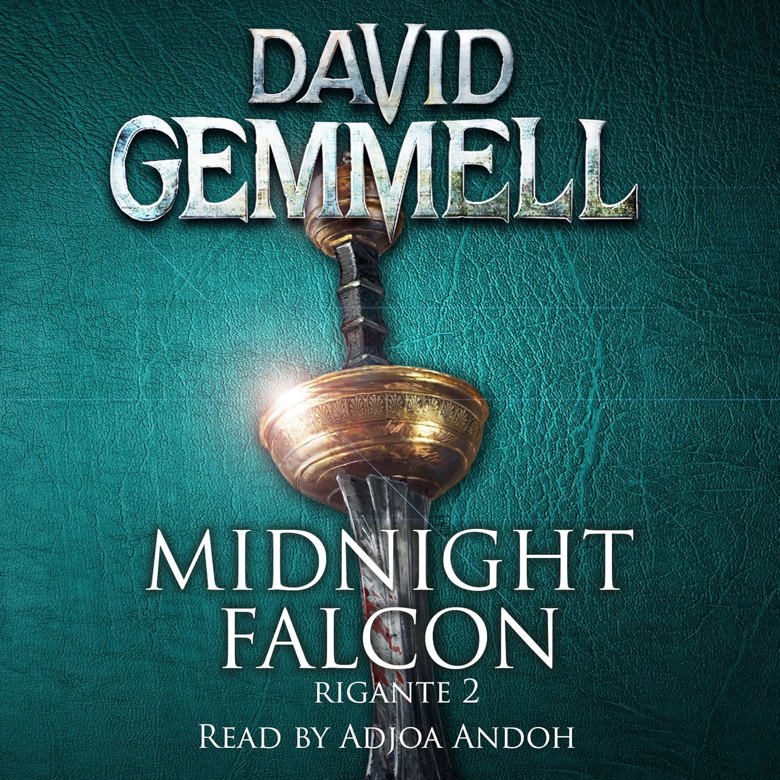
One of the things I enjoy about David Gemmell is his ability to take a world that feels as though it belongs to the realm of legend and fill it with people who feel decidedly human. His heroes make mistakes, their good intentions have a habit of going spectacularly wrong, and being destined for greatness rarely makes their lives any easier. Midnight Falcon, the second book in the Rigante series, returns us to the world of Sword in the Storm, but this time Gemmell takes a rather different approach to his central character. And I have to say, I found Bane an interesting fellow to spend time with, even when I occasionally wanted to give him a good shake.
Bane is the illegitimate son of Connavar, the legendary Rigante warrior whose story dominated the first book. That is quite a legacy to live with, particularly when you are growing up away from the people and traditions that might have helped you understand it. Bane has to make sense of his own identity while dealing with the consequences of his father’s reputation, and Gemmell does a good job of showing how resentment, pride and a desire to prove oneself can become a rather combustible mixture.
What I particularly liked was that Bane doesn’t simply inherit his father’s heroism along with his name. He has his own problems, his own prejudices and his own rather impressive capacity for making questionable decisions. There were moments when I could sympathise with his frustration, even when I thought he was going about things in entirely the wrong way. That tension made his development much more satisfying than watching another fantasy hero discover that he is secretly brilliant at absolutely everything.
His experiences beyond the immediate world of the Rigante also give the story an interesting contrast. Bane has to navigate unfamiliar surroundings and different ways of living, and I enjoyed seeing how these experiences challenge his assumptions. He cannot simply rely on the values and expectations he has inherited. He has to work out which principles are genuinely his own and which are merely reactions to the circumstances of his upbringing. For me, this is where the story becomes more than an entertaining adventure. Bane’s struggle is not just about becoming a warrior, but about deciding what sort of man he wants to be.
The wider setting remains a real pleasure. Gemmell’s Keltoi, Men of Stone and Vars draw on recognisable elements of ancient European history. The Keltoi evoke the ancient Celtic peoples, with their tribal loyalties, warrior traditions and spiritual beliefs. The Men of Stone recall the organisation and military might of Rome, while the Vars bring to mind the Anglo-Saxon and Norse raiders who helped shape Britain’s history. The Sidhe add the supernatural element, giving the world a sense that the old legends might be considerably more than stories told around a fire.
These are fantasy cultures rather than direct historical recreations, but the real-world parallels give their conflicts extra weight. I found it easy to understand why the Rigante would fight to preserve their traditions, even when those traditions might be holding them back. When a more powerful civilisation threatens your home, it isn’t just your land that is at stake. Your language, customs, beliefs and entire sense of identity can be swept away. Gemmell understands that conquest has consequences long after the fighting stops, and that makes the political background more interesting than a simple contest between good and evil.
Honour, duty and destiny are once again central themes. Bane’s circumstances make these questions particularly personal. How much responsibility should he accept for his father’s actions? Does he owe anything to a people and a heritage he has not fully experienced? And how much of his future has already been decided by the circumstances of his birth?
I enjoyed the way Gemmell explores these questions without turning the novel into a lecture. Honour can be admirable, but it can also encourage people to make terrible decisions simply because backing down feels like admitting defeat. Duty can give someone a purpose, yet it can also become a convenient excuse for demanding sacrifices from others. Destiny is the trickiest of the three. We see the influence of ancestry and reputation throughout the story, but Bane’s journey suggests that what we do with those influences matters just as much as where we begin.
There is a little social commentary here, too, about the roles society assigns us and the difficulty of escaping other people’s expectations. I particularly appreciated the idea that being born into a particular position does not necessarily mean you understand it, deserve it or should be expected to fulfil it in a particular way. That feels just as relevant outside fantasy as it does within Gemmell’s imagined world.
Of course, nobody picks up a David Gemmell novel expecting everyone to sit around discussing their feelings for seven hundred pages. There are battles, danger, betrayals and enough action to keep things moving. The author has a wonderful knack for making individual acts of courage feel important, even when the larger conflict seems hopeless. A few developments are rather convenient, and some of the more dramatic moments verge on melodrama, but I was enjoying myself too much to get terribly worked up about them.
The audiobook, narrated by Adjoa Andoh, is another strong performance. She brings real character to the dialogue, gives the various personalities their own identities and handles the emotional passages with a warmth that helps make Bane’s struggles engaging. She also knows when to let the action speak for itself, keeping the pace lively without sacrificing the quieter moments.
However, my ongoing battle with her pronunciation of Sidhe continues. It was enough to set my teeth on edge in Sword in the Storm, and I’m afraid familiarity has done absolutely nothing to improve matters. Every time it cropped up, I found myself noticing it all over again. Still, this is a relatively minor irritation in an otherwise excellent narration, and Andoh deserves plenty of credit for bringing the characters to life.
Overall, Midnight Falcon is a very enjoyable follow-up to Sword in the Storm. I found Bane’s journey compelling precisely because he is not simply a younger version of his father. His struggles with identity, inherited expectations and personal responsibility give the story a different perspective, while Gemmell’s historical influences and familiar themes provide plenty to think about alongside the action.
It might lack some of the first book’s impact, and Gemmell occasionally pushes the drama a little harder than necessary, but those are small complaints. I finished the audiobook feeling that I had spent time with a flawed but fascinating character, and that is always a good sign. The Rigante world still has plenty to offer, and I’m more than happy to continue the journey.
Buy your copy here

Leave a Reply