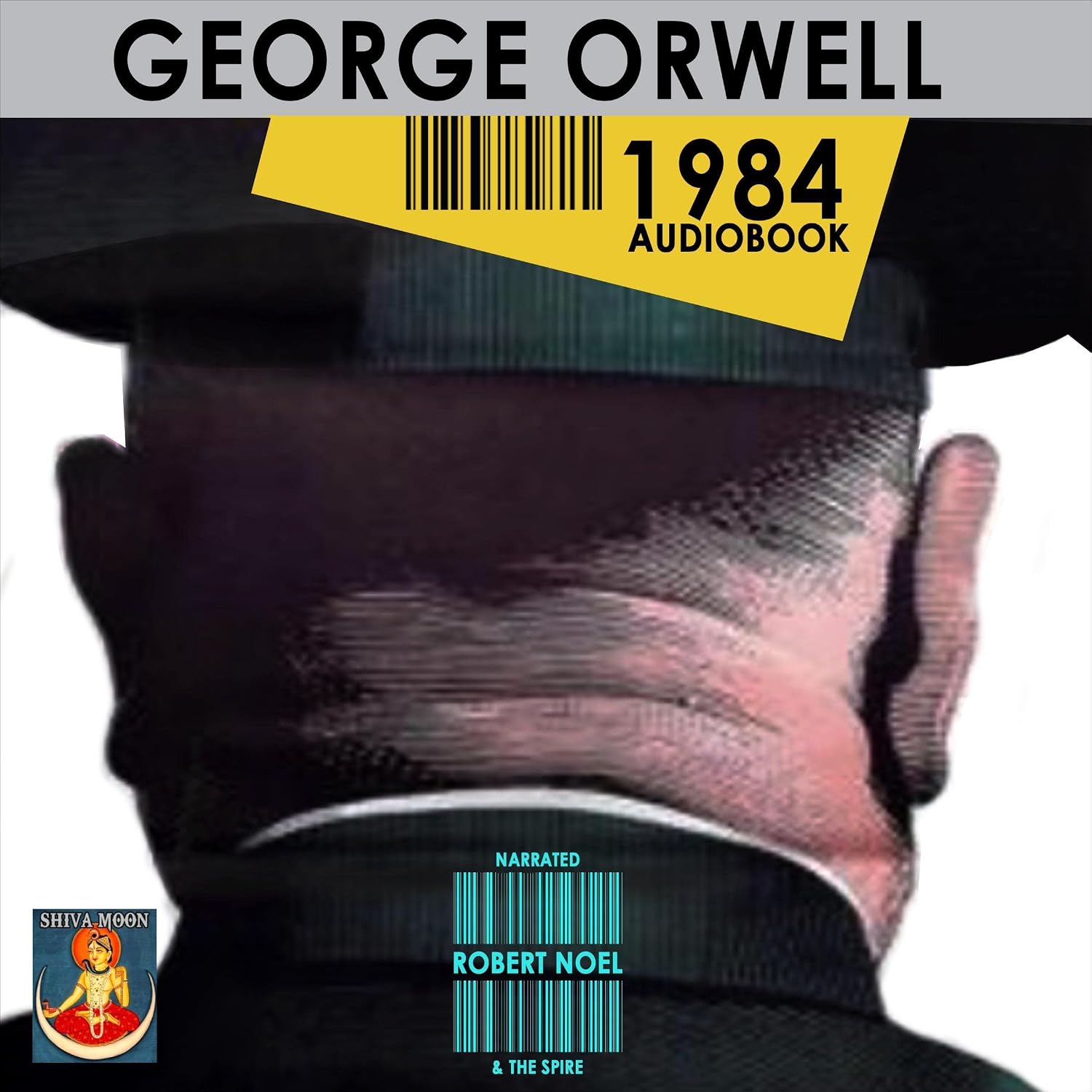
There are some books that become so embedded in popular culture that you can feel as though you already know them before you have actually read them. George Orwell’s 1984 is definitely one of those books. Like many people, I first read it as a school assignment, which probably isn’t the ideal way to discover one of the most influential novels of the twentieth century. At the time, I remember it primarily as a bleak story about a frightening future. Coming back to it now, I find myself much more interested in just how much Orwell managed to see coming.
Along with a handful of other novels, 1984 feels like one of the grandfathers of modern dystopian science fiction. So much of what we now recognise as dystopian fiction can be traced back to books like this. The totalitarian state, constant surveillance, propaganda, manipulated history, restricted language and the destruction of individuality have all become familiar elements of the genre, but Orwell’s treatment of them still has an extraordinary power.
What makes the book particularly fascinating from the perspective of 2026 is that Orwell’s ideas still feel uncomfortably familiar, even when his specific predictions obviously haven’t come to pass. We don’t live in Oceania, Big Brother isn’t sitting in a government office watching every one of us personally, and the world hasn’t divided itself into the exact political structures Orwell imagined.
But some of the underlying ideas have aged remarkably well.
Take surveillance. We carry devices around in our pockets that can track our location, record our activities, monitor our habits and build extraordinarily detailed pictures of what we like and dislike. Most of us willingly carry them around because they are useful. We have, in a rather strange way, volunteered to carry the telescreen.
Then there is the manipulation of information. Orwell’s Ministry of Truth is responsible for rewriting history so that the official version of events is always correct. Winston’s job is essentially to alter the past whenever the present requires it.
Orwell wasn’t predicting Twitter, TikTok or ChatGPT, but he understood something much more fundamental. Control information and you can influence people’s understanding of reality. In a world where misinformation, political spin and an overwhelming volume of competing claims can make it difficult to establish what is actually true, that idea has lost none of its bite.
And then there is Newspeak.
I have always thought this was one of the cleverest ideas in the book. If you can restrict the language available to people, you can potentially restrict the ideas they are capable of expressing. It sounds extreme, but Orwell understood that language isn’t simply a way of communicating thoughts. It also helps shape those thoughts.
The Party doesn’t merely want obedience. It wants control over reality itself. It wants people to accept contradictions because the Party says they are true. It wants loyalty that goes beyond behaviour and reaches into thought. That is where the novel becomes particularly bleak, because Orwell isn’t simply asking what happens when a government controls what you do. He is asking what happens when it attempts to control what you believe.
The story itself can be pretty grim going, and there are certainly moments where the relentless bleakness becomes a little much. Winston is not exactly the most cheerful companion, and the world Orwell creates offers precious few opportunities for optimism. Some of the characterisation can also feel rather functional, with characters sometimes serving the ideas more than existing as fully rounded people.
But I think those are relatively minor complaints.
The atmosphere is superb, the ideas remain powerful and the gradual sense of Winston’s world closing in around him is brilliantly handled. Orwell also has a knack for taking something that initially seems abstract and turning it into something deeply personal.
That is what makes the book work for me.
Reading 1984 as a school assignment, I was mainly interested in the story. Reading it now, I’m much more interested in the questions underneath it. How much privacy are we willing to surrender for convenience? How easily can information be manipulated? What happens when people stop agreeing about basic reality? How much control can a society tolerate before freedom becomes little more than a word?
Those questions have certainly gained an uncomfortable immediacy since I first encountered the book.
That is quite an achievement for a novel published in 1949.
1984 isn’t perfect, and some of its presentation inevitably feels tied to the political concerns of its time, but the central ideas remain remarkably sharp. It is one of those books where its reputation is completely justified, and revisiting it after all these years has reminded me why.
When I first read 1984 at school, I thought I was reading a warning about a possible future.
Coming back to it now, I think Orwell was doing something more useful. He was giving us a set of warning signs.
And they are still worth paying attention to.
Buy your copy here

Leave a Reply