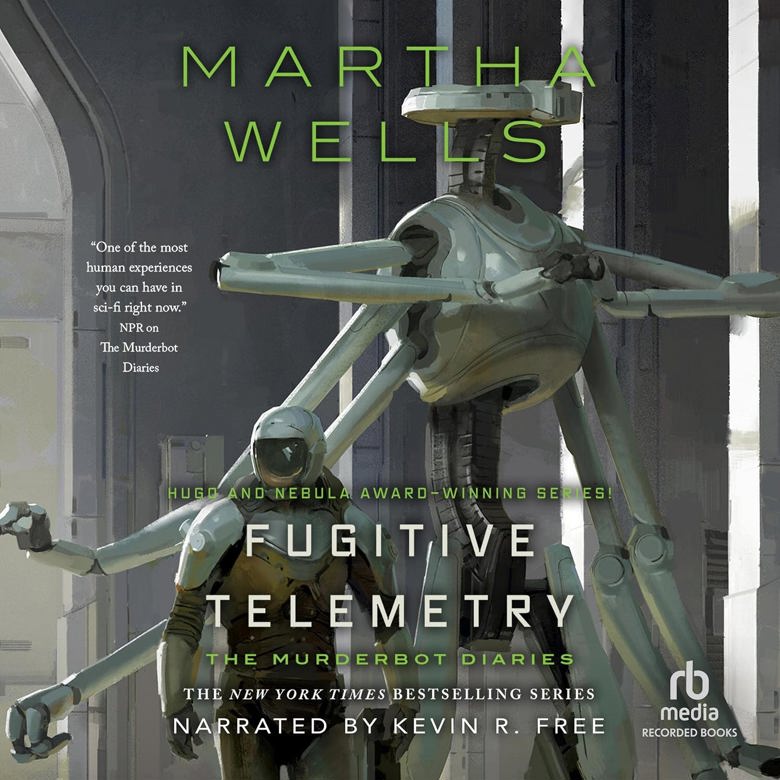
There is something wonderfully appropriate about Murderbot being dragged into a murder investigation. Give it a security assignment and it is perfectly capable of dealing with armed threats, corporate skulduggery and assorted technological nightmares. Ask it to investigate the suspicious death of a human on a space station, however, and suddenly things become considerably more complicated.
Not because Murderbot can’t solve the mystery. It absolutely can. The problem is that solving a murder involves talking to people, dealing with their emotions and generally becoming involved in other people’s business. All things that Murderbot would much rather avoid.
By this point in the Murderbot Diaries, I have become rather attached to our favourite antisocial SecUnit. What started out as me discovering the series through the excellent TV adaptation on Apple TV has turned into a slightly embarrassing level of investment in the adventures, anxieties and increasingly complicated relationships of a security unit that would really rather be left alone.
Sadly we’re back to the shorter stories. After Network Effect gave us a full-length novel and considerably more room to explore the characters and the wider universe, Fugitive Telemetry returns to the novella format, and there’s a little something sad about that. These shorter stories do, however, suit Murderbot particularly well because they allow Wells to throw it into a problem, let it complain about everything, and then watch it inevitably become far more involved than it intended.
What I particularly enjoyed about Fugitive Telemetry is that it feels like a proper murder mystery while still being unmistakably a Murderbot story. There is an investigation, there are suspects, there are clues to follow and there is a genuine question about what actually happened. The difference is that our detective is a heavily armed security unit with very little interest in conventional detective work and an even smaller interest in talking to people.
Watching Murderbot work its way through the investigation is great fun. It is incredibly competent, methodical and observant, but its internal commentary constantly undercuts the seriousness of what it is doing. Murderbot can analyse a situation involving multiple possible suspects and conflicting evidence with absolute precision, then immediately become irritated because somebody wants to have an actual conversation with it.
That contrast remains one of my favourite things about the series.
I also really enjoyed seeing Murderbot operating in a more contained environment. The previous books have steadily expanded the scope of the story, introducing bigger threats, more complicated relationships and increasingly significant questions about artificial intelligence and personhood. Fugitive Telemetry feels smaller by comparison, but that is not a criticism.
In fact, I found the change of pace rather refreshing.
There is more time here to simply enjoy Murderbot being Murderbot. Its relationship with humans remains complicated, and the story continues to play with the gap between what Murderbot says it wants and what it actually does. Its desire for independence is constantly running up against the practical reality that it has become very good at protecting people and making decisions of its own.
And yes, I am still amused by the fact that Murderbot would probably object quite strongly to being described as having friends.
One of the things I have particularly liked as the series has progressed is watching the distinction between Murderbot’s programmed responsibilities and its personal choices become increasingly blurred. It is supposed to provide security. It is not supposed to develop emotional attachments, form opinions about the people it protects or decide what it thinks is morally right.
That tension gives the series much of its emotional heart, and Fugitive Telemetry continues to develop it without ever becoming heavy-handed.
There is also some nice commentary here about corporate structures, ownership and the way supposedly autonomous systems are still treated as property. Wells has consistently used the Murderbot stories to explore questions of freedom and personhood without turning them into lectures, and I think that approach works particularly well.
The murder investigation also gives us another chance to see the difference between how humans perceive Murderbot and how Murderbot perceives itself. To everyone else, it is an unusual and potentially intimidating security unit. From inside its head, it is mostly trying to get through the day without having to deal with anyone’s feelings.
I can relate to the desire to avoid unnecessary conversations, if not quite to the heavily armed security unit part.
There is still plenty of humour, particularly in Murderbot’s observations about humans, corporate bureaucracy and social interaction. The sarcasm and dry delivery remain central to the appeal, but I think the humour works even better now because I have spent enough time with the character to recognise when the apparently detached commentary is hiding something more complicated.
The audiobook is once again wonderfully narrated by Kevin R Free. His performance has become such an important part of my experience of these books that I cannot really separate Murderbot from his voice anymore. The quality of expression and depth of character he brings to the narration are particularly impressive. He manages the deadpan humour beautifully, but also captures those little moments when Murderbot’s emotional defences slip.
After this many books, the character feels completely lived in.
My only real complaint is the familiar one. The book is short. I know that is rather the point of the novella format, and I have just spent several reviews complaining about how short these stories are, but I have become invested enough now that I always want more.
Fugitive Telemetry is another thoroughly enjoyable entry in the series. It gives us a murder mystery, plenty of Murderbot’s wonderfully sarcastic internal commentary, some interesting observations about autonomy and personhood, and another reminder of how much this supposedly antisocial SecUnit has developed.
I started the Murderbot Diaries looking for some entertaining science fiction.
Now I am reading a murder mystery featuring an emotionally repressed security unit and finding myself far more worried about its wellbeing than I probably should be.
At this point, I think I am officially part of the problem.
Buy your copy here

Leave a Reply