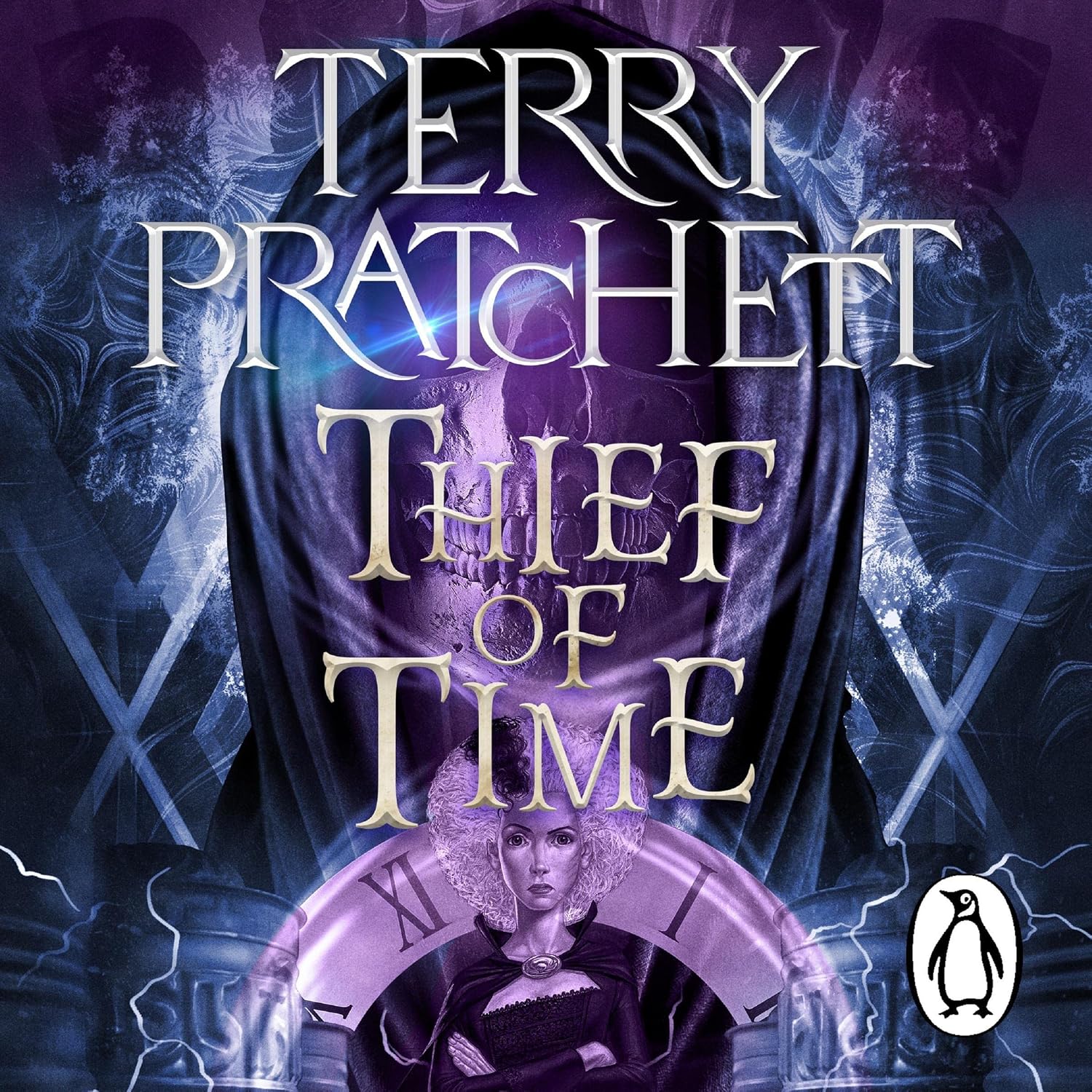
Time is a funny thing. We spend most of our lives complaining that we do not have enough of it, then spend enormous amounts of it waiting for kettles to boil, sitting in traffic and wondering why someone has decided that meetings need to be an hour long. We talk about saving time, wasting time, finding time and making time, despite the rather obvious problem that none of us actually knows where the spare time is kept.
In Thief of Time, Terry Pratchett takes this perfectly ordinary human obsession and asks what might happen if someone actually tried to manufacture more of it.
Naturally, things go wrong.
The story begins with the mysterious Jeremy Clockson, a young man who is extraordinarily good at making clocks. Not merely good, in fact. He is so good that he is recruited for a very unusual project involving the construction of a clock capable of doing something that clocks really ought not to do.
Meanwhile, the History Monks are becoming increasingly concerned about a threat to the very nature of time. Lu-Tze, one of my favourite characters in the book, finds himself at the centre of the action, armed with a broom, a remarkable amount of common sense and the sort of calm confidence that suggests he has seen this sort of thing before.
Probably several times.
One of the things I particularly enjoyed about Thief of Time is the way Pratchett uses time as a vehicle for talking about control. People are forever trying to organise their lives, predict what will happen and impose systems on the world around them. We create schedules, timetables, routines and rules because uncertainty is uncomfortable.
The problem is that life is not particularly interested in our filing systems.
The novel has plenty of fun with this contradiction. We want time to behave predictably, but we also complain when every day feels the same. We want routines because they make life manageable, but too much routine can leave us wondering where our lives actually went. We want to control the future, while simultaneously being incapable of remembering where we put our glasses five minutes ago.
There is some pointed social commentary here too. The book has an affectionately cynical view of bureaucracy and institutions, particularly the tendency to believe that complicated systems must be better than simple ones. There is an understandable human desire to impose order, but Pratchett repeatedly demonstrates how easily order can become an end in itself.
Sometimes the system is so busy protecting the system that nobody remembers what it was supposed to achieve.
That feels familiar.
The book also has plenty to say about individuality and free will. If time could be controlled perfectly, what would happen to spontaneity? If every event could be predicted, would choices still mean anything? There is an intriguing tension between the comfort of knowing what comes next and the value of being surprised by life.
And then there are the Auditors.
Their obsession with perfect order provides a particularly effective contrast to the messy, contradictory nature of humanity. They dislike individuality because individuality introduces variables, and variables are inconvenient. Unfortunately for them, people are rather fond of being people.
The result is a story that manages to discuss some surprisingly large philosophical ideas while also finding room for Yet Another Incident Involving Someone Falling Off Something.
That balance is one of the reasons the Discworld books work so well for me. The serious ideas are never allowed to become too self-important. You can be thinking about free will one moment and laughing at an absurd character the next. Then, before you have quite recovered, the story has slipped another observation about human behaviour into the conversation.
The audiobook is once again very well served by Sian Clifford. Her narration gives the story a briskness that suits its complicated plot, particularly as the various strands begin moving towards each other. She handles the character voices with enough variation to keep the large cast easy to follow, but without allowing the performance to overwhelm the storytelling.
There is also something particularly appropriate about her delivery in the quieter scenes. Thief of Time can become quite philosophical, and Clifford gives those moments enough space to land without turning them into lectures. The result feels lively but controlled, which is exactly what the story needs.
Peter Serafinowicz is once again excellent as Death. His performance has a wonderful sense of inevitability, which makes the moments where Death encounters the ordinary absurdities of life particularly entertaining. There is also a subtle warmth to the character that stops him becoming merely a comic device. He feels like a genuine presence within the story.
Bill Nighy’s contribution as the voice of the footnotes remains an absolute treat. His delivery has the wonderfully detached quality of someone making an entirely reasonable observation about a situation that is anything but reasonable. He never seems in any hurry to underline the joke, which is precisely why the jokes work so well.
What makes Thief of Time particularly satisfying is that it never settles for being simply a story about stopping the end of the world. It is interested in why we care so much about time in the first place.
We measure it obsessively. We organise our lives around it. We complain about losing it. We worry about getting older. We remember the past, anticipate the future and spend a remarkable amount of the present thinking about both.
Perhaps the real trick is learning to actually be where you are.
A surprisingly difficult task, as anyone who has ever opened their phone to check the time and then realised twenty minutes have disappeared will understand.
Thief of Time is clever, funny and wonderfully strange. It combines supernatural adventure with ideas about free will, routine, control and the value of uncertainty, without ever forgetting that the primary purpose of all this philosophical nonsense is to entertain.
And if Pratchett leaves you with a slightly different attitude towards time, that is probably no bad thing.
After all, you never know when you might need the spare twenty minutes.
Assuming you can find them.
Buy your copy here

Leave a Reply