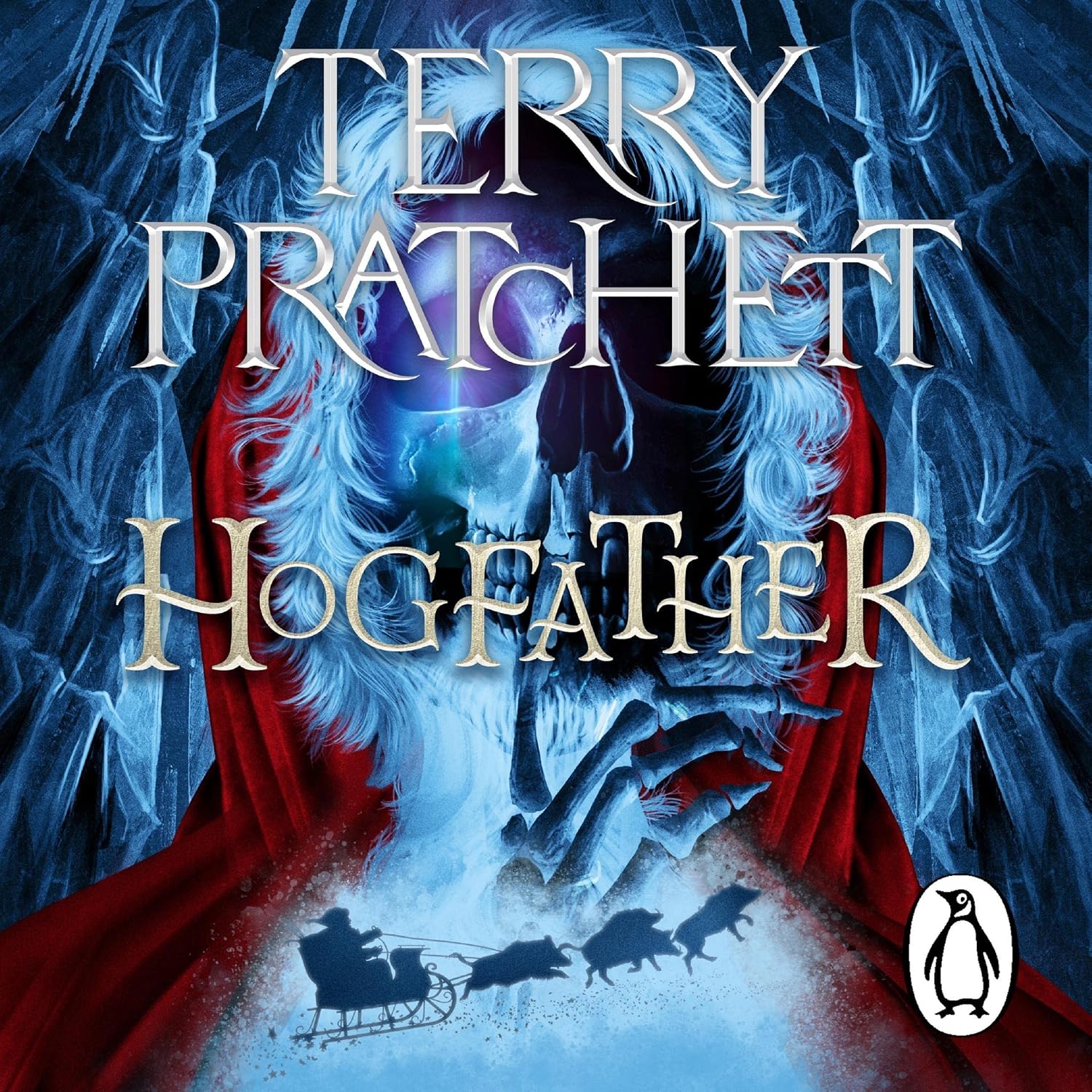
There is something slightly unsettling about discovering that Christmas is being held together by the collective belief of millions of people. It is the sort of information that makes you look at the festive decorations in your house and wonder whether they are actually doing enough work. Apparently, on Discworld, Christmas (or Hogswatch as it’s known there) is not simply a matter of presents, excessive food and arguing about who gets the television remote. It is a fundamental part of reality.
Which is why things become rather awkward when the Hogfather disappears.
Hogfather is one of those Discworld books that takes a familiar idea, shakes it vigorously and then examines what falls out. This time, it is Christmas. Or rather, the Discworld equivalent of Christmas, complete with a red-clad gift giver, flying pigs, festive traditions and an alarming number of people who have apparently never considered the practical implications of a large man entering their homes at night.
With the Hogfather missing, Death decides that somebody needs to keep the tradition going.
Death.
Naturally.
This means that children across the Discworld wake up to discover that their presents have been delivered by a very tall, skeletal figure who has rather different ideas about appropriate festive behaviour. Meanwhile, Susan Sto Helit finds herself attempting to work out what on earth is happening, while a collection of supernatural beings and rather questionable individuals pursue their own agendas.
It is gloriously strange.
What makes Hogfather particularly enjoyable, though, is that beneath all the comedy it is interested in why people believe in things. Not simply religious belief, but the everyday beliefs and stories that societies construct and pass down. Santa Claus, the Tooth Fairy, monsters under the bed and all the other ideas that children absorb before they are old enough to ask whether any of them make sense.
The book asks a surprisingly serious question: why do we need these stories?
Pratchett’s answer is not that they are simply childish nonsense. Instead, there is a recognition that imagination is part of how people understand the world. We create stories, symbols and traditions because they give shape to ideas that can otherwise be difficult to grasp.
Which is a rather grand philosophical concept to discover lurking underneath a story involving a murderous psychopath and a magical horse.
The social commentary is particularly good when it turns towards tradition. We tend to treat traditions as though they are permanent fixtures, when most of them were invented by somebody at some point. Then enough people repeat them for long enough and suddenly questioning them becomes almost impossible.
Hogfather has considerable fun with that idea.
It also explores the relationship between childhood and adulthood. Children are encouraged to believe in impossible things, while adults are expected to abandon that capacity for wonder as they grow older. Yet the novel suggests that completely losing our ability to believe in something beyond the immediately obvious might not actually be the great achievement we pretend it is.
Susan is an interesting vehicle for this idea because she is caught between worlds. She has inherited a supernatural responsibility she would rather not have, while simultaneously having to deal with the very human expectations surrounding her. She is practical, capable and increasingly exasperated, which makes her a particularly entertaining guide through the madness.
There is also a darker side to the story. The book recognises that belief can be frightening as well as comforting. Some of the things created by belief are not remotely friendly, and Pratchett has fun exploring what happens when the ideas hiding in children’s imaginations start wandering around outside their heads.
It gives the novel an appropriately creepy edge without ever losing its sense of fun.
Sian Clifford is once again superb as narrator. She gives the audiobook a lively pace that works especially well with the constant movement between comedy, supernatural weirdness and more thoughtful moments. Her character work is clear without becoming overblown, and she manages to keep the increasingly bizarre cast distinct while maintaining a consistent narrative voice.
Peter Serafinowicz brings an especially enjoyable quality to Death here. There is a solemnity to the performance, but also a wonderfully straight-faced acceptance of the absurdity surrounding him. Death treating Christmas traditions with complete seriousness while behaving in ways that are anything but conventional is a perfect fit for the story.
Bill Nighy’s footnotes are another highlight. His delivery has that wonderfully relaxed quality that makes the interruptions feel almost incidental. He sounds as though he is providing some mildly useful additional information while remaining entirely unconcerned that the information itself may be completely ridiculous. The contrast works beautifully.
What I really like about Hogfather is that it manages to be both a Christmas story and a story about Christmas. It can poke fun at presents, traditions, festive expectations and the commercial machinery surrounding the season, while still recognising why people enjoy these things in the first place.
It does not simply say that belief is foolish. It asks what happens when we stop believing in anything beyond what can be measured, categorised and explained.
And that gives the book considerably more substance than you might expect from a novel involving a skeletal Santa substitute.
Hogfather is funny, peculiar, occasionally dark and surprisingly warm. It has monsters, assassins, gods, children, Death and enough festive nonsense to keep even the most committed Christmas cynic entertained.
Most importantly, it understands that growing up does not necessarily mean abandoning imagination.
Sometimes it means learning what imagination is actually for.
Now, if you’ll excuse me, I have to check the chimney.
There may be a skeleton coming…
Buy your copy here

Leave a Reply