“There was a button,” Holden said. “I pushed it.”
“Jesus Christ. That really is how you go through life, isn’t it?”James SA Corey – Nemesis Games
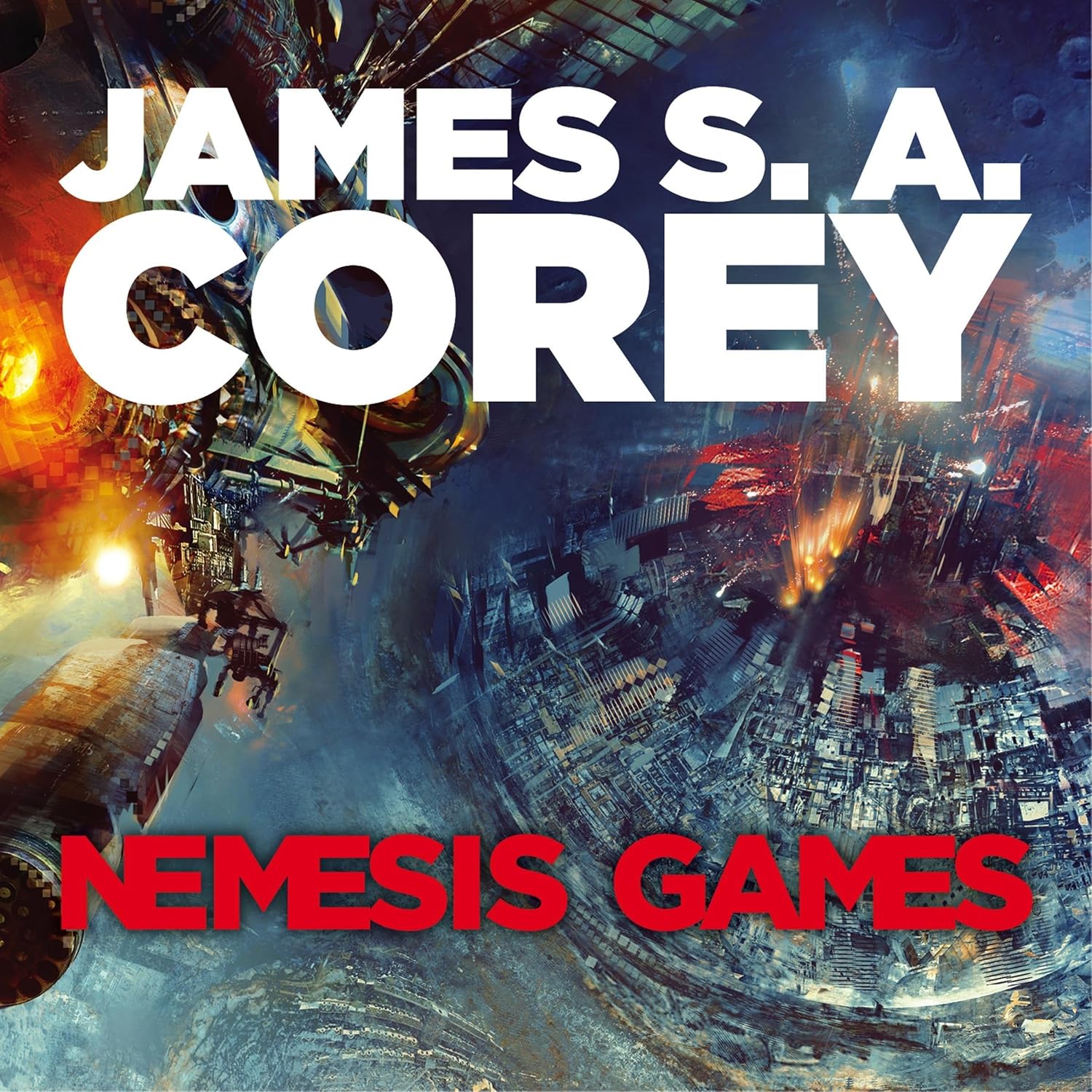
Nemesis Games caught me slightly off guard. After four books of watching the crew of the Rocinante face increasingly ridiculous levels of danger together, I had become rather comfortable with the idea that this was their story. Then James S. A. Corey goes and splits them up. Not only that, but instead of simply following Holden and letting everyone else orbit around him, the novel gives each member of the crew their own story and, in the process, shows me just how much I still had to learn about these characters.
And I absolutely loved it.
The decision to separate Holden, Naomi, Amos and Alex could easily have gone horribly wrong. After four books of seeing them function as a team, suddenly following them on four separate paths felt like a risky move. Instead, I found it one of the most interesting things Corey has done with the series so far. The official synopsis describes the novel as driving the Rocinante crew apart while the inner planets are subjected to a catastrophic attack, and that split becomes the perfect excuse to dig much deeper into each character.
For me, Naomi’s story was probably the biggest revelation.
We have known Naomi for several books, but Nemesis Games finally starts pulling back some of the curtain on who she was before the Rocinante became home. Her connection to the Belt, her history with Marco Inaros and her relationship with the politics of the OPA suddenly become much more important. What I particularly enjoyed was the way Corey refuses to make her past a simple case of youthful mistakes that she has conveniently left behind. The consequences are still there, and they come crashing back into her present.
That fits beautifully with one of the novel’s major themes: the past never really goes away.
The title is particularly appropriate because Nemesis Games is full of old grievances coming home to roost. The political tensions between Earth, Mars and the Belt have been building since the beginning of the series, and now someone has decided to weaponise all that resentment on an absolutely enormous scale. Terror attacks devastate Earth, political structures begin to collapse and the old balance of power suddenly looks remarkably fragile.
Corey has always been interested in the consequences of inequality, but this book takes that idea somewhere darker. The Belt has spent generations being exploited by the inner planets, and there is a genuine history of injustice behind the anger. Nemesis Games asks what happens when that anger is turned into a political weapon.
And, importantly, it does not suggest that understandable grievances automatically make every response justified.
That distinction matters. There is a fascinating tension between legitimate political dissatisfaction and extremism, between wanting justice and wanting revenge. The novel shows how easily people can be persuaded that violence is necessary when they believe they have been ignored for too long.
There is also some wonderfully pointed commentary about nationalism and identity. Earth, Mars and the Belt have become more than political entities. They represent different ways of understanding what humanity is and where people belong. The problem is that once identity becomes the basis for political mobilisation, it becomes remarkably easy to divide people into “us” and “them”.
And then Corey brings the whole thing back down to the individual.
Amos on Earth is a brilliant example. His story takes him into his own past and into a version of Baltimore that feels worlds away from the grand political events unfolding elsewhere. I found his sections fascinating because they force me to reconsider a character I thought I understood. Amos has always been one of the more mysterious members of the crew, and Nemesis Games gives us considerably more insight into why he is the way he is.
Alex gets similar treatment, although in a different way. His relationship with Mars and the military culture that shaped him suddenly feels much more significant. I particularly enjoyed seeing him alongside Bobbie, because their shared Martian background gives them a connection that feels very different from the relationships aboard the Rocinante.
Even Holden, who for once is not the centre of everything, benefits from the change. I actually enjoyed having him take a slightly less dominant role. He remains Holden, of course, so the instinct to charge towards the problem and attempt to fix everything has not disappeared, but allowing the other characters more room makes the entire series feel richer.
There is also a fascinating examination of family throughout the book. Not just biological family, but the families we choose. The Rocinante crew has gradually become a family, and separating them demonstrates just how much that bond matters. They are not simply colleagues who happen to share a spaceship. They have become each other’s home.
That idea hit me harder than I expected.
For all the enormous political events, alien technology and interplanetary warfare, Nemesis Games is ultimately about people trying to find somewhere they belong.
Jefferson Mays is superb throughout the audiobook, and this time his performance benefits enormously from the character-focused structure. He gives each perspective its own emotional flavour without making the narration feel overworked. The differences between characters are subtle but consistently clear, and his handling of the quieter, more introspective passages is particularly effective. He has become so comfortable with this cast that the narration feels less like someone reading me a novel and more like someone opening the door and letting me spend time with people I already know.
My only real criticism is that I occasionally missed having the whole Rocinante crew together. Some sections naturally grabbed me more than others, and the constant movement between separate storylines can make the narrative feel fragmented at times. But that is also the point, and once the individual threads begin coming back together, the structure pays off beautifully.
What I came away with most strongly is that Nemesis Games makes The Expanse feel much more personal.
The previous books have been about planets, factions, alien technology and the future of humanity. This one is about the people caught underneath all of that.
And somehow, by tearing the crew apart, Corey has made me care about them even more.
Five books in, I am now considerably more worried about what happens to these people than I am about the fate of the bloody galaxy.
Which probably means James S. A. Corey has done something right.
Buy your copy here

Leave a Reply