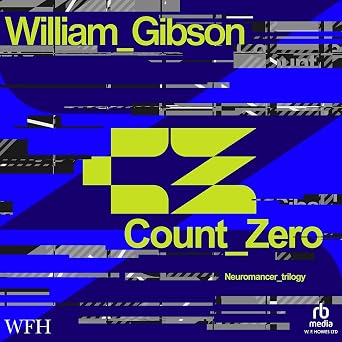
There is something slightly strange about reading Count Zero in 2026. William Gibson’s second novel in the Sprawl trilogy is now more than forty years old, yet so much of what it contains has become part of the standard vocabulary of science fiction that it can be easy to forget just how influential it was. The hackers, cyberspace, corporate power, artificial intelligence, mercenaries, bioengineering, augmented humans and sprawling urban landscapes all feel familiar now, but that is largely because Gibson was one of the writers who helped establish them in the first place.
That is the peculiar burden carried by books such as Count Zero. It is one of the primary roots of many of the sci-fi tropes we’ve become accustomed to over the last four decades. Reading it today means encountering ideas that no longer seem particularly revolutionary because so many subsequent writers, filmmakers and game designers have built upon them. The trick is to put that familiarity aside and appreciate what Gibson is actually doing with them.
Following Neuromancer was never going to be an easy job, particularly when the first book helped establish so much of the genre in the first place. Fortunately, Count Zero wisely chooses not to simply repeat its predecessor. Instead, Gibson takes the world of the Sprawl and expands it, showing us different corners of a future where technology has developed into something increasingly difficult for ordinary humans to understand.
The story is split between several characters whose apparently separate lives gradually begin to intersect. Bobby Newmark, the Count Zero of the title, is a young man who wants to make a name for himself as a hacker and finds himself very quickly in considerably more danger than he expected. Turner is a corporate mercenary whose latest assignment involves extracting an important scientist from a multinational corporation. Then there is Marly Krushkova, an art dealer who becomes involved in the search for mysterious and apparently impossible works of art.
As the three strands develop, Gibson slowly reveals that there is considerably more going on than any of the characters initially realise. Corporate interests, technological evolution and strange new forms of intelligence begin to overlap, creating a story that is part thriller, part mystery and part philosophical exploration of what artificial intelligence might become.
One of the things I particularly enjoyed about Count Zero is the way Gibson handles its multiple viewpoints. Rather than immediately explaining how everything connects, he allows the reader to spend time with each character and understand their particular corner of this world. Bobby’s youthful enthusiasm, Turner’s professional detachment and Marly’s more contemplative perspective provide very different ways of looking at the same increasingly strange reality.
It also gives Gibson the opportunity to explore different aspects of the Sprawl. Neuromancer was heavily concerned with cyberspace and the hacker experience, whereas Count Zero feels more interested in the consequences of what happens when technology begins to evolve beyond the intentions of its creators. The result is a story that feels broader and, in some respects, stranger than its predecessor.
The corporate world remains particularly effective. Gibson’s future is one where multinational companies possess enormous resources and influence, while individuals are generally expected to find ways of surviving within systems they have little control over. The technology is impressive, but it is the social consequences that often make the setting feel convincing.
And then there are the mysterious entities emerging from cyberspace.
Without getting into spoiler territory, this is where Count Zero becomes particularly interesting. Gibson takes the concept of artificial intelligence and pushes it into territory that feels almost mythological. What begins as a technological question gradually becomes something much stranger, raising questions about identity, belief, consciousness and whether humanity is actually capable of understanding what it has created.
That combination of hard-edged technology and almost supernatural imagery is one of the novel’s great strengths. Gibson manages to make cyberspace feel both technological and mysterious, which is quite an achievement considering how much of his imagined future has since become familiar to us.
The book is not perfect. As with Neuromancer, Gibson is not particularly interested in holding the reader’s hand. There are plenty of unfamiliar terms, concepts and pieces of technology that are simply thrown into the story and left for us to work out. Some of the plotting can also feel deliberately opaque, particularly while the three narratives are still operating independently.
However, I think that is part of the appeal. Count Zero rewards paying attention, and there is something satisfying about watching apparently unrelated details gradually acquire significance. Gibson trusts the reader to keep up, even when the ground beneath the story is shifting.
The audiobook benefits enormously from its cast. Kyle Soller, Alix Wilton Regan and Sebastián Capitán Viveros all bring something distinctive to the narration, helping to separate the different perspectives and personalities. Their performances bring the characters to life and make the whole thing feel real, which is particularly important when the story is dealing with concepts that can otherwise become rather abstract.
There is also a pleasing sense of scale to the production. The Sprawl feels like a place populated by people rather than simply a backdrop for Gibson’s ideas, and the narration helps maintain that impression. Characters who could easily have remained little more than descriptions on the page become much more immediate.
Ultimately, Count Zero is another fascinating piece of science fiction from William Gibson. It does not have quite the same historical shock value as Neuromancer, but then very few books do. Instead, it demonstrates what Gibson could do once he had established the foundations of his cyberpunk world and was free to start exploring its consequences.
The great pleasure of returning to these books is seeing how much modern science fiction has grown from their foundations. Count Zero takes the world Gibson created and pushes it somewhere stranger, more expansive and considerably more mysterious. Some of its technology has inevitably aged, and the deliberately opaque prose will occasionally make you work for your understanding, but beneath it all is a genuinely imaginative story that remains compelling.
Count Zero is not simply living in the shadow of Neuromancer. It is Gibson taking the world he created and asking what happens next. Forty years later, that remains a pretty good question.
Buy your copy here

Leave a Reply